

%20{%20.f%20{%20fill:%20%23EE7466%20}%20.s%20{%20stroke:%20%23EE7466%20}%20}%3c/style%3e%3cdefs%3e%3cfilter%20id='ink-fav'%20x='-5%25'%20y='-5%25'%20width='110%25'%20height='110%25'%3e%3cfeTurbulence%20type='fractalNoise'%20baseFrequency='0.9'%20numOctaves='2'%20seed='7'%20result='n'/%3e%3cfeDisplacementMap%20in='SourceGraphic'%20in2='n'%20scale='2.2'%20result='d'/%3e%3cfeTurbulence%20type='fractalNoise'%20baseFrequency='0.05'%20numOctaves='3'%20seed='18'%20result='blot'/%3e%3cfeColorMatrix%20in='blot'%20type='matrix'%20values='0%200%200%200%200%200%200%200%200%200%200%200%200%200%200%200%200%200%20-1.5%201.62'%20result='m1'/%3e%3cfeTurbulence%20type='fractalNoise'%20baseFrequency='1.6'%20numOctaves='1'%20seed='12'%20result='grain'/%3e%3cfeColorMatrix%20in='grain'%20type='matrix'%20values='0%200%200%200%200%200%200%200%200%200%200%200%200%200%200%200%200%200%20-2.4%202.25'%20result='m2'/%3e%3cfeComposite%20in='m1'%20in2='m2'%20operator='arithmetic'%20k1='1'/%3e%3cfeComposite%20in='d'%20operator='in'/%3e%3c/filter%3e%3c/defs%3e%3cg%20filter='url(%23ink-fav)'%20transform='rotate(-6%2080%2080)'%3e%3ccircle%20class='s'%20cx='80'%20cy='80'%20r='69'%20fill='none'%20stroke-width='16'/%3e%3cpath%20class='f'%20d='M47.33%2044.42Q46.25%2041.94%2045.01%2040.64Q43.77%2039.35%2041.71%2038.75Q39.66%2038.16%2035.67%2037.84L35.67%2033.84L80.16%2033.84L80.16%2037.84Q74.11%2038.27%2071.85%2039.13Q69.58%2040%2069.58%2042.05Q69.58%2043.24%2070.23%2045.07L86.32%2089.57L86.97%2089.57L102.3%2049.61Q103.38%2046.8%20103.38%2044.75Q103.38%2041.83%20100.68%2040.27Q97.98%2038.7%2091.39%2037.84L91.39%2033.84L124.77%2033.84L124.77%2037.84Q119.69%2038.59%20117.15%2039.67Q114.61%2040.75%20113.05%2042.97Q111.48%2045.18%20109.65%2049.82L82.97%20118.08L77.79%20118.08L47.33%2044.42Z'/%3e%3c/g%3e%3c/svg%3e)
In the news1739
The Hard Winter 1739
The hard winter of 1739 brought extreme weather that caused rising poor rates, widespread destitution, and higher mortality rates.
Norfolk House, 4 Jun 1738 – Windsor Castle, 29 Jan 1820
18 facts3 sources
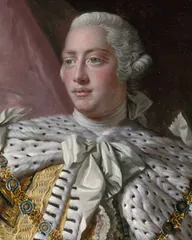
The collection records George III’s birth in 1738 at Norfolk House and his death in 1820 at Windsor Castle. His parents were Frederick, Prince of Wales, and Princess Augusta of Saxe-Gotha. 1Birth · 4 Jun 1738, Norfolk House · Probable2Death · 29 Jan 1820, Windsor Castle · Probable3Parent · Frederick, Prince of Wales · Confirmed4Parent · Princess Augusta of Saxe-Gotha · Confirmed
George III ruled as monarch of Great Britain and, following the political union, as monarch of the United Kingdom of Great Britain and Ireland. These two titles trace the transformation of the monarchy during his reign. 5Title · Monarch of Great Britain, 1760–1801 · Confirmed6Title · monarch of the United Kingdom of Great Britain and Ireland, 1801–1820 · Confirmed7Known for · George III was King of Great Britain and Ireland from 25 October 1760 until his death in 1820. He was concurrently duke and prince-elector of Hanover in the Holy Roman Empire before becoming King of Hanover on 12 October 1814. He was the first monarch of the House of Hanover who was born in Great Britain, spoke English as his first language, and never visited Hanover. · Probable
The family record links George III to Charlotte of Mecklenburg-Strelitz. A summary in the collection describes him as the first Hanoverian monarch born in Great Britain, speaking English as his first language and never visiting Hanover. 7Known for · George III was King of Great Britain and Ireland from 25 October 1760 until his death in 1820. He was concurrently duke and prince-elector of Hanover in the Holy Roman Empire before becoming King of Hanover on 12 October 1814. He was the first monarch of the House of Hanover who was born in Great Britain, spoke English as his first language, and never visited Hanover. · Probable8Union · Charlotte of Mecklenburg-Strelitz · Confirmed
Drafted with AI and edited against the archive. Open a citation to see the record, its sources and how certain it is.
4 Jun 1738
Born in Norfolk House
1751–1760
Heir apparent
1751–1760
Duke of Edinburgh
1760–1801
King of Ireland
1760–1806
Prince-Elector
1760–1801
Monarch of Great Britain
1760–1814
Duke of Brunswick-Lüneburg
1762–1783
15 children are born
1801–1820
Monarch of the United Kingdom of Great Britain and Ireland
1814–1820
King of Hanover
29 Jan 1820
Dies in Windsor Castle, aged 81
He lived through 10 decades. Pick one to hear and see what it was like around Norfolk House.
General history, not a record about the family: each item says where it comes from.
In the news1739
The hard winter of 1739 brought extreme weather that caused rising poor rates, widespread destitution, and higher mortality rates.
At the table
Gin and beer replaced unsafe water
The London poor consumed over six million gallons of gin annually by 1730, as it was often cheaper and safer than water. Alcohol, including small beer, was a staple because brewing removed contaminants that made water unsafe to drink.
What people wore
Typical working-class female attire
Working-class women typically wore a shift, petticoat, and gown, often accessorized with an apron to protect their clothes during daily labor.
Getting around
Costs of pack horse transport
Transporting goods by pack horse cost about 5 shillings for 112 pounds of weight carried over 100 miles. Summer travel was generally cheaper and faster than in the winter months.
What it cost
Costs of meat and bread provisions
Butcher's meat cost 1s. 10d. per stone in 1729. Bread prices fluctuated, but in 1745, one penny could purchase 15 ounces and 9/16 of bread.
Music
Masked performers singing for eggs and beer
Groups known as pace-eggers would travel from house to house wearing masks and fantastic costumes, singing and dancing in exchange for rewards like eggs and strong beer.
Daily life
Lighting homes without modern matches
Candles were essential for light as there were no matches; people used flint and steel to strike a light, and brass candlesticks with snuffers were common household items.