

%20{%20.f%20{%20fill:%20%23EE7466%20}%20.s%20{%20stroke:%20%23EE7466%20}%20}%3c/style%3e%3cdefs%3e%3cfilter%20id='ink-fav'%20x='-5%25'%20y='-5%25'%20width='110%25'%20height='110%25'%3e%3cfeTurbulence%20type='fractalNoise'%20baseFrequency='0.9'%20numOctaves='2'%20seed='7'%20result='n'/%3e%3cfeDisplacementMap%20in='SourceGraphic'%20in2='n'%20scale='2.2'%20result='d'/%3e%3cfeTurbulence%20type='fractalNoise'%20baseFrequency='0.05'%20numOctaves='3'%20seed='18'%20result='blot'/%3e%3cfeColorMatrix%20in='blot'%20type='matrix'%20values='0%200%200%200%200%200%200%200%200%200%200%200%200%200%200%200%200%200%20-1.5%201.62'%20result='m1'/%3e%3cfeTurbulence%20type='fractalNoise'%20baseFrequency='1.6'%20numOctaves='1'%20seed='12'%20result='grain'/%3e%3cfeColorMatrix%20in='grain'%20type='matrix'%20values='0%200%200%200%200%200%200%200%200%200%200%200%200%200%200%200%200%200%20-2.4%202.25'%20result='m2'/%3e%3cfeComposite%20in='m1'%20in2='m2'%20operator='arithmetic'%20k1='1'/%3e%3cfeComposite%20in='d'%20operator='in'/%3e%3c/filter%3e%3c/defs%3e%3cg%20filter='url(%23ink-fav)'%20transform='rotate(-6%2080%2080)'%3e%3ccircle%20class='s'%20cx='80'%20cy='80'%20r='69'%20fill='none'%20stroke-width='16'/%3e%3cpath%20class='f'%20d='M47.33%2044.42Q46.25%2041.94%2045.01%2040.64Q43.77%2039.35%2041.71%2038.75Q39.66%2038.16%2035.67%2037.84L35.67%2033.84L80.16%2033.84L80.16%2037.84Q74.11%2038.27%2071.85%2039.13Q69.58%2040%2069.58%2042.05Q69.58%2043.24%2070.23%2045.07L86.32%2089.57L86.97%2089.57L102.3%2049.61Q103.38%2046.8%20103.38%2044.75Q103.38%2041.83%20100.68%2040.27Q97.98%2038.7%2091.39%2037.84L91.39%2033.84L124.77%2033.84L124.77%2037.84Q119.69%2038.59%20117.15%2039.67Q114.61%2040.75%20113.05%2042.97Q111.48%2045.18%20109.65%2049.82L82.97%20118.08L77.79%20118.08L47.33%2044.42Z'/%3e%3c/g%3e%3c/svg%3e)
In the news1832
Cholera epidemic hits Brussels
A cholera epidemic struck Brussels in 1832, resulting in the deaths of over 3,000 people.
Brussels, 9 Apr 1835 – Laeken, 17 Dec 1909
13 facts3 sources
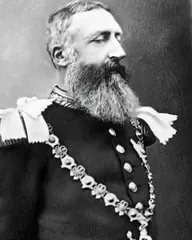
The collection records Leopold II’s birth in Brussels in 1835 and his death at Laeken in 1909. It also describes him as the second king of the Belgians. 1Birth · 9 Apr 1835, Brussels · Probable2Death · 17 Dec 1909, Laeken · Probable3Known for · Leopold II was the second king of the Belgians from 1865 to 1909, and the founder and sole owner of the Congo Free State from 1885 to 1908. · Probable
Leopold II held the title of King of the Belgians and was also Sovereign of the Congo Free State. The collection identifies him as the founder and sole owner of that colonial possession. 4Title · King of the Belgians, 1865–1909 · Confirmed5Title · Sovereign of the Congo Free State, 1885–1908 · Confirmed3Known for · Leopold II was the second king of the Belgians from 1865 to 1909, and the founder and sole owner of the Congo Free State from 1885 to 1908. · Probable
His confirmed family connections included Leopold I of Belgium as his father and Louise of Orléans as his mother. His recorded unions were with Marie Henriette of Austria and Caroline Lacroix. 6Parent · Leopold I of Belgium · Confirmed7Parent · Louise of Orléans · Confirmed8Union · Marie Henriette of Austria · Confirmed9Union · Caroline Lacroix · Confirmed
Drafted with AI and edited against the archive. Open a citation to see the record, its sources and how certain it is.
9 Apr 1835
Born in Brussels
1853–1865
Senator by Right
1858–1907
6 children are born
1865–1909
King of the Belgians
1885–1908
Sovereign of the Congo Free State
17 Dec 1909
Dies in Laeken, aged 74
He lived through 8 decades. Pick one to hear and see what it was like around Brussels.
General history, not a record about the family: each item says where it comes from.
In the news1832
A cholera epidemic struck Brussels in 1832, resulting in the deaths of over 3,000 people.
What people wore
Women's festive and daily dress
Women typically wore a solid-colored bodice, a long skirt made of thick cotton, and a white cotton petticoat with lace. For feast days and Sundays, they enhanced this ensemble with a black silk apron and black or brown buttoned boots.
Daily life
Lighting homes with oil and water carafes
Homes were often illuminated by oil lamps (lamponnette) or candles placed in glass lanterns, while on dark days, workers used a spherical water carafe to concentrate candlelight.
In the news1830
On August 25, 1830, riots broke out in Brussels after an opera performance, triggering a revolution that led to Belgium's independence from the Netherlands.
Music
Festivities rewarded with small coins
Lacemakers celebrated Saint Anne’s Day with singing, dancing, and picnics, often earning a small reward of five centimes from their teachers for the occasion.
Around the world1825–1830
In England a steam locomotive pulled the first public train in 1825; within decades railways crossed every continent.
Getting around
Tow barges for reliable canal travel
Before the railway, tow barges drawn by horses were a primary, reliable, and punctual way to travel between towns along waterways. They moved at a slow speed of 3 to 4 km per hour, but maintained a strict schedule that did not wait for latecomers.