

%20{%20.f%20{%20fill:%20%23EE7466%20}%20.s%20{%20stroke:%20%23EE7466%20}%20}%3c/style%3e%3cdefs%3e%3cfilter%20id='ink-fav'%20x='-5%25'%20y='-5%25'%20width='110%25'%20height='110%25'%3e%3cfeTurbulence%20type='fractalNoise'%20baseFrequency='0.9'%20numOctaves='2'%20seed='7'%20result='n'/%3e%3cfeDisplacementMap%20in='SourceGraphic'%20in2='n'%20scale='2.2'%20result='d'/%3e%3cfeTurbulence%20type='fractalNoise'%20baseFrequency='0.05'%20numOctaves='3'%20seed='18'%20result='blot'/%3e%3cfeColorMatrix%20in='blot'%20type='matrix'%20values='0%200%200%200%200%200%200%200%200%200%200%200%200%200%200%200%200%200%20-1.5%201.62'%20result='m1'/%3e%3cfeTurbulence%20type='fractalNoise'%20baseFrequency='1.6'%20numOctaves='1'%20seed='12'%20result='grain'/%3e%3cfeColorMatrix%20in='grain'%20type='matrix'%20values='0%200%200%200%200%200%200%200%200%200%200%200%200%200%200%200%200%200%20-2.4%202.25'%20result='m2'/%3e%3cfeComposite%20in='m1'%20in2='m2'%20operator='arithmetic'%20k1='1'/%3e%3cfeComposite%20in='d'%20operator='in'/%3e%3c/filter%3e%3c/defs%3e%3cg%20filter='url(%23ink-fav)'%20transform='rotate(-6%2080%2080)'%3e%3ccircle%20class='s'%20cx='80'%20cy='80'%20r='69'%20fill='none'%20stroke-width='16'/%3e%3cpath%20class='f'%20d='M47.33%2044.42Q46.25%2041.94%2045.01%2040.64Q43.77%2039.35%2041.71%2038.75Q39.66%2038.16%2035.67%2037.84L35.67%2033.84L80.16%2033.84L80.16%2037.84Q74.11%2038.27%2071.85%2039.13Q69.58%2040%2069.58%2042.05Q69.58%2043.24%2070.23%2045.07L86.32%2089.57L86.97%2089.57L102.3%2049.61Q103.38%2046.8%20103.38%2044.75Q103.38%2041.83%20100.68%2040.27Q97.98%2038.7%2091.39%2037.84L91.39%2033.84L124.77%2033.84L124.77%2037.84Q119.69%2038.59%20117.15%2039.67Q114.61%2040.75%20113.05%2042.97Q111.48%2045.18%20109.65%2049.82L82.97%20118.08L77.79%20118.08L47.33%2044.42Z'/%3e%3c/g%3e%3c/svg%3e)
Francis I of France
Castle of Cognac, 21 Sep 1494 – Château de Rambouillet, 10 Apr 1547
17 facts3 sources
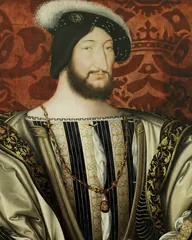
About Francis I
Francis I of France: Renaissance and Franco-Ottoman Alliance
AI-assisted · editedThe collection records Francis I’s probable birth in 1494 at the Castle of Cognac. He held the title King of France from 1515 to 1547. He was the son of Charles, Count of Angoulême, and Louise of Savoy, and he succeeded his first cousin once removed and father-in-law, Louis XII, who died without a legitimate son. 1Birth · 21 Sep 1494, Castle of Cognac · Probable2Title · King of France, 1515–1547 · Confirmed3Known for · Francis I was King of France from 1515 until his death in 1547. He was the son of Charles, Count of Angoulême, and Louise of Savoy. He succeeded his first cousin once removed and father-in-law Louis XII, who died without a legitimate son. · Probable
The preferred death record places Francis at the Château de Rambouillet in 1547, while another disputed record also dates his death to 1547. His recorded unions included Eleanor of Austria and Claude of France. 4Death · 10 Apr 1547, Château de Rambouillet · Probable5Death · 31 Jul 1547 · Probable6Union · Eleanor of Austria · Confirmed7Union · Claude of France · Confirmed
The collection places the French Renaissance and the Franco-Ottoman alliance among the events associated with Francis I. His record is also connected to the Italian Wars, situating the king within the cultural, diplomatic, and military history represented in the collection. 8Event · French Renaissance · Confirmed9Event · Franco-Ottoman alliance · Confirmed10Event · Italian Wars · Confirmed
Drafted with AI and edited against the archive. Open a citation to see the record, its sources and how certain it is.
Facts and their sources
- Born21 Sep 1494, Castle of CognacVerified · Vitrine1 source
- TitleKing of France, 1515–1547Verified · Vitrine1 source
- EventField of the Cloth of Goldor French Renaissance · Franco-Ottoman alliance · Massacre of Mérindol · Italian Wars · Edict of FontainebleauVerified · Vitrine1 source
- EventEdict of Fontainebleauor French Renaissance · Franco-Ottoman alliance · Massacre of Mérindol · Italian Wars · Field of the Cloth of GoldVerified · Vitrine1 source
- EventFrench Renaissanceor Franco-Ottoman alliance · Massacre of Mérindol · Italian Wars · Edict of Fontainebleau · Field of the Cloth of GoldVerified · Vitrine1 source
- EventFranco-Ottoman allianceor French Renaissance · Massacre of Mérindol · Italian Wars · Edict of Fontainebleau · Field of the Cloth of GoldVerified · Vitrine1 source
- EventMassacre of Mérindolor French Renaissance · Franco-Ottoman alliance · Italian Wars · Edict of Fontainebleau · Field of the Cloth of GoldVerified · Vitrine1 source
- EventItalian Warsor French Renaissance · Franco-Ottoman alliance · Massacre of Mérindol · Edict of Fontainebleau · Field of the Cloth of GoldVerified · Vitrine1 source
- Died10 Apr 1547, Château de Rambouilletor 31 Jul 1547Records disagree1 source
A life in time
21 Sep 1494
Born in Castle of Cognac
1513–1545
9 children are born
1515–1547
King of France
10 Apr 1547
Dies in Château de Rambouillet, aged 52
Family
See the treePartners
Children · 9
During his lifetime
He lived through 6 decades. Pick one to hear and see what it was like around Castle of Cognac.
General history, not a record about the family: each item says where it comes from.
The 1490s · Francis I is born in Castle of Cognac
What people wore
Around 1500–1524Safe storage for peasant coins
For security, men often wrapped their coins in the long, split tails of their linen chemises.
Daily life
Around 1500–1524The rise of village schools
In the early 16th century, public authorities began to prioritize primary instruction, such as when the municipality of Morhange established a school in 1517. Households sometimes provided initial learning, and a home for teaching children was donated in Dieulouard in 1504.
Work
Around 1500–1524Female roles at the Nancy Mint
At the Nancy Mint, female workers known as tailleresses were specifically employed to trim excess metal from coin blanks to ensure they reached the correct weight. This task was frequently performed by the wives or daughters of the male minters.
Music
Around 1500–1524Popular carnival dance at court
The Morisca was the most popular dance at the court of Lorraine, frequently performed by both men and women during the carnival season in costume.
At the table
Around 1500–1524Drinks and Fasting Days
Common people often drank water or a low-quality fermented drink called picotte, while taverns were important social spaces. During the frequent religious fast days, which numbered up to 150 per year, they relied on river fish or dried sea fish instead of meat.
Getting around
Around 1500–1524Daily travel distance for pack animals
In level country, merchant trains using pack animals could cover fifteen to twenty-five miles per day.
What it cost
Around 1500–1599Cost of shoes
The cost of shoemaking, specifically a pair of shoes, ranged from 0.6 to 1.34 sols tournois during the 16th century.