

%20{%20.f%20{%20fill:%20%23EE7466%20}%20.s%20{%20stroke:%20%23EE7466%20}%20}%3c/style%3e%3cdefs%3e%3cfilter%20id='ink-fav'%20x='-5%25'%20y='-5%25'%20width='110%25'%20height='110%25'%3e%3cfeTurbulence%20type='fractalNoise'%20baseFrequency='0.9'%20numOctaves='2'%20seed='7'%20result='n'/%3e%3cfeDisplacementMap%20in='SourceGraphic'%20in2='n'%20scale='2.2'%20result='d'/%3e%3cfeTurbulence%20type='fractalNoise'%20baseFrequency='0.05'%20numOctaves='3'%20seed='18'%20result='blot'/%3e%3cfeColorMatrix%20in='blot'%20type='matrix'%20values='0%200%200%200%200%200%200%200%200%200%200%200%200%200%200%200%200%200%20-1.5%201.62'%20result='m1'/%3e%3cfeTurbulence%20type='fractalNoise'%20baseFrequency='1.6'%20numOctaves='1'%20seed='12'%20result='grain'/%3e%3cfeColorMatrix%20in='grain'%20type='matrix'%20values='0%200%200%200%200%200%200%200%200%200%200%200%200%200%200%200%200%200%20-2.4%202.25'%20result='m2'/%3e%3cfeComposite%20in='m1'%20in2='m2'%20operator='arithmetic'%20k1='1'/%3e%3cfeComposite%20in='d'%20operator='in'/%3e%3c/filter%3e%3c/defs%3e%3cg%20filter='url(%23ink-fav)'%20transform='rotate(-6%2080%2080)'%3e%3ccircle%20class='s'%20cx='80'%20cy='80'%20r='69'%20fill='none'%20stroke-width='16'/%3e%3cpath%20class='f'%20d='M47.33%2044.42Q46.25%2041.94%2045.01%2040.64Q43.77%2039.35%2041.71%2038.75Q39.66%2038.16%2035.67%2037.84L35.67%2033.84L80.16%2033.84L80.16%2037.84Q74.11%2038.27%2071.85%2039.13Q69.58%2040%2069.58%2042.05Q69.58%2043.24%2070.23%2045.07L86.32%2089.57L86.97%2089.57L102.3%2049.61Q103.38%2046.8%20103.38%2044.75Q103.38%2041.83%20100.68%2040.27Q97.98%2038.7%2091.39%2037.84L91.39%2033.84L124.77%2033.84L124.77%2037.84Q119.69%2038.59%20117.15%2039.67Q114.61%2040.75%20113.05%2042.97Q111.48%2045.18%20109.65%2049.82L82.97%20118.08L77.79%20118.08L47.33%2044.42Z'/%3e%3c/g%3e%3c/svg%3e)
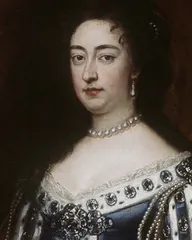
Mary II of England
St James's Palace, 1662 – Kensington Palace, 1694
15 facts3 sources
Facts and their sources
- Born1662, St James's PalaceRecords disagree1 source
- Titlequeen regnantor Monarch of Scotland, 1689–1694 · Monarch of England, 1689–1694 · King of Ireland, 1689–1694Verified · Vitrine1 source
- TitleKing of Ireland, 1689–1694or Monarch of Scotland, 1689–1694 · Monarch of England, 1689–1694 · queen regnantVerified · Vitrine1 source
- TitleMonarch of Scotland, 1689–1694or Monarch of England, 1689–1694 · King of Ireland, 1689–1694 · queen regnantVerified · Vitrine1 source
- TitleMonarch of England, 1689–1694or Monarch of Scotland, 1689–1694 · King of Ireland, 1689–1694 · queen regnantVerified · Vitrine1 source
- EventCoronation, 1689Verified · Vitrine1 source
- Died1694, Kensington Palaceor 7 Jan 1695Records disagree1 source
A life in time
1662
Born in St James's Palace
1678–1680
2 children are born
1689
Coronation
1689–1694
King of Ireland
1689–1694
Monarch of Scotland
1689–1694
Monarch of England
1694
Dies in Kensington Palace
Family
See the treeDuring her lifetime
She lived through 4 decades. Pick one to hear and see what it was like around St James's Palace.
General history, not a record about the family: each item says where it comes from.
The 1660s · Mary II is born in St James's Palace
What people wore
Around 1625–1649Ordinary women's linen smocks
Ordinary women wore smocks as an undergarment, which were loose, all-enveloping linen dresses. These could be made of holland linen for best or coarser fabrics for daily work.
Daily life
Around 1625–1649Candles and open fires lit homes
Lighting and cooking relied heavily on fire: people used candles for light and open fires for cooking. Many houses were built close together and often of wood, increasing the risk of fire.
Work
Around 1625–1649Highly Seasonal Female Agricultural Work
Women's agricultural work was highly seasonal, with 72.7 per cent of their recorded workdays occurring between July and September.
Music
Around 1625–1649Psalm Books as Treasured Possessions
Commoners and nobility alike cherished psalm books, which were sometimes bound with bibles and could be easily carried in a purse due to their small size.
At the table
Around 1625–1649Beer and ale safer than water
Most people avoided water because it was rarely clean and could spread disease, so they drank beer or ale made from malted barley and water. Beer was the cheapest drink because its higher alcohol helped it last; some beers were aged for up to two years.
Getting around
Around 1625–1649Transport via packhorses
Travelers often used packhorses to transport goods, and humble passengers sometimes rode on packsaddles between baskets.
What it cost
Around 1600–1624Typical food prices in England
When bread cost a penny a pound, cheese cost threepence a pound, and butter cost fivepence to sixpence a pound.