

%20{%20.f%20{%20fill:%20%23EE7466%20}%20.s%20{%20stroke:%20%23EE7466%20}%20}%3c/style%3e%3cdefs%3e%3cfilter%20id='ink-fav'%20x='-5%25'%20y='-5%25'%20width='110%25'%20height='110%25'%3e%3cfeTurbulence%20type='fractalNoise'%20baseFrequency='0.9'%20numOctaves='2'%20seed='7'%20result='n'/%3e%3cfeDisplacementMap%20in='SourceGraphic'%20in2='n'%20scale='2.2'%20result='d'/%3e%3cfeTurbulence%20type='fractalNoise'%20baseFrequency='0.05'%20numOctaves='3'%20seed='18'%20result='blot'/%3e%3cfeColorMatrix%20in='blot'%20type='matrix'%20values='0%200%200%200%200%200%200%200%200%200%200%200%200%200%200%200%200%200%20-1.5%201.62'%20result='m1'/%3e%3cfeTurbulence%20type='fractalNoise'%20baseFrequency='1.6'%20numOctaves='1'%20seed='12'%20result='grain'/%3e%3cfeColorMatrix%20in='grain'%20type='matrix'%20values='0%200%200%200%200%200%200%200%200%200%200%200%200%200%200%200%200%200%20-2.4%202.25'%20result='m2'/%3e%3cfeComposite%20in='m1'%20in2='m2'%20operator='arithmetic'%20k1='1'/%3e%3cfeComposite%20in='d'%20operator='in'/%3e%3c/filter%3e%3c/defs%3e%3cg%20filter='url(%23ink-fav)'%20transform='rotate(-6%2080%2080)'%3e%3ccircle%20class='s'%20cx='80'%20cy='80'%20r='69'%20fill='none'%20stroke-width='16'/%3e%3cpath%20class='f'%20d='M47.33%2044.42Q46.25%2041.94%2045.01%2040.64Q43.77%2039.35%2041.71%2038.75Q39.66%2038.16%2035.67%2037.84L35.67%2033.84L80.16%2033.84L80.16%2037.84Q74.11%2038.27%2071.85%2039.13Q69.58%2040%2069.58%2042.05Q69.58%2043.24%2070.23%2045.07L86.32%2089.57L86.97%2089.57L102.3%2049.61Q103.38%2046.8%20103.38%2044.75Q103.38%2041.83%20100.68%2040.27Q97.98%2038.7%2091.39%2037.84L91.39%2033.84L124.77%2033.84L124.77%2037.84Q119.69%2038.59%20117.15%2039.67Q114.61%2040.75%20113.05%2042.97Q111.48%2045.18%20109.65%2049.82L82.97%20118.08L77.79%20118.08L47.33%2044.42Z'/%3e%3c/g%3e%3c/svg%3e)
Catherine de' Medici
Florence, 23 Apr 1519 – Château de Blois, 5 Jan 1589
9 facts3 sources
About Catherine
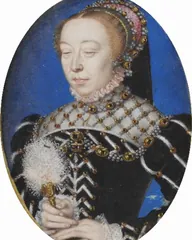
Catherine de' Medici: Queen and Regent of France
AI-assisted · editedThe collection records Catherine de' Medici’s birth in Florence in 1519. It also places her death at the Château de Blois in 1589. 1Birth · 23 Apr 1519, Florence · Probable2Death · 5 Jan 1589, Château de Blois · Probable
By marriage to King Henry II of France, Catherine became Queen Consort of France, a position she held from 1547 to 1559. She also served as regent, joining these two offices with her role at the French court. 3Union · Henry II of France · Confirmed4Title · Queen Consort of France, 1547–1559 · Confirmed5Title · regent · Confirmed
Catherine was the mother of the French kings Francis II, Charles IX, and Henry III, as well as a cousin of Pope Clement VII. The period in which her sons reigned has been called the age of Catherine de’ Medici, reflecting her extensive but sometimes varying influence on French political life. 6Known for · Catherine de' Medici was Queen of France from 1547 to 1559 by marriage to King Henry II. She was the mother of French kings Francis II, Charles IX, and Henry III, and a cousin to Pope Clement VII. The years during which her sons reigned have been called "the age of Catherine de' Medici" since she had extensive, albeit at times varying, influence on the political life of France. · Probable
Drafted with AI and edited against the archive. Open a citation to see the record, its sources and how certain it is.
Facts and their sources
- Born23 Apr 1519, FlorenceVerified · Vitrine1 source
- Titleregentor Queen Consort of France, 1547–1559Verified · Vitrine1 source
- TitleQueen Consort of France, 1547–1559or regentVerified · Vitrine1 source
- Died5 Jan 1589, Château de BloisVerified · Vitrine1 source
A life in time
23 Apr 1519
Born in Florence
1544–1556
10 children are born
1547–1559
Queen Consort of France
5 Jan 1589
Dies in Château de Blois, aged 69
Family
See the treeDuring her lifetime
She lived through 8 decades. Pick one to hear and see what it was like around Florence.
General history, not a record about the family: each item says where it comes from.
The 1510s · Catherine is born in Florence
What people wore
Extreme fabric usage in winter garments
In April 1511, some winter garments were so voluminous that they required up to 35 braccia of fabric, making them so heavy that they were difficult to wear.
Daily life
Dining arrangements in the home
Florentine homes lacked dedicated dining rooms; instead, tables were set up wherever convenient, such as in front of a fireplace during winter. Food was passed to diners who sat only on one side of the table.
Work
The Rhythm of the Working Day
Workdays began at dawn and ended at sunset, regulated by church bells, with the number of effective work days per year estimated at only about 230 due to numerous holidays. Apprenticeships typically started between ages 10 and 11 and lasted at least 3 years, with families sometimes paying masters to host and train their children.
Music
Domestic Instruments and Decorated Keyboards
By the mid-16th century, musical instruments like lutes, harpsichords, and spinets were found in households of various social levels, from noble families to barbers and merchants. Owners often decorated their keyboard instruments with mottoes such as There is dancing when I sing.
At the table
Daily meal schedule for the poor
The poor consumed three scarce daily meals: bread soaked in wine upon waking, lunch around eleven, and dinner after sunset.
Getting around
Mountain travel time to Bologna
Travel between Florence and Bologna through the Apennine passes on horseback or mule typically took two to three days.
What it cost
Cost of footwear
While basic shoes were affordable at around 2 soldi, a pair of nice shoes could cost as much as 2 florins, equivalent to about 140 soldi.