

%20{%20.f%20{%20fill:%20%23EE7466%20}%20.s%20{%20stroke:%20%23EE7466%20}%20}%3c/style%3e%3cdefs%3e%3cfilter%20id='ink-fav'%20x='-5%25'%20y='-5%25'%20width='110%25'%20height='110%25'%3e%3cfeTurbulence%20type='fractalNoise'%20baseFrequency='0.9'%20numOctaves='2'%20seed='7'%20result='n'/%3e%3cfeDisplacementMap%20in='SourceGraphic'%20in2='n'%20scale='2.2'%20result='d'/%3e%3cfeTurbulence%20type='fractalNoise'%20baseFrequency='0.05'%20numOctaves='3'%20seed='18'%20result='blot'/%3e%3cfeColorMatrix%20in='blot'%20type='matrix'%20values='0%200%200%200%200%200%200%200%200%200%200%200%200%200%200%200%200%200%20-1.5%201.62'%20result='m1'/%3e%3cfeTurbulence%20type='fractalNoise'%20baseFrequency='1.6'%20numOctaves='1'%20seed='12'%20result='grain'/%3e%3cfeColorMatrix%20in='grain'%20type='matrix'%20values='0%200%200%200%200%200%200%200%200%200%200%200%200%200%200%200%200%200%20-2.4%202.25'%20result='m2'/%3e%3cfeComposite%20in='m1'%20in2='m2'%20operator='arithmetic'%20k1='1'/%3e%3cfeComposite%20in='d'%20operator='in'/%3e%3c/filter%3e%3c/defs%3e%3cg%20filter='url(%23ink-fav)'%20transform='rotate(-6%2080%2080)'%3e%3ccircle%20class='s'%20cx='80'%20cy='80'%20r='69'%20fill='none'%20stroke-width='16'/%3e%3cpath%20class='f'%20d='M47.33%2044.42Q46.25%2041.94%2045.01%2040.64Q43.77%2039.35%2041.71%2038.75Q39.66%2038.16%2035.67%2037.84L35.67%2033.84L80.16%2033.84L80.16%2037.84Q74.11%2038.27%2071.85%2039.13Q69.58%2040%2069.58%2042.05Q69.58%2043.24%2070.23%2045.07L86.32%2089.57L86.97%2089.57L102.3%2049.61Q103.38%2046.8%20103.38%2044.75Q103.38%2041.83%20100.68%2040.27Q97.98%2038.7%2091.39%2037.84L91.39%2033.84L124.77%2033.84L124.77%2037.84Q119.69%2038.59%20117.15%2039.67Q114.61%2040.75%20113.05%2042.97Q111.48%2045.18%20109.65%2049.82L82.97%20118.08L77.79%20118.08L47.33%2044.42Z'/%3e%3c/g%3e%3c/svg%3e)
In the news1685
Huguenot migration to Brandenburg
The Great Elector issued the Edict of Potsdam, inviting French Huguenot refugees to settle in Brandenburg and Berlin to help rebuild the economy.
Hanover, 10 Nov 1683 – London, 1760
17 facts3 sources
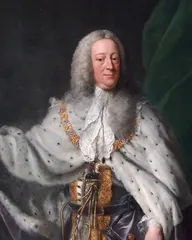
The collection records George II’s birth in Hanover in 1683, although the precise date remains disputed. He was the son of George I of Great Britain and Sophia Dorothea of Celle. 1Birth · 10 Nov 1683, Hanover · Probable2Birth · 9 Nov 1683 · Probable3Birth · 1683 · Probable4Parent · George I of Great Britain · Confirmed5Parent · Sophia Dorothea of Celle · Confirmed
From 1727 until 1760, George II was King of Great Britain and Ireland and held the title of Duke of Brunswick-Lüneburg. 6Description · King of Great Britain and Ireland from 1727 to 1760 (1683-1760) · Probable7Title · Duke of Brunswick-Lüneburg, 1727–1760 · Confirmed8Title · Monarch of Great Britain, 1727–1760 · Confirmed9Known for · George II was King of Great Britain and Ireland, Duke of Brunswick-Lüneburg (Hanover) and a prince-elector of the Holy Roman Empire from 11 June 1727 (O.S.) until his death in 1760. · Probable
George II was united in marriage to Caroline of Ansbach. The collection places his death in London in 1760, the same year that closed the period assigned to his kingship, while recording a dispute over the precise death date. 10Union · Caroline of Ansbach · Confirmed11Death · 1760, London · Probable12Death · 25 Oct 1760 · Probable6Description · King of Great Britain and Ireland from 1727 to 1760 (1683-1760) · Probable
Drafted with AI and edited against the archive. Open a citation to see the record, its sources and how certain it is.
10 Nov 1683
Born in Hanover
1706–1727
Duke of Cambridge
1707–1736
10 children are born
1727–1760
Prince-Elector
1727–1760
King of Ireland
1727–1760
Monarch of Great Britain
1727–1760
Duke of Brunswick-Lüneburg
1760
Dies in London
He lived through 9 decades. Pick one to hear and see what it was like around Hanover.
General history, not a record about the family: each item says where it comes from.
In the news1685
The Great Elector issued the Edict of Potsdam, inviting French Huguenot refugees to settle in Brandenburg and Berlin to help rebuild the economy.
Work
Common Jobs in Rural Villages
Most common occupations were in agriculture, including fullholders, smallholders, and landless laborers like cottars (Seldner) and day laborers who often combined farming with small-scale craft or wage work. Female labor was essential and included tasks like spinning, sewing, agricultural labor, and working as live-in maidservants.
What people wore
Men's multi-functional hat design
The Winkelmann hat for men featured an integrated fabric bag designed to carry items like a prayer book, bread, and a hip flask.
Daily life
Seasonal and limited schooling
There was no general compulsory schooling, and children often attended only during winter months because their labor was required for farm work in the summer. Instruction focused primarily on memorizing the Bible and learning to pray, with limited teaching of reading and writing.
News and letters
Chaotic cargo on post wagons
Post wagons often carried a chaotic mix of goods, including barrels, crates, and even unpackaged game like deer or pigs.
Music
Popular wedding dance needed the fiddle
In Weseke, a record from 1662 calls a local musician “Fidicen” (violinist) whose fiddle provided the energy for festivities, and wedding celebrations were incomplete without dancing.
At the table
Porridge was the primary warm meal
Porridge made from oats or millet was the most important warm meal, often prepared in large batches and reheated, which gave it a tough, semi-solid consistency. People typically ate directly from a common bowl at the center of the table using their hands or a wooden spoon.