

%20{%20.f%20{%20fill:%20%23EE7466%20}%20.s%20{%20stroke:%20%23EE7466%20}%20}%3c/style%3e%3cdefs%3e%3cfilter%20id='ink-fav'%20x='-5%25'%20y='-5%25'%20width='110%25'%20height='110%25'%3e%3cfeTurbulence%20type='fractalNoise'%20baseFrequency='0.9'%20numOctaves='2'%20seed='7'%20result='n'/%3e%3cfeDisplacementMap%20in='SourceGraphic'%20in2='n'%20scale='2.2'%20result='d'/%3e%3cfeTurbulence%20type='fractalNoise'%20baseFrequency='0.05'%20numOctaves='3'%20seed='18'%20result='blot'/%3e%3cfeColorMatrix%20in='blot'%20type='matrix'%20values='0%200%200%200%200%200%200%200%200%200%200%200%200%200%200%200%200%200%20-1.5%201.62'%20result='m1'/%3e%3cfeTurbulence%20type='fractalNoise'%20baseFrequency='1.6'%20numOctaves='1'%20seed='12'%20result='grain'/%3e%3cfeColorMatrix%20in='grain'%20type='matrix'%20values='0%200%200%200%200%200%200%200%200%200%200%200%200%200%200%200%200%200%20-2.4%202.25'%20result='m2'/%3e%3cfeComposite%20in='m1'%20in2='m2'%20operator='arithmetic'%20k1='1'/%3e%3cfeComposite%20in='d'%20operator='in'/%3e%3c/filter%3e%3c/defs%3e%3cg%20filter='url(%23ink-fav)'%20transform='rotate(-6%2080%2080)'%3e%3ccircle%20class='s'%20cx='80'%20cy='80'%20r='69'%20fill='none'%20stroke-width='16'/%3e%3cpath%20class='f'%20d='M47.33%2044.42Q46.25%2041.94%2045.01%2040.64Q43.77%2039.35%2041.71%2038.75Q39.66%2038.16%2035.67%2037.84L35.67%2033.84L80.16%2033.84L80.16%2037.84Q74.11%2038.27%2071.85%2039.13Q69.58%2040%2069.58%2042.05Q69.58%2043.24%2070.23%2045.07L86.32%2089.57L86.97%2089.57L102.3%2049.61Q103.38%2046.8%20103.38%2044.75Q103.38%2041.83%20100.68%2040.27Q97.98%2038.7%2091.39%2037.84L91.39%2033.84L124.77%2033.84L124.77%2037.84Q119.69%2038.59%20117.15%2039.67Q114.61%2040.75%20113.05%2042.97Q111.48%2045.18%20109.65%2049.82L82.97%20118.08L77.79%20118.08L47.33%2044.42Z'/%3e%3c/g%3e%3c/svg%3e)
In the news1869
Suez Canal opened in 1869
The Suez Canal opened in 1869, significantly increasing exposure to Western culture and trade.
Naples, 11 Nov 1869 – Alexandria, 28 Dec 1947
13 facts3 sources
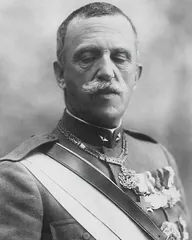
The collection records Victor Emmanuel III as born in Naples in 1869. A member of the House of Savoy, he was the son of Umberto I of Italy and Margherita of Savoy. The record also identifies Elena of Montenegro as his partner in a union. 1Birth · 11 Nov 1869, Naples · Probable2Known for · Victor Emmanuel III was King of Italy from 29 July 1900 until his abdication on 9 May 1946. A member of the House of Savoy, he also reigned as Emperor of Ethiopia from 1936 to 1941 and King of the Albanians from 1939 to 1943, following the Italian invasions of Ethiopia and Albania. · Probable3Parent · Umberto I of Italy · Confirmed4Parent · Margherita of Savoy · Confirmed5Union · Elena of Montenegro · Confirmed
He was monarch of Italy from 1900 to 1946, a reign that ended with his abdication. The collection also assigns him the imperial title of Ethiopia for 1936–1941, recording the two titles for overlapping periods. 6Title · Monarch of Italy, 1900–1946 · Confirmed2Known for · Victor Emmanuel III was King of Italy from 29 July 1900 until his abdication on 9 May 1946. A member of the House of Savoy, he also reigned as Emperor of Ethiopia from 1936 to 1941 and King of the Albanians from 1939 to 1943, following the Italian invasions of Ethiopia and Albania. · Probable7Title · Emperor of Ethiopia, 1936–1941 · Confirmed
The collection records his death in Alexandria in 1947. His documented trajectory connects the Italian and Ethiopian crowns through a sovereign whose family ties reach Italy, Savoy, and Montenegro. 8Death · 28 Dec 1947, Alexandria · Probable6Title · Monarch of Italy, 1900–1946 · Confirmed7Title · Emperor of Ethiopia, 1936–1941 · Confirmed3Parent · Umberto I of Italy · Confirmed4Parent · Margherita of Savoy · Confirmed5Union · Elena of Montenegro · Confirmed
Drafted with AI and edited against the archive. Open a citation to see the record, its sources and how certain it is.
11 Nov 1869
Born in Naples
1900–1946
Monarch of Italy
1901–1914
5 children are born
1936–1941
Emperor of Ethiopia
1939–1943
King of Albania
28 Dec 1947
Dies in Alexandria, aged 78
He lived through 9 decades. Pick one to hear and see what it was like around Naples.
General history, not a record about the family: each item says where it comes from.
Who governed
Monarch of Italy, 1861–1878 · Kingdom of Italy
Monarch of Italy, 951 · Kingdom of Italy
Monarch of Italy, 947 · Kingdom of Italy
What people wore
Folk costumes signaled social status
Folk costumes in rural Italy served as detailed social markers, where the quality of dye, the number of buttons, or even the type of metal in a finger ring signaled a wearer's wealth and marital status. These traditional outfits, often featuring unique local embroidery and lace, were brought out specifically for harvest festivals and religious processions.
Getting around
Travel by foot and mule
In many mountainous and southern areas, people could only reach towns on foot or by mule along uncomfortable mountain paths until roads were improved.
At the table
Frugal flavor for polenta
For peasant families, one salted herring was considered sufficient to flavor a large serving of polenta for at least three people.
 In Europe · 1859–1871
Italy is unified. Garibaldi, Cavour and Victor Emmanuel joined the Italian states into one kingdom, with Rome its capital from 1871.
In the news1869
The Suez Canal opened in 1869, significantly increasing exposure to Western culture and trade.
Music
Pifferari musicians perform for the Madonna
As Christmas approached, wandering musicians known as pifferari traveled from the mountains to Rome, playing bagpipes and oboe-like pifferi to perform devotional concerts before images of the Madonna.
Daily life
Poor housing and shared living spaces
In many rural areas, peasant families lived in small, damp, two-story houses with dirt floors, often sharing space and warmth with their livestock during the winter. Urban poor households frequently lacked windows, relied on smoke-filled kitchens, and suffered from a lack of sanitation, such as sewers or waste collection.