

%20{%20.f%20{%20fill:%20%23EE7466%20}%20.s%20{%20stroke:%20%23EE7466%20}%20}%3c/style%3e%3cdefs%3e%3cfilter%20id='ink-fav'%20x='-5%25'%20y='-5%25'%20width='110%25'%20height='110%25'%3e%3cfeTurbulence%20type='fractalNoise'%20baseFrequency='0.9'%20numOctaves='2'%20seed='7'%20result='n'/%3e%3cfeDisplacementMap%20in='SourceGraphic'%20in2='n'%20scale='2.2'%20result='d'/%3e%3cfeTurbulence%20type='fractalNoise'%20baseFrequency='0.05'%20numOctaves='3'%20seed='18'%20result='blot'/%3e%3cfeColorMatrix%20in='blot'%20type='matrix'%20values='0%200%200%200%200%200%200%200%200%200%200%200%200%200%200%200%200%200%20-1.5%201.62'%20result='m1'/%3e%3cfeTurbulence%20type='fractalNoise'%20baseFrequency='1.6'%20numOctaves='1'%20seed='12'%20result='grain'/%3e%3cfeColorMatrix%20in='grain'%20type='matrix'%20values='0%200%200%200%200%200%200%200%200%200%200%200%200%200%200%200%200%200%20-2.4%202.25'%20result='m2'/%3e%3cfeComposite%20in='m1'%20in2='m2'%20operator='arithmetic'%20k1='1'/%3e%3cfeComposite%20in='d'%20operator='in'/%3e%3c/filter%3e%3c/defs%3e%3cg%20filter='url(%23ink-fav)'%20transform='rotate(-6%2080%2080)'%3e%3ccircle%20class='s'%20cx='80'%20cy='80'%20r='69'%20fill='none'%20stroke-width='16'/%3e%3cpath%20class='f'%20d='M47.33%2044.42Q46.25%2041.94%2045.01%2040.64Q43.77%2039.35%2041.71%2038.75Q39.66%2038.16%2035.67%2037.84L35.67%2033.84L80.16%2033.84L80.16%2037.84Q74.11%2038.27%2071.85%2039.13Q69.58%2040%2069.58%2042.05Q69.58%2043.24%2070.23%2045.07L86.32%2089.57L86.97%2089.57L102.3%2049.61Q103.38%2046.8%20103.38%2044.75Q103.38%2041.83%20100.68%2040.27Q97.98%2038.7%2091.39%2037.84L91.39%2033.84L124.77%2033.84L124.77%2037.84Q119.69%2038.59%20117.15%2039.67Q114.61%2040.75%20113.05%2042.97Q111.48%2045.18%20109.65%2049.82L82.97%20118.08L77.79%20118.08L47.33%2044.42Z'/%3e%3c/g%3e%3c/svg%3e)
Around the world1825–1830
The first passenger railway
In England a steam locomotive pulled the first public train in 1825; within decades railways crossed every continent.
Turin, 14 Mar 1820 – Rome, 9 Jan 1878
13 facts3 sources
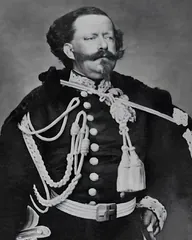
Victor Emmanuel II was born in Turin in 1820 and died in Rome in 1878; the collection records both dates as probable. His parents were Carlo Alberto I of Sardinia and Maria Theresa of Austria. 1Birth · 14 Mar 1820, Turin · Probable2Death · 9 Jan 1878, Rome · Probable3Parent · Carlo Alberto I of Sardinia · Confirmed4Parent · Maria Theresa of Austria · Confirmed
He served as King of Sardinia and Duke of Savoy, then became Monarch of Italy. The collection describes him as King of Sardinia from 1849 to 1861 and King of Italy from 1861 to 1878. It also presents him as the first king of an independent, united Italy since the sixth century, although this summary is recorded as probable. 5Title · King of Sardinia and Duke of Savoy, 1839–1861 · Confirmed6Title · Monarch of Italy, 1861–1878 · Confirmed7Description · King of Sardinia (1849–1861) and King of Italy (1861–1878) · Probable8Known for · Victor Emmanuel II was King of Sardinia from 23 March 1849 until 17 March 1861, when he assumed the title of King of Italy and became the first king of an independent, united Italy since the 6th century, a title he held until his death in 1878. Borrowing from the old Latin title Pater Patriae of the Roman emperors, the Italians gave him the epithet of "Father of the Fatherland". · Probable
Victor Emmanuel II was also head of the House of Savoy. His recorded unions were with Archduchess Adelaide of Austria and Rosa Vercellana. Italians came to call him the “Father of the Fatherland,” an epithet derived from the old Latin title Pater Patriae associated with Roman emperors. 9Title · Head of the House of Savoy · Confirmed10Union · Archduchess Adelaide of Austria · Confirmed11Union · Rosa Vercellana · Confirmed8Known for · Victor Emmanuel II was King of Sardinia from 23 March 1849 until 17 March 1861, when he assumed the title of King of Italy and became the first king of an independent, united Italy since the 6th century, a title he held until his death in 1878. Borrowing from the old Latin title Pater Patriae of the Roman emperors, the Italians gave him the epithet of "Father of the Fatherland". · Probable
Drafted with AI and edited against the archive. Open a citation to see the record, its sources and how certain it is.
14 Mar 1820
Born in Turin
1839–1861
King of Sardinia and Duke of Savoy
1843–1866
15 children are born
1861–1878
Monarch of Italy
9 Jan 1878
Dies in Rome, aged 57
He lived through 6 decades. Pick one to hear and see what it was like around Turin.
General history, not a record about the family: each item says where it comes from.
Around the world1825–1830
In England a steam locomotive pulled the first public train in 1825; within decades railways crossed every continent.
At the table
Street foods costing one soldo
For a single soldo, the poor in Naples could purchase various street foods, such as slices of pizza, portions of fried fish known as fragaglia, or nine boiled chestnuts to eat with bread.
What people wore
Calabrian men's festival clothing
During festivals in Calabria, men commonly wore black velvet jackets and breeches, paired with long white cotton caps that hung over their shoulders.
Getting around
The Lettiga: A Mule-Drawn Carriage
The lettiga, a national carriage suspended between two mules, was a common way to travel through regions lacking roads suitable for wheeled vehicles. It was notoriously fatiguing and slow, moving at an average speed of about three miles per hour.
What it cost
Food prices for daily necessities
Bread cost 6 grana per rotolo (approx. 890 grams), while beef cost 16 grana and a liter of wine was 3 grana. Pasta was a staple, with machine-made pasta costing 7 grana and finer varieties reaching 8 grana per rotolo.
Music
Essential instruments for daily life
Castanets and tambourines were essential instruments for dancers, frequently accompanied by violins and guitars. Guitars were especially favored for nocturnal serenades, open-air concerts, and romantic declarations.
Daily life
Gender-restricted education controlled by the Church
There was no compulsory schooling, and education was heavily influenced by the Church, with 30 articles regulating male education versus only 22 for females. While boys could study reading, writing, and arithmetic, girls' education was largely restricted to domestic arts, catechism, and religious duties.