

%20{%20.f%20{%20fill:%20%23EE7466%20}%20.s%20{%20stroke:%20%23EE7466%20}%20}%3c/style%3e%3cdefs%3e%3cfilter%20id='ink-fav'%20x='-5%25'%20y='-5%25'%20width='110%25'%20height='110%25'%3e%3cfeTurbulence%20type='fractalNoise'%20baseFrequency='0.9'%20numOctaves='2'%20seed='7'%20result='n'/%3e%3cfeDisplacementMap%20in='SourceGraphic'%20in2='n'%20scale='2.2'%20result='d'/%3e%3cfeTurbulence%20type='fractalNoise'%20baseFrequency='0.05'%20numOctaves='3'%20seed='18'%20result='blot'/%3e%3cfeColorMatrix%20in='blot'%20type='matrix'%20values='0%200%200%200%200%200%200%200%200%200%200%200%200%200%200%200%200%200%20-1.5%201.62'%20result='m1'/%3e%3cfeTurbulence%20type='fractalNoise'%20baseFrequency='1.6'%20numOctaves='1'%20seed='12'%20result='grain'/%3e%3cfeColorMatrix%20in='grain'%20type='matrix'%20values='0%200%200%200%200%200%200%200%200%200%200%200%200%200%200%200%200%200%20-2.4%202.25'%20result='m2'/%3e%3cfeComposite%20in='m1'%20in2='m2'%20operator='arithmetic'%20k1='1'/%3e%3cfeComposite%20in='d'%20operator='in'/%3e%3c/filter%3e%3c/defs%3e%3cg%20filter='url(%23ink-fav)'%20transform='rotate(-6%2080%2080)'%3e%3ccircle%20class='s'%20cx='80'%20cy='80'%20r='69'%20fill='none'%20stroke-width='16'/%3e%3cpath%20class='f'%20d='M47.33%2044.42Q46.25%2041.94%2045.01%2040.64Q43.77%2039.35%2041.71%2038.75Q39.66%2038.16%2035.67%2037.84L35.67%2033.84L80.16%2033.84L80.16%2037.84Q74.11%2038.27%2071.85%2039.13Q69.58%2040%2069.58%2042.05Q69.58%2043.24%2070.23%2045.07L86.32%2089.57L86.97%2089.57L102.3%2049.61Q103.38%2046.8%20103.38%2044.75Q103.38%2041.83%20100.68%2040.27Q97.98%2038.7%2091.39%2037.84L91.39%2033.84L124.77%2033.84L124.77%2037.84Q119.69%2038.59%20117.15%2039.67Q114.61%2040.75%20113.05%2042.97Q111.48%2045.18%20109.65%2049.82L82.97%20118.08L77.79%20118.08L47.33%2044.42Z'/%3e%3c/g%3e%3c/svg%3e)
In the news1685
Revocation of Edict of Nantes (1685)
The 1685 revocation of the Edict of Nantes forced 200,000 Huguenots to flee, damaging textile and luxury craft industries and seizing Protestant assets.
Versailles, 19 Dec 1683 – Madrid, 9 Jul 1746
17 facts1 source
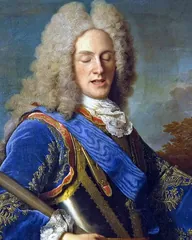
The collection records Philip V’s birth at Versailles in 1683 and his death in Madrid in 1746. His family record identifies Louis, Grand Dauphin, as his father and Maria Anna Victoria of Bavaria as his mother. 1Birth · 19 Dec 1683, Versailles · Probable2Death · 9 Jul 1746, Madrid · Probable3Parent · Louis, Grand Dauphin · Confirmed4Parent · Maria Anna Victoria of Bavaria · Confirmed
The title records distinguish his rule over the Crown of Aragon from two later periods as monarch of Spain. They present his public role through changing territorial titles rather than a single uninterrupted entry. 5Title · monarch of the Crown of Aragon, 1700–1706 · Confirmed6Title · Monarch of Spain, 1714–1724 · Confirmed7Title · Monarch of Spain, 1724–1746 · Confirmed
Two unions are also recorded: those with Elisabeth Farnese and Maria Luisa of Savoy, identifying both women as his spouses. 8Union · Elisabeth Farnese · Confirmed9Union · Maria Luisa of Savoy · Confirmed
Drafted with AI and edited against the archive. Open a citation to see the record, its sources and how certain it is.
19 Dec 1683
Born in Versailles
1700–1713
King of Sardinia
1700–1706
Monarch of the Crown of Aragon
1700–1714
Monarch of Castile and Leon
1707–1729
11 children are born
1714–1724
Monarch of Spain
1714–1724
Head of State of Spain
1724–1746
Head of State of Spain
1724–1746
Monarch of Spain
9 Jul 1746
Dies in Madrid, aged 62
He lived through 7 decades. Pick one to hear and see what it was like around Versailles.
General history, not a record about the family: each item says where it comes from.
In the news1685
The 1685 revocation of the Edict of Nantes forced 200,000 Huguenots to flee, damaging textile and luxury craft industries and seizing Protestant assets.
At the table
Daily Bread Consumption Requirements
To meet daily calorie needs, men typically consumed three pounds of bread per day, while women consumed two pounds and children one pound.
What people wore
Standard Men's Attire
In the late 17th century, ordinary men wore a three-piece suit consisting of a justaucorps (coat), veste (vest), and culotte (breeches), often made from simple, durable wool fabrics.
Getting around
Barque de poste canal travel
In 1674, the barque de poste service was introduced, allowing passengers to travel from Toulouse to Castelnaudary in one day. The journey included scheduled stops for meals and overnight rests.
What it cost
Medical treatment cost versus cutlery price
A medical enema in the 17th century cost 15 sous, which was the same price as a gross of small whistle knives.
Music
Sunday Dancing and the Pipe and Tabor
In the late 17th century, peasants often enjoyed dancing to the pipe and tabor on the Sabbath, an amusement that was sometimes tolerated by church officials as a necessary relief from a week of hard labor.
Daily life
Limited and basic primary schooling
Primary schooling was often sporadic or unavailable, usually consisting only of basic reading, writing, and catechism taught by a priest or vicar.