

%20{%20.f%20{%20fill:%20%23EE7466%20}%20.s%20{%20stroke:%20%23EE7466%20}%20}%3c/style%3e%3cdefs%3e%3cfilter%20id='ink-fav'%20x='-5%25'%20y='-5%25'%20width='110%25'%20height='110%25'%3e%3cfeTurbulence%20type='fractalNoise'%20baseFrequency='0.9'%20numOctaves='2'%20seed='7'%20result='n'/%3e%3cfeDisplacementMap%20in='SourceGraphic'%20in2='n'%20scale='2.2'%20result='d'/%3e%3cfeTurbulence%20type='fractalNoise'%20baseFrequency='0.05'%20numOctaves='3'%20seed='18'%20result='blot'/%3e%3cfeColorMatrix%20in='blot'%20type='matrix'%20values='0%200%200%200%200%200%200%200%200%200%200%200%200%200%200%200%200%200%20-1.5%201.62'%20result='m1'/%3e%3cfeTurbulence%20type='fractalNoise'%20baseFrequency='1.6'%20numOctaves='1'%20seed='12'%20result='grain'/%3e%3cfeColorMatrix%20in='grain'%20type='matrix'%20values='0%200%200%200%200%200%200%200%200%200%200%200%200%200%200%200%200%200%20-2.4%202.25'%20result='m2'/%3e%3cfeComposite%20in='m1'%20in2='m2'%20operator='arithmetic'%20k1='1'/%3e%3cfeComposite%20in='d'%20operator='in'/%3e%3c/filter%3e%3c/defs%3e%3cg%20filter='url(%23ink-fav)'%20transform='rotate(-6%2080%2080)'%3e%3ccircle%20class='s'%20cx='80'%20cy='80'%20r='69'%20fill='none'%20stroke-width='16'/%3e%3cpath%20class='f'%20d='M47.33%2044.42Q46.25%2041.94%2045.01%2040.64Q43.77%2039.35%2041.71%2038.75Q39.66%2038.16%2035.67%2037.84L35.67%2033.84L80.16%2033.84L80.16%2037.84Q74.11%2038.27%2071.85%2039.13Q69.58%2040%2069.58%2042.05Q69.58%2043.24%2070.23%2045.07L86.32%2089.57L86.97%2089.57L102.3%2049.61Q103.38%2046.8%20103.38%2044.75Q103.38%2041.83%20100.68%2040.27Q97.98%2038.7%2091.39%2037.84L91.39%2033.84L124.77%2033.84L124.77%2037.84Q119.69%2038.59%20117.15%2039.67Q114.61%2040.75%20113.05%2042.97Q111.48%2045.18%20109.65%2049.82L82.97%20118.08L77.79%20118.08L47.33%2044.42Z'/%3e%3c/g%3e%3c/svg%3e)
In the news1856
Abolition of Milling Restrictions
In 1856, the government abolished restrictive milling legislation, allowing the construction of steam-driven milling factories that produced cheaper bread for the public.
Kronprinzenpalais, 27 Jan 1859 – Huis Doorn, 4 Jun 1941
14 facts3 sources
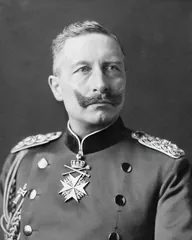
The collection records Wilhelm II’s birth in 1859 at the Kronprinzenpalais. He was the son of Frederick III, German Emperor, and Victoria, Princess Royal. 1Birth · 27 Jan 1859, Kronprinzenpalais · Probable2Parent · Frederick III, German Emperor · Confirmed3Parent · Victoria, Princess Royal · Confirmed
Wilhelm held the offices of German Emperor and King of Prussia, and is described as the last ruler in both capacities. His tenure in both offices ended with his abdication in 1918, an event associated with the end of the German Empire. 4Title · German Emperor, 1888–1918 · Confirmed5Title · King of Prussia, 1888–1918 · Confirmed6Description · as King of Prussia last German Emperor from 1888 to 1918 (1859–1941) · Probable7Event · abdication, 1918 · Confirmed8Known for · Wilhelm II was the last German Emperor from 1888 until his abdication in 1918. His fall from power marked the end of the German Empire as well as the Hohenzollern dynasty's 400-year rule over Prussia. · Probable
Two assassination attempts against Kaiser Wilhelm II are recorded, one in 1900 and another in 1901. His union with Princess Hermine Reuss of Greiz forms another recorded family connection. The collection records his death in 1941 at Huis Doorn. 9Event · Assassination attempt on Kaiser Wilhelm II on November 16, 1900 · Confirmed10Event · Assasination attempt on Kaiser Wilhelm II on March 6, 1901 · Confirmed11Union · Princess Hermine Reuss of Greiz · Confirmed12Death · 4 Jun 1941, Huis Doorn · Probable
Drafted with AI and edited against the archive. Open a citation to see the record, its sources and how certain it is.
27 Jan 1859
Born in Kronprinzenpalais
1882–1892
7 children are born
1888–1918
German Emperor
1888–1918
King of Prussia
1918
Abdication
4 Jun 1941
Dies in Huis Doorn, aged 82
He lived through 10 decades. Pick one to hear and see what it was like around Kronprinzenpalais.
General history, not a record about the family: each item says where it comes from.
In the news1856
In 1856, the government abolished restrictive milling legislation, allowing the construction of steam-driven milling factories that produced cheaper bread for the public.
What people wore
Creative Sewing to Save Fabric
To save money on expensive fabrics, rural women often sewed a piece of linen into the hidden parts of their dresses that were covered by an apron, a practice known as Magsachte.
Getting around
Limitations of mail-coach travel
Before railways became dominant, mail-coaches reached speeds of 8 to 12.7 km/h, but their daily range was limited to around 100 kilometers due to frequent stops, meals, and border controls.
 In Europe · 1859–1871
Italy is unified. Garibaldi, Cavour and Victor Emmanuel joined the Italian states into one kingdom, with Rome its capital from 1871.
In the news1854
In 1854, Amsterdam became the first large municipality in the Netherlands to introduce a piped drinking water system to address health concerns from urban crowding.
Music
Music and dance at public festivals
Popular festivities like shooting festivals and local fairs were central to social life, while the educated classes attended balls, concerts, and theater performances.
Daily life
Compulsory schooling and kindergarten costs
Children were required to attend school from ages six to fourteen, often carrying books in long tin satchels. In model kindergartens, families could pay fees between sixpence and three shillings a month for care and meals.