

%20{%20.f%20{%20fill:%20%23EE7466%20}%20.s%20{%20stroke:%20%23EE7466%20}%20}%3c/style%3e%3cdefs%3e%3cfilter%20id='ink-fav'%20x='-5%25'%20y='-5%25'%20width='110%25'%20height='110%25'%3e%3cfeTurbulence%20type='fractalNoise'%20baseFrequency='0.9'%20numOctaves='2'%20seed='7'%20result='n'/%3e%3cfeDisplacementMap%20in='SourceGraphic'%20in2='n'%20scale='2.2'%20result='d'/%3e%3cfeTurbulence%20type='fractalNoise'%20baseFrequency='0.05'%20numOctaves='3'%20seed='18'%20result='blot'/%3e%3cfeColorMatrix%20in='blot'%20type='matrix'%20values='0%200%200%200%200%200%200%200%200%200%200%200%200%200%200%200%200%200%20-1.5%201.62'%20result='m1'/%3e%3cfeTurbulence%20type='fractalNoise'%20baseFrequency='1.6'%20numOctaves='1'%20seed='12'%20result='grain'/%3e%3cfeColorMatrix%20in='grain'%20type='matrix'%20values='0%200%200%200%200%200%200%200%200%200%200%200%200%200%200%200%200%200%20-2.4%202.25'%20result='m2'/%3e%3cfeComposite%20in='m1'%20in2='m2'%20operator='arithmetic'%20k1='1'/%3e%3cfeComposite%20in='d'%20operator='in'/%3e%3c/filter%3e%3c/defs%3e%3cg%20filter='url(%23ink-fav)'%20transform='rotate(-6%2080%2080)'%3e%3ccircle%20class='s'%20cx='80'%20cy='80'%20r='69'%20fill='none'%20stroke-width='16'/%3e%3cpath%20class='f'%20d='M47.33%2044.42Q46.25%2041.94%2045.01%2040.64Q43.77%2039.35%2041.71%2038.75Q39.66%2038.16%2035.67%2037.84L35.67%2033.84L80.16%2033.84L80.16%2037.84Q74.11%2038.27%2071.85%2039.13Q69.58%2040%2069.58%2042.05Q69.58%2043.24%2070.23%2045.07L86.32%2089.57L86.97%2089.57L102.3%2049.61Q103.38%2046.8%20103.38%2044.75Q103.38%2041.83%20100.68%2040.27Q97.98%2038.7%2091.39%2037.84L91.39%2033.84L124.77%2033.84L124.77%2037.84Q119.69%2038.59%20117.15%2039.67Q114.61%2040.75%20113.05%2042.97Q111.48%2045.18%20109.65%2049.82L82.97%20118.08L77.79%20118.08L47.33%2044.42Z'/%3e%3c/g%3e%3c/svg%3e)
Charles V
Ghent, 5 Mar 1500 – Monastery of Yuste, 1 Oct 1558
15 facts3 sources
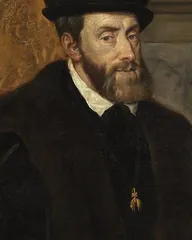
About Charles V
Charles V: Emperor and Monarch of Castile and Leon
AI-assisted · editedThe collection records Charles V’s birth in Ghent in 1500. He was the son of Philip I of Castile and Juana I of Castile. 1Birth · 5 Mar 1500, Ghent · Probable2Parent · Philip I of Castile · Confirmed3Parent · Juana I of Castile · Confirmed
Charles V held the office of Holy Roman Emperor from 1519 to 1556. He was also monarch of Castile and Leon from 1516 to 1556. 4Title · Holy Roman Emperor, 1519–1556 · Confirmed5Title · Monarch of Castile and Leon, 1516–1556 · Confirmed
His documented union was with Isabella of Portugal. The collection records his death at the Monastery of Yuste in 1558, although the precise date is presented as probable. 6Union · Isabella of Portugal · Confirmed7Death · 1 Oct 1558, Monastery of Yuste · Probable
Drafted with AI and edited against the archive. Open a citation to see the record, its sources and how certain it is.
Facts and their sources
- Born5 Mar 1500, GhentVerified · Vitrine1 source
- TitleLord of the Netherlandsor Monarch of Castile and Leon, 1516–1556 · monarch of the Crown of Aragon, 1516–1556 · King of Sardinia, 1516–1556 · Holy Roman Emperor, 1519–1556Verified · Vitrine1 source
- TitleKing of Sardinia, 1516–1556or Monarch of Castile and Leon, 1516–1556 · monarch of the Crown of Aragon, 1516–1556 · Holy Roman Emperor, 1519–1556 · Lord of the NetherlandsVerified · Vitrine1 source
- TitleMonarch of Castile and Leon, 1516–1556or monarch of the Crown of Aragon, 1516–1556 · King of Sardinia, 1516–1556 · Holy Roman Emperor, 1519–1556 · Lord of the NetherlandsVerified · Vitrine1 source
- Titlemonarch of the Crown of Aragon, 1516–1556or Monarch of Castile and Leon, 1516–1556 · King of Sardinia, 1516–1556 · Holy Roman Emperor, 1519–1556 · Lord of the NetherlandsVerified · Vitrine1 source
- TitleHoly Roman Emperor, 1519–1556or Monarch of Castile and Leon, 1516–1556 · monarch of the Crown of Aragon, 1516–1556 · King of Sardinia, 1516–1556 · Lord of the NetherlandsVerified · Vitrine1 source
- EventCoronation of the Holy Roman Emperor, 1530Verified · Vitrine1 source
- Died1 Oct 1558, Monastery of YusteVerified · Vitrine1 source
A life in time
5 Mar 1500
Born in Ghent
1516–1556
King of Sardinia
1516–1556
Monarch of Castile and Leon
1516–1556
Monarch of the Crown of Aragon
1518–1547
10 children are born
1519–1556
Holy Roman Emperor
1530
Coronation of the Holy Roman Emperor
1 Oct 1558
Dies in Monastery of Yuste, aged 58
Family
See the treeParents
Partner
Children · 11
During his lifetime
He lived through 6 decades. Pick one to hear and see what it was like around Ghent.
General history, not a record about the family: each item says where it comes from.
The 1500s · Charles V is born in Ghent
What people wore
Flemish peasant men's clothing
Flemish peasant men typically wore a long linen undershirt, a tight-fitting doublet secured with ties, and snug hose tied to the doublet to keep them in place. A codpiece, made of the same fabric as the hose, was worn over the front opening for modesty.
Daily life
Elementary schooling in villages
Almost every village or parish had at least one elementary school where children paid a few pennies per month per subject. Tuition for poor children was often covered by the Church or philanthropists.
Work
Work bells structured the daily rhythm
Workers often relied on city bells, or work bells, to regulate the start, breaks, and end of their long days. Industrial tasks like textile production were tightly supervised, with bells dictating when labourers had to be at their workshops.
Music
Loud instruments at village festivals
At village festivals in Flanders, loud instruments such as trumpets, oboes, flutes, fifes, bagpipes, and drums were commonly used to entertain the crowds.
At the table
Ordinary household diet and cooking fat
While the wealthy enjoyed complex pies and ragouts, ordinary people often used leftover scraps to make soups and kept pigs, sheep, or chickens for meat, eggs, and cheese. Cooking was primarily done using pig fat rather than butter.
Getting around
Staple rights could delay travelers significantly
Staple rights in cities like Grave or Venlo could force merchants to offer their goods for sale for several days, significantly delaying journeys.
What it cost
Price of simple leather shoes
Simple leather shoes cost between 3 and 8 guilders, depending on the quality of the leather and the craftsmanship.