

%20{%20.f%20{%20fill:%20%23EE7466%20}%20.s%20{%20stroke:%20%23EE7466%20}%20}%3c/style%3e%3cdefs%3e%3cfilter%20id='ink-fav'%20x='-5%25'%20y='-5%25'%20width='110%25'%20height='110%25'%3e%3cfeTurbulence%20type='fractalNoise'%20baseFrequency='0.9'%20numOctaves='2'%20seed='7'%20result='n'/%3e%3cfeDisplacementMap%20in='SourceGraphic'%20in2='n'%20scale='2.2'%20result='d'/%3e%3cfeTurbulence%20type='fractalNoise'%20baseFrequency='0.05'%20numOctaves='3'%20seed='18'%20result='blot'/%3e%3cfeColorMatrix%20in='blot'%20type='matrix'%20values='0%200%200%200%200%200%200%200%200%200%200%200%200%200%200%200%200%200%20-1.5%201.62'%20result='m1'/%3e%3cfeTurbulence%20type='fractalNoise'%20baseFrequency='1.6'%20numOctaves='1'%20seed='12'%20result='grain'/%3e%3cfeColorMatrix%20in='grain'%20type='matrix'%20values='0%200%200%200%200%200%200%200%200%200%200%200%200%200%200%200%200%200%20-2.4%202.25'%20result='m2'/%3e%3cfeComposite%20in='m1'%20in2='m2'%20operator='arithmetic'%20k1='1'/%3e%3cfeComposite%20in='d'%20operator='in'/%3e%3c/filter%3e%3c/defs%3e%3cg%20filter='url(%23ink-fav)'%20transform='rotate(-6%2080%2080)'%3e%3ccircle%20class='s'%20cx='80'%20cy='80'%20r='69'%20fill='none'%20stroke-width='16'/%3e%3cpath%20class='f'%20d='M47.33%2044.42Q46.25%2041.94%2045.01%2040.64Q43.77%2039.35%2041.71%2038.75Q39.66%2038.16%2035.67%2037.84L35.67%2033.84L80.16%2033.84L80.16%2037.84Q74.11%2038.27%2071.85%2039.13Q69.58%2040%2069.58%2042.05Q69.58%2043.24%2070.23%2045.07L86.32%2089.57L86.97%2089.57L102.3%2049.61Q103.38%2046.8%20103.38%2044.75Q103.38%2041.83%20100.68%2040.27Q97.98%2038.7%2091.39%2037.84L91.39%2033.84L124.77%2033.84L124.77%2037.84Q119.69%2038.59%20117.15%2039.67Q114.61%2040.75%20113.05%2042.97Q111.48%2045.18%20109.65%2049.82L82.97%20118.08L77.79%20118.08L47.33%2044.42Z'/%3e%3c/g%3e%3c/svg%3e)
In the news1717
Christmas flood kills 11,000 people
A major storm surge on Christmas claimed over 11,000 lives along the German North Sea coast.
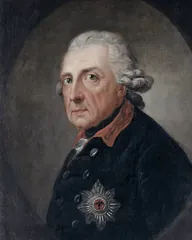
Also known as Frederick the Great (epithet)
Berlin, 24 Jan 1712 – Potsdam, 17 Aug 1786
15 facts3 sources
24 Jan 1712
Born in Berlin
1740–1786
King of Prussia
1740
Margrave of Brandenburg
17 Aug 1786
Dies in Potsdam, aged 74
1991
Reburial
He lived through 8 decades. Pick one to hear and see what it was like around Berlin.
General history, not a record about the family: each item says where it comes from.
In the news1717
A major storm surge on Christmas claimed over 11,000 lives along the German North Sea coast.
Getting around
Travel by Foot and Early Mail Coaches
Ordinary people typically traveled by walking, as non-private transportation was limited and expensive. Regular mail coach lines for passengers, such as the Nuremberg-Leipzig route, began emerging in the late 17th and 18th centuries.
At the table
Simple meals of porridge, soup, and stew
Ordinary families commonly consumed grain-based porridges and soups for breakfast and dinner, while a hearty stew served as the main midday meal. Meat was expensive, so many households reserved it for special occasions like a Sunday roast.
 In Europe · 1701–1714
War of the Spanish Succession. Europe’s powers fought for thirteen years over who would inherit the Spanish throne; a Bourbon kept it, and Britain gained Gibraltar.
What people wore
Limited Wardrobes and Sunday Best
For ordinary people, clothing was strictly divided into everyday wear and Sunday best, as a person's wardrobe was very limited three hundred years ago.
Music
High fines for unauthorized trumpet playing
In the Principality of Anhalt-Zerbst, musicians who performed with unauthorized trumpets or kettledrums at public fairs or taverns faced a fine of fifty Reichsthaler.
Daily life
Simple and Frugal Home Interiors
Homes often had low ceilings, whitewashed walls, and floors made of stone or brick that were covered in sand. Rooms were sparsely furnished, and houses frequently lacked clocks, making time-keeping and domestic life simple and frugal.