

%20{%20.f%20{%20fill:%20%23EE7466%20}%20.s%20{%20stroke:%20%23EE7466%20}%20}%3c/style%3e%3cdefs%3e%3cfilter%20id='ink-fav'%20x='-5%25'%20y='-5%25'%20width='110%25'%20height='110%25'%3e%3cfeTurbulence%20type='fractalNoise'%20baseFrequency='0.9'%20numOctaves='2'%20seed='7'%20result='n'/%3e%3cfeDisplacementMap%20in='SourceGraphic'%20in2='n'%20scale='2.2'%20result='d'/%3e%3cfeTurbulence%20type='fractalNoise'%20baseFrequency='0.05'%20numOctaves='3'%20seed='18'%20result='blot'/%3e%3cfeColorMatrix%20in='blot'%20type='matrix'%20values='0%200%200%200%200%200%200%200%200%200%200%200%200%200%200%200%200%200%20-1.5%201.62'%20result='m1'/%3e%3cfeTurbulence%20type='fractalNoise'%20baseFrequency='1.6'%20numOctaves='1'%20seed='12'%20result='grain'/%3e%3cfeColorMatrix%20in='grain'%20type='matrix'%20values='0%200%200%200%200%200%200%200%200%200%200%200%200%200%200%200%200%200%20-2.4%202.25'%20result='m2'/%3e%3cfeComposite%20in='m1'%20in2='m2'%20operator='arithmetic'%20k1='1'/%3e%3cfeComposite%20in='d'%20operator='in'/%3e%3c/filter%3e%3c/defs%3e%3cg%20filter='url(%23ink-fav)'%20transform='rotate(-6%2080%2080)'%3e%3ccircle%20class='s'%20cx='80'%20cy='80'%20r='69'%20fill='none'%20stroke-width='16'/%3e%3cpath%20class='f'%20d='M47.33%2044.42Q46.25%2041.94%2045.01%2040.64Q43.77%2039.35%2041.71%2038.75Q39.66%2038.16%2035.67%2037.84L35.67%2033.84L80.16%2033.84L80.16%2037.84Q74.11%2038.27%2071.85%2039.13Q69.58%2040%2069.58%2042.05Q69.58%2043.24%2070.23%2045.07L86.32%2089.57L86.97%2089.57L102.3%2049.61Q103.38%2046.8%20103.38%2044.75Q103.38%2041.83%20100.68%2040.27Q97.98%2038.7%2091.39%2037.84L91.39%2033.84L124.77%2033.84L124.77%2037.84Q119.69%2038.59%20117.15%2039.67Q114.61%2040.75%20113.05%2042.97Q111.48%2045.18%20109.65%2049.82L82.97%20118.08L77.79%20118.08L47.33%2044.42Z'/%3e%3c/g%3e%3c/svg%3e)
Philip III of Spain
Madrid, 24 Apr 1578 – Madrid, 31 Mar 1621
15 facts3 sources
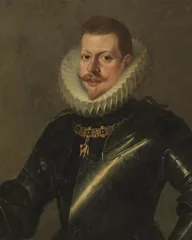
About Philip III
Philip III of Spain: Castile, Portugal, and the Iberian Union
AI-assisted · editedThe collection records Philip III of Spain’s birth in Madrid in 1578. He was the son of King Philip II of Spain and Anna of Austria, Queen of Spain. 1Birth · 24 Apr 1578, Madrid · Probable2Parent · Philip II of Spain · Confirmed3Parent · Anna of Austria, Queen of Spain · Confirmed
His two principal offices recorded here are monarch of Castile and Leon and monarch of Portugal, both associated with the period from 1598 to 1621. Together, these roles connect his identity to the political structure described in the collection’s summary as the Iberian Union. 4Title · Monarch of Castile and Leon, 1598–1621 · Confirmed5Title · Monarch of Portugal, 1598–1621 · Confirmed6Known for · Philip III was King of Spain and Portugal during the period known as the Iberian Union, reigning from 1598 until his death in 1621. He was also King of Naples and Sicily, Duke of Milan, and Lord of the Seventeen Provinces. A member of the House of Habsburg, he was born in Madrid to King Philip II of Spain and his fourth wife, Anna of Austria. · Probable
The collection records Philip’s death in Madrid in 1621. Both the birth and death entries carry a probable confidence rating. Its summary identifies him as a member of the House of Habsburg and places his reign within the Iberian Union. 6Known for · Philip III was King of Spain and Portugal during the period known as the Iberian Union, reigning from 1598 until his death in 1621. He was also King of Naples and Sicily, Duke of Milan, and Lord of the Seventeen Provinces. A member of the House of Habsburg, he was born in Madrid to King Philip II of Spain and his fourth wife, Anna of Austria. · Probable1Birth · 24 Apr 1578, Madrid · Probable7Death · 31 Mar 1621, Madrid · Probable
Drafted with AI and edited against the archive. Open a citation to see the record, its sources and how certain it is.
Facts and their sources
- Born24 Apr 1578, MadridVerified · Vitrine1 source
- Titlemonarchor Prince of Asturias, 1584–1598 · Monarch of Castile and Leon, 1598–1621 · monarch of the Crown of Aragon, 1598–1621 · Monarch of Portugal, 1598–1621 · King of Sardinia, 1598–1621Verified · Vitrine1 source
- TitlePrince of Asturias, 1584–1598or Monarch of Castile and Leon, 1598–1621 · monarch of the Crown of Aragon, 1598–1621 · Monarch of Portugal, 1598–1621 · King of Sardinia, 1598–1621 · monarchVerified · Vitrine1 source
- TitleMonarch of Portugal, 1598–1621or Prince of Asturias, 1584–1598 · Monarch of Castile and Leon, 1598–1621 · monarch of the Crown of Aragon, 1598–1621 · King of Sardinia, 1598–1621 · monarchVerified · Vitrine1 source
- TitleKing of Sardinia, 1598–1621or Prince of Asturias, 1584–1598 · Monarch of Castile and Leon, 1598–1621 · monarch of the Crown of Aragon, 1598–1621 · Monarch of Portugal, 1598–1621 · monarchVerified · Vitrine1 source
- TitleMonarch of Castile and Leon, 1598–1621or Prince of Asturias, 1584–1598 · monarch of the Crown of Aragon, 1598–1621 · Monarch of Portugal, 1598–1621 · King of Sardinia, 1598–1621 · monarchVerified · Vitrine1 source
- Titlemonarch of the Crown of Aragon, 1598–1621or Prince of Asturias, 1584–1598 · Monarch of Castile and Leon, 1598–1621 · Monarch of Portugal, 1598–1621 · King of Sardinia, 1598–1621 · monarchVerified · Vitrine1 source
- Died31 Mar 1621, MadridVerified · Vitrine1 source
A life in time
24 Apr 1578
Born in Madrid
1584–1598
Prince of Asturias
1598–1621
Monarch of Portugal
1598–1621
King of Sardinia
1598–1621
Monarch of Castile and Leon
1598–1621
Monarch of the Crown of Aragon
1601–1611
8 children are born
31 Mar 1621
Dies in Madrid, aged 42
Family
See the treeParents
Partner
Children · 8
During his lifetime
He lived through 6 decades. Pick one to hear and see what it was like around Madrid.
General history, not a record about the family: each item says where it comes from.
The 1570s · Philip III is born in Madrid
What people wore
Festive Accessories for Women
On feast days, rural women decorated their modest outfits with modest silver crosses, necklaces made of jet, coral, or amber, and ribbons that adorned their chests. While they often worked barefoot, these festive accessories allowed them to appear much more elegant than on regular working days.
Daily life
Daily water collection at public fountains
Most people fetched water daily from the nearest public fountain because owning a private well was a rare luxury. Inside homes, water was typically stored in clay jars known as bucaros or large ceramic vessels.
Work
A violent strike in Córdoba, 1595
In 1595, agricultural workers in Córdoba went on strike for higher wages and shorter hours; the city responded by arresting strikers and sentencing them to four hours in the pillory and ten days in jail.
Music
Religious villancicos in church
During religious festivals like Corpus Christi, church music featured villancicos sung in the vernacular language accompanied by multiple choirs and instruments.
At the table
Wine was preferred to unsafe water
Wine was commonly drunk and even used to drink and cook; sources note people avoided water because its potability was poor and it could cause gastrointestinal illnesses.
Getting around
The postal relay system
The postal service system, established in the 16th century, allowed travelers to change horses at relay stations, which was considered the fastest and most advanced method of transport.
What it cost
Rising bread prices in the 1550s
The price of a loaf of bread in Málaga surged from 7 maravedíes in 1553 to 24 maravedíes by May 1557 due to poor harvests.