

%20{%20.f%20{%20fill:%20%23EE7466%20}%20.s%20{%20stroke:%20%23EE7466%20}%20}%3c/style%3e%3cdefs%3e%3cfilter%20id='ink-fav'%20x='-5%25'%20y='-5%25'%20width='110%25'%20height='110%25'%3e%3cfeTurbulence%20type='fractalNoise'%20baseFrequency='0.9'%20numOctaves='2'%20seed='7'%20result='n'/%3e%3cfeDisplacementMap%20in='SourceGraphic'%20in2='n'%20scale='2.2'%20result='d'/%3e%3cfeTurbulence%20type='fractalNoise'%20baseFrequency='0.05'%20numOctaves='3'%20seed='18'%20result='blot'/%3e%3cfeColorMatrix%20in='blot'%20type='matrix'%20values='0%200%200%200%200%200%200%200%200%200%200%200%200%200%200%200%200%200%20-1.5%201.62'%20result='m1'/%3e%3cfeTurbulence%20type='fractalNoise'%20baseFrequency='1.6'%20numOctaves='1'%20seed='12'%20result='grain'/%3e%3cfeColorMatrix%20in='grain'%20type='matrix'%20values='0%200%200%200%200%200%200%200%200%200%200%200%200%200%200%200%200%200%20-2.4%202.25'%20result='m2'/%3e%3cfeComposite%20in='m1'%20in2='m2'%20operator='arithmetic'%20k1='1'/%3e%3cfeComposite%20in='d'%20operator='in'/%3e%3c/filter%3e%3c/defs%3e%3cg%20filter='url(%23ink-fav)'%20transform='rotate(-6%2080%2080)'%3e%3ccircle%20class='s'%20cx='80'%20cy='80'%20r='69'%20fill='none'%20stroke-width='16'/%3e%3cpath%20class='f'%20d='M47.33%2044.42Q46.25%2041.94%2045.01%2040.64Q43.77%2039.35%2041.71%2038.75Q39.66%2038.16%2035.67%2037.84L35.67%2033.84L80.16%2033.84L80.16%2037.84Q74.11%2038.27%2071.85%2039.13Q69.58%2040%2069.58%2042.05Q69.58%2043.24%2070.23%2045.07L86.32%2089.57L86.97%2089.57L102.3%2049.61Q103.38%2046.8%20103.38%2044.75Q103.38%2041.83%20100.68%2040.27Q97.98%2038.7%2091.39%2037.84L91.39%2033.84L124.77%2033.84L124.77%2037.84Q119.69%2038.59%20117.15%2039.67Q114.61%2040.75%20113.05%2042.97Q111.48%2045.18%20109.65%2049.82L82.97%20118.08L77.79%20118.08L47.33%2044.42Z'/%3e%3c/g%3e%3c/svg%3e)
Charles II of Spain
Madrid, 6 Nov 1661 – Madrid, 1 Nov 1700
13 facts3 sources
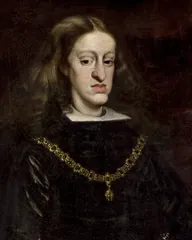
Facts and their sources
- Born6 Nov 1661, MadridVerified · Vitrine1 source
- TitlePrince of Asturias, 1661–1665or monarch of the Crown of Aragon, 1665–1700 · Monarch of Castile and Leon, 1665–1700Verified · Vitrine1 source
- Titlemonarch of the Crown of Aragon, 1665–1700or Prince of Asturias, 1661–1665 · Monarch of Castile and Leon, 1665–1700Verified · Vitrine1 source
- TitleMonarch of Castile and Leon, 1665–1700or Prince of Asturias, 1661–1665 · monarch of the Crown of Aragon, 1665–1700Verified · Vitrine1 source
- EventOath of the Fueros de Aragón, 1677Verified · Vitrine1 source
- Died1 Nov 1700, MadridVerified · Vitrine1 source
A life in time
1661–1665
Prince of Asturias
6 Nov 1661
Born in Madrid
1665–1700
Monarch of the Crown of Aragon
1665–1700
Monarch of Castile and Leon
1677
Oath of the Fueros de Aragón
1 Nov 1700
Dies in Madrid, aged 38
Family
See the treeDuring his lifetime
He lived through 5 decades. Pick one to hear and see what it was like around Madrid.
General history, not a record about the family: each item says where it comes from.
The 1660s · Charles II is born in Madrid
What people wore
Cost of fashionable accessories in reales
In 1680, a vara (roughly 84 cm) of smoke-colored fabric for a mantle was valued at seven and a half reales, while a luxurious fan could cost as much as six escudos. These prices illustrate the significant investment required for fashionable accessories, which were sometimes bought at the expense of necessities like basic clothing for the poor.
Daily life
Water access for common households
Ordinary people often lacked access to private wells or fountains, relying on water carriers to bring them fresh water.
Work
Young female olive pickers in gangs
Female olive pickers in Mallorca began working as early as 13 years old, and gangs of pickers frequently consisted of related family members, such as mothers, sisters, and brothers.
Music
Church music featured multi-choir villancicos
Religious festivals like Corpus Christi featured elaborate musical performances in churches, including villancicos sung by multiple choirs accompanied by instruments.
At the table
Wine replaced unsafe drinking water
Ordinary families often drank wine instead of water because water was frequently contaminated, and wine provided necessary calories. Wine was typically consumed diluted, sometimes mixed with spices.
Getting around
Common modes of travel in mid-17th century Spain
During the mid-17th century, ordinary people primarily traveled on foot or horseback. Specialized transport like litters, pulled by mules, or human-powered sedan chairs were used in exceptional cases.
What it cost
Cost of bread and beef in 1665
In 1665, a pound of bread cost 37.6 maravedíes, while a kilogram of beef cost 52 maravedíes.