

%20{%20.f%20{%20fill:%20%23EE7466%20}%20.s%20{%20stroke:%20%23EE7466%20}%20}%3c/style%3e%3cdefs%3e%3cfilter%20id='ink-fav'%20x='-5%25'%20y='-5%25'%20width='110%25'%20height='110%25'%3e%3cfeTurbulence%20type='fractalNoise'%20baseFrequency='0.9'%20numOctaves='2'%20seed='7'%20result='n'/%3e%3cfeDisplacementMap%20in='SourceGraphic'%20in2='n'%20scale='2.2'%20result='d'/%3e%3cfeTurbulence%20type='fractalNoise'%20baseFrequency='0.05'%20numOctaves='3'%20seed='18'%20result='blot'/%3e%3cfeColorMatrix%20in='blot'%20type='matrix'%20values='0%200%200%200%200%200%200%200%200%200%200%200%200%200%200%200%200%200%20-1.5%201.62'%20result='m1'/%3e%3cfeTurbulence%20type='fractalNoise'%20baseFrequency='1.6'%20numOctaves='1'%20seed='12'%20result='grain'/%3e%3cfeColorMatrix%20in='grain'%20type='matrix'%20values='0%200%200%200%200%200%200%200%200%200%200%200%200%200%200%200%200%200%20-2.4%202.25'%20result='m2'/%3e%3cfeComposite%20in='m1'%20in2='m2'%20operator='arithmetic'%20k1='1'/%3e%3cfeComposite%20in='d'%20operator='in'/%3e%3c/filter%3e%3c/defs%3e%3cg%20filter='url(%23ink-fav)'%20transform='rotate(-6%2080%2080)'%3e%3ccircle%20class='s'%20cx='80'%20cy='80'%20r='69'%20fill='none'%20stroke-width='16'/%3e%3cpath%20class='f'%20d='M47.33%2044.42Q46.25%2041.94%2045.01%2040.64Q43.77%2039.35%2041.71%2038.75Q39.66%2038.16%2035.67%2037.84L35.67%2033.84L80.16%2033.84L80.16%2037.84Q74.11%2038.27%2071.85%2039.13Q69.58%2040%2069.58%2042.05Q69.58%2043.24%2070.23%2045.07L86.32%2089.57L86.97%2089.57L102.3%2049.61Q103.38%2046.8%20103.38%2044.75Q103.38%2041.83%20100.68%2040.27Q97.98%2038.7%2091.39%2037.84L91.39%2033.84L124.77%2033.84L124.77%2037.84Q119.69%2038.59%20117.15%2039.67Q114.61%2040.75%20113.05%2042.97Q111.48%2045.18%20109.65%2049.82L82.97%20118.08L77.79%20118.08L47.33%2044.42Z'/%3e%3c/g%3e%3c/svg%3e)
In the news1842
Freedom of movement laws in 1842
Prussia introduced new laws enabling greater freedom of movement and settlement for individuals not dependent on public relief.
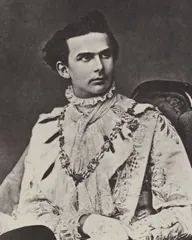
Nymphenburg Palace, 25 Aug 1845 – Lake Starnberg, 13 Jun 1886
12 facts3 sources
25 Aug 1845
Born in Nymphenburg Palace
1864–1886
King of Bavaria
1867
Engagement
1886
Incapacitation
13 Jun 1886
Dies in Lake Starnberg, aged 40
He lived through 5 decades. Pick one to hear and see what it was like around Nymphenburg Palace.
General history, not a record about the family: each item says where it comes from.
In the news1842
Prussia introduced new laws enabling greater freedom of movement and settlement for individuals not dependent on public relief.
What people wore
Saving fabric with the Magsachte patch
Women saved money on expensive fabric by sewing a hidden patch of coarser linen, called a Magsachte, onto their dresses where it would be covered by an apron.
Daily life
Homes heated by smoky, open hearths
Peasant homes often lacked chimneys, relying on open hearths that provided both light and heat while filling the living space with smoke. Small bundles of green pine brush, known as Kulelkes, were commonly used as fuel for these fires.
In the news1844
Handloom weavers in Upper Silesia led a famous protest against their publishers due to harsh competition from mechanized factories.
Music
Daily castle tower music in Königsberg
City tower musicians performed chorales daily from Königsberg's castle tower, such as 'Ich weiß mein Gott, daß all mein Tun' at 11 am and 'Nun ruhen alle Wälder' at 9 pm.
In Europe1845–1852
Potato blight ruined harvests: a million Irish people died and a million more emigrated, many to America.
Getting around
Faster express coaches were costly
The introduction of the "Diligence" or express post coach in 1821 allowed for faster travel at speeds of around 10 km/h, making trips of 100 km possible in a single day. However, travel remained expensive, with a short trip from Berlin to Magdeburg costing four talers, nearly a schoolteacher's monthly salary.