

%20{%20.f%20{%20fill:%20%23EE7466%20}%20.s%20{%20stroke:%20%23EE7466%20}%20}%3c/style%3e%3cdefs%3e%3cfilter%20id='ink-fav'%20x='-5%25'%20y='-5%25'%20width='110%25'%20height='110%25'%3e%3cfeTurbulence%20type='fractalNoise'%20baseFrequency='0.9'%20numOctaves='2'%20seed='7'%20result='n'/%3e%3cfeDisplacementMap%20in='SourceGraphic'%20in2='n'%20scale='2.2'%20result='d'/%3e%3cfeTurbulence%20type='fractalNoise'%20baseFrequency='0.05'%20numOctaves='3'%20seed='18'%20result='blot'/%3e%3cfeColorMatrix%20in='blot'%20type='matrix'%20values='0%200%200%200%200%200%200%200%200%200%200%200%200%200%200%200%200%200%20-1.5%201.62'%20result='m1'/%3e%3cfeTurbulence%20type='fractalNoise'%20baseFrequency='1.6'%20numOctaves='1'%20seed='12'%20result='grain'/%3e%3cfeColorMatrix%20in='grain'%20type='matrix'%20values='0%200%200%200%200%200%200%200%200%200%200%200%200%200%200%200%200%200%20-2.4%202.25'%20result='m2'/%3e%3cfeComposite%20in='m1'%20in2='m2'%20operator='arithmetic'%20k1='1'/%3e%3cfeComposite%20in='d'%20operator='in'/%3e%3c/filter%3e%3c/defs%3e%3cg%20filter='url(%23ink-fav)'%20transform='rotate(-6%2080%2080)'%3e%3ccircle%20class='s'%20cx='80'%20cy='80'%20r='69'%20fill='none'%20stroke-width='16'/%3e%3cpath%20class='f'%20d='M47.33%2044.42Q46.25%2041.94%2045.01%2040.64Q43.77%2039.35%2041.71%2038.75Q39.66%2038.16%2035.67%2037.84L35.67%2033.84L80.16%2033.84L80.16%2037.84Q74.11%2038.27%2071.85%2039.13Q69.58%2040%2069.58%2042.05Q69.58%2043.24%2070.23%2045.07L86.32%2089.57L86.97%2089.57L102.3%2049.61Q103.38%2046.8%20103.38%2044.75Q103.38%2041.83%20100.68%2040.27Q97.98%2038.7%2091.39%2037.84L91.39%2033.84L124.77%2033.84L124.77%2037.84Q119.69%2038.59%20117.15%2039.67Q114.61%2040.75%20113.05%2042.97Q111.48%2045.18%20109.65%2049.82L82.97%20118.08L77.79%20118.08L47.33%2044.42Z'/%3e%3c/g%3e%3c/svg%3e)
Marie Antoinette
Hofburg Palace, 2 Nov 1755 – place de la Concorde, 16 Oct 1793
11 facts2 sources
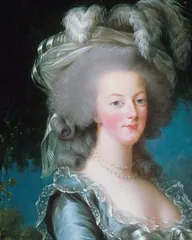
About Marie
Marie Antoinette: from Hofburg to the French court
AI-assisted · editedThe collection records Marie Antoinette’s birth in 1755 at Hofburg Palace. Her father was Francis I, Holy Roman Emperor, and her mother was Maria Theresa of Austria. 1Birth · 2 Nov 1755, Hofburg Palace · Probable2Parent · Francis I, Holy Roman Emperor · Confirmed3Parent · Maria Theresa of Austria · Confirmed
Marie Antoinette became Queen Consort of France through her marriage to Louis XVI. She held the position from 1774 until the abolition of the French monarchy in 1792 during the French Revolution. 4Title · Queen Consort of France · Confirmed5Union · Louis XVI of France · Confirmed6Known for · Marie Antoinette was Queen of France as the wife of Louis XVI from 10 May 1774 until the abolition of the French monarchy in 1792 during the French Revolution. · Probable
The collection associates Marie Antoinette with the French Revolution and identifies her as the last Queen of France before it. It records her death in 1793 at the Place de la Concorde. 7Event · French Revolution · Confirmed8Description · last Queen of France prior to the French Revolution (1755–1793) · Probable9Death · 16 Oct 1793, place de la Concorde · Probable
Drafted with AI and edited against the archive. Open a citation to see the record, its sources and how certain it is.
Facts and their sources
- Born2 Nov 1755, Hofburg PalaceVerified · Vitrine1 source
- TitleQueen Consort of FranceVerified · Vitrine1 source
- EventFrench RevolutionVerified · Vitrine1 source
- Died16 Oct 1793, place de la ConcordeVerified · Vitrine1 source
A life in time
2 Nov 1755
Born in Hofburg Palace
1778–1786
6 children are born
16 Oct 1793
Dies in place de la Concorde, aged 37
Family
See the treeParents
Partners
Children · 6
During her lifetime
She lived through 5 decades. Pick one to hear and see what it was like around Hofburg Palace.
General history, not a record about the family: each item says where it comes from.
The 1750s · Marie is born in Hofburg Palace
What people wore
Cleanliness as a mark of respectability
By the mid-eighteenth century, even people in lower wealth tiers in Vienna typically owned enough shirts and shifts to change them at least twice a week. Clean white linen was considered the standard for judging personal morality and respectability.
Getting around
Travel times by carriage in the 1700s
In the 18th century, a 30-kilometer trip between St. Pölten and Melk took 5 to 7 hours, while a 115-kilometer journey to St. Florian took 20 to 28 hours.
At the table
Affordable coffee substitute for the poor
Poorer residents drank a substitute for coffee made from roasted barley sweetened with syrup, which cost only 1 Kreuzer for a cup and a roll.
 Around the world · 1756–1763
The Seven Years’ War. Fought in Europe, the Americas, Africa and India, often called the first world war: Britain took Canada and India from France.
Music
The Ländler and Early Viennese Waltz
Around 1750, the Ländler, also known as the Schleifer, served as a popular country dance for couples and provided the foundation for the later Viennese waltz.
Daily life
Shared urban living in cramped quarters
For ordinary residents, homes were often cramped rented rooms in multi-story buildings where daily tasks like cooking, sleeping, and working were all performed in the same limited space. Families relied on neighborhood wells and fountains for water and had to manage heating through tiled stoves that required constant attention.
What it cost
Wedding music cost 33 gulden in 1755
In 1755, a wealthy merchant family paid 33 gulden for music for a wedding, which is equivalent to a significant luxury expense compared to everyday food costs.