

%20{%20.f%20{%20fill:%20%23EE7466%20}%20.s%20{%20stroke:%20%23EE7466%20}%20}%3c/style%3e%3cdefs%3e%3cfilter%20id='ink-fav'%20x='-5%25'%20y='-5%25'%20width='110%25'%20height='110%25'%3e%3cfeTurbulence%20type='fractalNoise'%20baseFrequency='0.9'%20numOctaves='2'%20seed='7'%20result='n'/%3e%3cfeDisplacementMap%20in='SourceGraphic'%20in2='n'%20scale='2.2'%20result='d'/%3e%3cfeTurbulence%20type='fractalNoise'%20baseFrequency='0.05'%20numOctaves='3'%20seed='18'%20result='blot'/%3e%3cfeColorMatrix%20in='blot'%20type='matrix'%20values='0%200%200%200%200%200%200%200%200%200%200%200%200%200%200%200%200%200%20-1.5%201.62'%20result='m1'/%3e%3cfeTurbulence%20type='fractalNoise'%20baseFrequency='1.6'%20numOctaves='1'%20seed='12'%20result='grain'/%3e%3cfeColorMatrix%20in='grain'%20type='matrix'%20values='0%200%200%200%200%200%200%200%200%200%200%200%200%200%200%200%200%200%20-2.4%202.25'%20result='m2'/%3e%3cfeComposite%20in='m1'%20in2='m2'%20operator='arithmetic'%20k1='1'/%3e%3cfeComposite%20in='d'%20operator='in'/%3e%3c/filter%3e%3c/defs%3e%3cg%20filter='url(%23ink-fav)'%20transform='rotate(-6%2080%2080)'%3e%3ccircle%20class='s'%20cx='80'%20cy='80'%20r='69'%20fill='none'%20stroke-width='16'/%3e%3cpath%20class='f'%20d='M47.33%2044.42Q46.25%2041.94%2045.01%2040.64Q43.77%2039.35%2041.71%2038.75Q39.66%2038.16%2035.67%2037.84L35.67%2033.84L80.16%2033.84L80.16%2037.84Q74.11%2038.27%2071.85%2039.13Q69.58%2040%2069.58%2042.05Q69.58%2043.24%2070.23%2045.07L86.32%2089.57L86.97%2089.57L102.3%2049.61Q103.38%2046.8%20103.38%2044.75Q103.38%2041.83%20100.68%2040.27Q97.98%2038.7%2091.39%2037.84L91.39%2033.84L124.77%2033.84L124.77%2037.84Q119.69%2038.59%20117.15%2039.67Q114.61%2040.75%20113.05%2042.97Q111.48%2045.18%20109.65%2049.82L82.97%20118.08L77.79%20118.08L47.33%2044.42Z'/%3e%3c/g%3e%3c/svg%3e)
In the news1884
Electric street lighting installed in 1884
In 1884, the first permanent electric street lighting system in the empire was installed in Temesvár.
Persenbeug Castle, 17 Aug 1887 – Funchal, 1 Apr 1922
14 facts3 sources
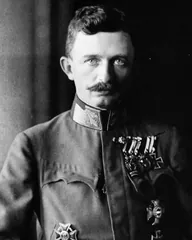
The collection records Charles I as born in 1887 at Persenbeug Castle. He was the son of Archduke Otto of Austria and Princess Maria Josepha of Saxony. 1Birth · 17 Aug 1887, Persenbeug Castle · Probable2Parent · Archduke Otto of Austria · Confirmed3Parent · Princess Maria Josepha of Saxony · Confirmed
Charles served as Emperor of Austria and Apostolic King of Hungary, with both titles recorded for 1916–1918. His coronation is recorded in 1916. The collection also describes him as the last monarch of Austria-Hungary, whose reign lasted from 1916 to 1918. 4Title · Emperor of Austria, 1916–1918 · Confirmed5Title · Apostolic King of Hungary, 1916–1918 · Confirmed6Event · coronation, 1916 · Confirmed7Description · Last monarch of Austria-Hungary (r. 1916–1918) · Probable
The collection also identifies Charles as Head of the House of Habsburg. It records his death in 1922 in Funchal. 8Title · Head of the House of Habsburg · Confirmed9Death · 1 Apr 1922, Funchal · Probable
Drafted with AI and edited against the archive. Open a citation to see the record, its sources and how certain it is.
17 Aug 1887
Born in Persenbeug Castle
1907–1916
Member of the House of Lords (Austria)
1912–1922
8 children are born
1916
Coronation
1916–1918
Apostolic King of Hungary
1916–1918
King of Bohemia
1916–1918
Emperor of Austria
1 Apr 1922
Dies in Funchal, aged 34
He lived through 5 decades. Pick one to hear and see what it was like around Persenbeug Castle.
General history, not a record about the family: each item says where it comes from.
Who governed
Monarch of Portugal, 1861–1889 · Kingdom of Portugal
Monarch of Portugal, 1889–1908 · Kingdom of Portugal
What people wore
Prankish feast day dessert centerpieces
At peasant feast day dinners, a dessert centerpiece was garnished with bows of bright ribbons, flowers, and deliberately hidden thorns and stinging nettles.
Getting around
Faster rail connections to Budapest
By 1900, the travel time for a direct train between Vienna and Budapest had been reduced to four and a half hours, down from the approximately six hours required when the line first opened.
At the table
Limited meat consumption for poor families
Poor industrial workers and families often survived on dry bread, with meat, such as boiled beef, appearing on their tables only during holidays or feasts.
Krakatoa erupts. The volcano in Indonesia exploded with a bang heard 4,800 km away, and its ash reddened sunsets around the world.
In the news1884
In 1884, the first permanent electric street lighting system in the empire was installed in Temesvár.
Music
Rural music instruments in Voralpen
In rural areas near the Semmering and Wechsel regions, music was often performed using the zither and the hammered dulcimer (Hackbrett). This contrasted with urban areas where violin and harp combinations were more common in taverns.
Daily life
Shared water taps in Vienna apartment buildings
In urban Vienna, many apartments lacked private water or toilets, requiring residents to fetch water from a shared tap in the corridor called a bassena.