

%20{%20.f%20{%20fill:%20%23EE7466%20}%20.s%20{%20stroke:%20%23EE7466%20}%20}%3c/style%3e%3cdefs%3e%3cfilter%20id='ink-fav'%20x='-5%25'%20y='-5%25'%20width='110%25'%20height='110%25'%3e%3cfeTurbulence%20type='fractalNoise'%20baseFrequency='0.9'%20numOctaves='2'%20seed='7'%20result='n'/%3e%3cfeDisplacementMap%20in='SourceGraphic'%20in2='n'%20scale='2.2'%20result='d'/%3e%3cfeTurbulence%20type='fractalNoise'%20baseFrequency='0.05'%20numOctaves='3'%20seed='18'%20result='blot'/%3e%3cfeColorMatrix%20in='blot'%20type='matrix'%20values='0%200%200%200%200%200%200%200%200%200%200%200%200%200%200%200%200%200%20-1.5%201.62'%20result='m1'/%3e%3cfeTurbulence%20type='fractalNoise'%20baseFrequency='1.6'%20numOctaves='1'%20seed='12'%20result='grain'/%3e%3cfeColorMatrix%20in='grain'%20type='matrix'%20values='0%200%200%200%200%200%200%200%200%200%200%200%200%200%200%200%200%200%20-2.4%202.25'%20result='m2'/%3e%3cfeComposite%20in='m1'%20in2='m2'%20operator='arithmetic'%20k1='1'/%3e%3cfeComposite%20in='d'%20operator='in'/%3e%3c/filter%3e%3c/defs%3e%3cg%20filter='url(%23ink-fav)'%20transform='rotate(-6%2080%2080)'%3e%3ccircle%20class='s'%20cx='80'%20cy='80'%20r='69'%20fill='none'%20stroke-width='16'/%3e%3cpath%20class='f'%20d='M47.33%2044.42Q46.25%2041.94%2045.01%2040.64Q43.77%2039.35%2041.71%2038.75Q39.66%2038.16%2035.67%2037.84L35.67%2033.84L80.16%2033.84L80.16%2037.84Q74.11%2038.27%2071.85%2039.13Q69.58%2040%2069.58%2042.05Q69.58%2043.24%2070.23%2045.07L86.32%2089.57L86.97%2089.57L102.3%2049.61Q103.38%2046.8%20103.38%2044.75Q103.38%2041.83%20100.68%2040.27Q97.98%2038.7%2091.39%2037.84L91.39%2033.84L124.77%2033.84L124.77%2037.84Q119.69%2038.59%20117.15%2039.67Q114.61%2040.75%20113.05%2042.97Q111.48%2045.18%20109.65%2049.82L82.97%20118.08L77.79%20118.08L47.33%2044.42Z'/%3e%3c/g%3e%3c/svg%3e)
In the news1593
Lutheranism established as the state religion
The Uppsala Synod affirmed the Evangelical Lutheran faith as the state religion, solidifying Sweden's break from the Catholic Church.
Also known as the Lion from the North (nickname)
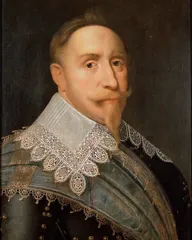
Stockholm Palace, 19 Dec 1594 – Lützen, 16 Nov 1632
13 facts3 sources
19 Dec 1594
Born in Stockholm Palace
1611–1632
Monarch of Sweden
1616–1626
2 children are born
16 Nov 1632
Dies in Lützen, aged 37
He lived through 5 decades. Pick one to hear and see what it was like around Stockholm Palace.
General history, not a record about the family: each item says where it comes from.
In the news1593
The Uppsala Synod affirmed the Evangelical Lutheran faith as the state religion, solidifying Sweden's break from the Catholic Church.
Getting around
Winter travel by sledge and guest house
Travelers often used sledges during winter, as road conditions were frequently difficult due to deep snow and ice. Hiring horses and drivers for these sledges was managed through a system of guest houses located about every two Swedish miles.
In the news1596–1598
General crop failures caused by severe weather led to widespread hardship and peasant unrest in Finland.
Daily life
Cramped winter living with livestock
In winter, peasant families lived in a single room with their young animals; infants slept in hanging wooden cradles, and other children slept near the baking oven for warmth. Households often kept the door threshold very high to keep young livestock inside the room.
What people wore
Working dress for women
Peasant women often worked in long linen chemises, sometimes tying a knot in the skirt to move more easily while performing daily tasks.
Music
Instruments for song and dance
Common instruments used by people for singing and dancing included the flute, drum, fiddle, lute, and bagpipe.
At the table
Beaver Served as Fasting Fish
Beaver was consumed as a fish substitute on fasting days because people believed it was a water-dwelling animal that swam using its tail. This allowed it to be eaten during the religious periods when meat was prohibited.