

%20{%20.f%20{%20fill:%20%23EE7466%20}%20.s%20{%20stroke:%20%23EE7466%20}%20}%3c/style%3e%3cdefs%3e%3cfilter%20id='ink-fav'%20x='-5%25'%20y='-5%25'%20width='110%25'%20height='110%25'%3e%3cfeTurbulence%20type='fractalNoise'%20baseFrequency='0.9'%20numOctaves='2'%20seed='7'%20result='n'/%3e%3cfeDisplacementMap%20in='SourceGraphic'%20in2='n'%20scale='2.2'%20result='d'/%3e%3cfeTurbulence%20type='fractalNoise'%20baseFrequency='0.05'%20numOctaves='3'%20seed='18'%20result='blot'/%3e%3cfeColorMatrix%20in='blot'%20type='matrix'%20values='0%200%200%200%200%200%200%200%200%200%200%200%200%200%200%200%200%200%20-1.5%201.62'%20result='m1'/%3e%3cfeTurbulence%20type='fractalNoise'%20baseFrequency='1.6'%20numOctaves='1'%20seed='12'%20result='grain'/%3e%3cfeColorMatrix%20in='grain'%20type='matrix'%20values='0%200%200%200%200%200%200%200%200%200%200%200%200%200%200%200%200%200%20-2.4%202.25'%20result='m2'/%3e%3cfeComposite%20in='m1'%20in2='m2'%20operator='arithmetic'%20k1='1'/%3e%3cfeComposite%20in='d'%20operator='in'/%3e%3c/filter%3e%3c/defs%3e%3cg%20filter='url(%23ink-fav)'%20transform='rotate(-6%2080%2080)'%3e%3ccircle%20class='s'%20cx='80'%20cy='80'%20r='69'%20fill='none'%20stroke-width='16'/%3e%3cpath%20class='f'%20d='M47.33%2044.42Q46.25%2041.94%2045.01%2040.64Q43.77%2039.35%2041.71%2038.75Q39.66%2038.16%2035.67%2037.84L35.67%2033.84L80.16%2033.84L80.16%2037.84Q74.11%2038.27%2071.85%2039.13Q69.58%2040%2069.58%2042.05Q69.58%2043.24%2070.23%2045.07L86.32%2089.57L86.97%2089.57L102.3%2049.61Q103.38%2046.8%20103.38%2044.75Q103.38%2041.83%20100.68%2040.27Q97.98%2038.7%2091.39%2037.84L91.39%2033.84L124.77%2033.84L124.77%2037.84Q119.69%2038.59%20117.15%2039.67Q114.61%2040.75%20113.05%2042.97Q111.48%2045.18%20109.65%2049.82L82.97%20118.08L77.79%20118.08L47.33%2044.42Z'/%3e%3c/g%3e%3c/svg%3e)
Joseph II, Holy Roman Emperor
Vienna, 1741 – Vienna, 20 Feb 1790
15 facts3 sources
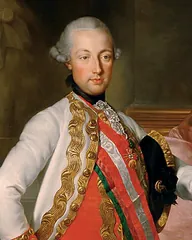
About Joseph
Joseph II: Imperial Rule and Habsburg Family
AI-assisted · editedThe collection records Joseph II’s birth in Vienna in 1741 and his death in Vienna in 1790; both entries are marked probable and disputed. He served as Holy Roman Emperor from 1765 to 1790. 1Birth · 1741, Vienna · Probable2Death · 20 Feb 1790, Vienna · Probable3Title · Holy Roman Emperor, 1765–1790 · Confirmed
He was also Apostolic King of Hungary from 1780 to 1790. The collection records his union with Maria Josepha of Bavaria, and this union is marked confirmed. 4Title · Apostolic King of Hungary, 1780–1790 · Confirmed5Union · Maria Josepha of Bavaria · Confirmed
The collection’s summary identifies Joseph as the eldest son of Empress Maria Theresa and Emperor Francis I, and names Leopold II among his brothers. The parent records separately link him to Maria Theresa and Francis. 6Known for · Joseph II was Holy Roman Emperor from 18 August 1765 and sole ruler of the Habsburg monarchy from 29 November 1780 until his death. He was the eldest son of Empress Maria Theresa and her husband, Emperor Francis I, and the brother of Marie Antoinette, Leopold II, Maria Carolina of Austria, and Maria Amalia, Duchess of Parma. · Probable7Parent · Maria Theresa of Austria · Confirmed8Parent · Francis I, Holy Roman Emperor · Confirmed
Drafted with AI and edited against the archive. Open a citation to see the record, its sources and how certain it is.
Facts and their sources
- Born1741, ViennaRecords disagree1 source
- TitlePrince-Electoror Holy Roman Emperor, 1765–1790 · Apostolic King of Hungary, 1780–1790 · King of Bohemia, 1780–1790Verified · Vitrine1 source
- TitleHoly Roman Emperor, 1765–1790or Apostolic King of Hungary, 1780–1790 · King of Bohemia, 1780–1790 · Prince-ElectorVerified · Vitrine1 source
- TitleApostolic King of Hungary, 1780–1790or Holy Roman Emperor, 1765–1790 · King of Bohemia, 1780–1790 · Prince-ElectorVerified · Vitrine1 source
- TitleKing of Bohemia, 1780–1790or Holy Roman Emperor, 1765–1790 · Apostolic King of Hungary, 1780–1790 · Prince-ElectorVerified · Vitrine1 source
- Died20 Feb 1790, ViennaRecords disagree1 source
A life in time
1741
Born in Vienna
1762–1763
2 children are born
1765–1790
Holy Roman Emperor
1780–1790
Apostolic King of Hungary
1780–1790
King of Bohemia
20 Feb 1790
Dies in Vienna
Family
See the treeParents
Partners
Children · 2
During his lifetime
He lived through 6 decades. Pick one to hear and see what it was like around Vienna.
General history, not a record about the family: each item says where it comes from.
The 1740s · Joseph is born in Vienna
What people wore
Feast day versus daily wear
For feast days, people wore finer clothing, such as a blouse made of fine linen, whereas daily work clothes were made of coarse linen.
Getting around
Slow boat transport on the Inn River
In 1745, a boat trip on the Inn River between Kufstein and Hall took eight days, requiring 50 to 60 horses for towing.
At the table
Meager diet of the common people
The vast majority of the population ate very meagerly, relying on dishes made from legumes like peas, beans, and lentils, as well as porridges made from millet, oats, or barley. Meat was only rarely served to the common person.
 In Europe · 1740–1748
War of the Austrian Succession. When Maria Theresa inherited the Habsburg lands, Prussia seized Silesia and much of Europe joined the fight.
Music
Masquerade balls were a social highlight
During the carnival season, masquerade balls were highly popular, with noble guests often wearing costumes of lower social orders, such as cooks, servants, or exotic figures.
Daily life
Feeding children with bread-based pap
It was fashionable to feed young children a semisolid pap made of flour or bread cooked in water or milk to keep them quiet. Wealthy households often employed wet nurses and nannies to assist with the demands of child care.
What it cost
Vienna wages and meat prices 1749
By 1749, the daily wage for a worker in Vienna remained 15 Kreuzer, but the price of beef had risen to 8.93 Kreuzer per kilogram.