

%20{%20.f%20{%20fill:%20%23EE7466%20}%20.s%20{%20stroke:%20%23EE7466%20}%20}%3c/style%3e%3cdefs%3e%3cfilter%20id='ink-fav'%20x='-5%25'%20y='-5%25'%20width='110%25'%20height='110%25'%3e%3cfeTurbulence%20type='fractalNoise'%20baseFrequency='0.9'%20numOctaves='2'%20seed='7'%20result='n'/%3e%3cfeDisplacementMap%20in='SourceGraphic'%20in2='n'%20scale='2.2'%20result='d'/%3e%3cfeTurbulence%20type='fractalNoise'%20baseFrequency='0.05'%20numOctaves='3'%20seed='18'%20result='blot'/%3e%3cfeColorMatrix%20in='blot'%20type='matrix'%20values='0%200%200%200%200%200%200%200%200%200%200%200%200%200%200%200%200%200%20-1.5%201.62'%20result='m1'/%3e%3cfeTurbulence%20type='fractalNoise'%20baseFrequency='1.6'%20numOctaves='1'%20seed='12'%20result='grain'/%3e%3cfeColorMatrix%20in='grain'%20type='matrix'%20values='0%200%200%200%200%200%200%200%200%200%200%200%200%200%200%200%200%200%20-2.4%202.25'%20result='m2'/%3e%3cfeComposite%20in='m1'%20in2='m2'%20operator='arithmetic'%20k1='1'/%3e%3cfeComposite%20in='d'%20operator='in'/%3e%3c/filter%3e%3c/defs%3e%3cg%20filter='url(%23ink-fav)'%20transform='rotate(-6%2080%2080)'%3e%3ccircle%20class='s'%20cx='80'%20cy='80'%20r='69'%20fill='none'%20stroke-width='16'/%3e%3cpath%20class='f'%20d='M47.33%2044.42Q46.25%2041.94%2045.01%2040.64Q43.77%2039.35%2041.71%2038.75Q39.66%2038.16%2035.67%2037.84L35.67%2033.84L80.16%2033.84L80.16%2037.84Q74.11%2038.27%2071.85%2039.13Q69.58%2040%2069.58%2042.05Q69.58%2043.24%2070.23%2045.07L86.32%2089.57L86.97%2089.57L102.3%2049.61Q103.38%2046.8%20103.38%2044.75Q103.38%2041.83%20100.68%2040.27Q97.98%2038.7%2091.39%2037.84L91.39%2033.84L124.77%2033.84L124.77%2037.84Q119.69%2038.59%20117.15%2039.67Q114.61%2040.75%20113.05%2042.97Q111.48%2045.18%20109.65%2049.82L82.97%20118.08L77.79%20118.08L47.33%2044.42Z'/%3e%3c/g%3e%3c/svg%3e)
In the news1716
Foundation of Law's Bank in 1716
John Law established the Banque Générale in 1716, which later issued paper bank notes guaranteed by the king to stimulate the economy.
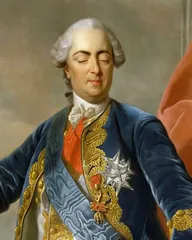
Also known as Louis the Beloved (epithet)
Versailles, 15 Feb 1710 – Versailles, 10 May 1774
10 facts3 sources
The collection records Louis XV’s birth in 1710 at Versailles and his death there in 1774. His father was Louis, Dauphin of France, Duke of Burgundy, and his mother was Marie Adélaïde of Savoy, placing him within the French royal family. 1Birth · 15 Feb 1710, Versailles · Probable2Death · 10 May 1774, Versailles · Probable3Parent · Louis, Dauphin of France, Duke of Burgundy · Confirmed4Parent · Marie Adélaïde of Savoy · Confirmed
Louis XV, also known as Louis the Beloved, held the title King of France and Navarre from 1715 until 1774. He succeeded his great-grandfather Louis XIV at the age of five, beginning his reign as a child monarch. 5Title · King of France and Navarre, 1715–1774 · Confirmed6Known for · Louis XV, known as Louis the Beloved, was King of France from 1 September 1715 until his death in 1774. He succeeded his great-grandfather Louis XIV at the age of five. Until he reached maturity in 1723, the kingdom was ruled by his grand-uncle Philippe II, Duke of Orléans, as Regent of France. · Probable
Until Louis reached maturity in 1723, the kingdom was ruled by his grand-uncle Philippe II, Duke of Orléans, as Regent of France. His early kingship therefore unfolded within a regency established while he was still a child. 6Known for · Louis XV, known as Louis the Beloved, was King of France from 1 September 1715 until his death in 1774. He succeeded his great-grandfather Louis XIV at the age of five. Until he reached maturity in 1723, the kingdom was ruled by his grand-uncle Philippe II, Duke of Orléans, as Regent of France. · Probable
Drafted with AI and edited against the archive. Open a citation to see the record, its sources and how certain it is.
15 Feb 1710
Born in Versailles
1715–1774
King of France and Navarre
1727–1764
19 children are born
10 May 1774
Dies in Versailles, aged 64
He lived through 7 decades. Pick one to hear and see what it was like around Versailles.
General history, not a record about the family: each item says where it comes from.
In the news1716
John Law established the Banque Générale in 1716, which later issued paper bank notes guaranteed by the king to stimulate the economy.
What people wore
Origin of the term Grisette
The term grisette described poor working-class women, named after the simple gray woolen cloth used to make their dresses.
Getting around
Travel times between major French cities
Traveling between cities often involved water coaches (coches d'eau) for rivers or road carriages, with a journey from Lyon to Paris taking six days at a slow pace or three days at a faster pace in 1742.
 In Europe · 1700–1721
The Great Northern War. Russia, Denmark and Saxony fought Sweden for the Baltic; Peter the Great won and built St Petersburg on the conquered coast.
In the news1709–1710
The Great Winter of 1709 brought extreme cold and severe famine to France, marking one of the century's worst economic crises.
Music
Teaching Dance via Written Notation
Dance masters used specialized choreographic notation created by Raoul Auger Feuillet to distribute and teach new dance steps between Paris and the provinces. By 1721, collections contained dozens of dances composed by masters like Pécour and Balon for the French court.
Daily life
Intense use of single-room dwellings
Ordinary homes often consisted of a single room used for all daily activities, including cooking, sleeping, and childcare, with furniture rearranged throughout the day. In rural areas, houses were typically made of wattle and daub with thatched roofs, often lacking glass windows and floorboards.