

%20{%20.f%20{%20fill:%20%23EE7466%20}%20.s%20{%20stroke:%20%23EE7466%20}%20}%3c/style%3e%3cdefs%3e%3cfilter%20id='ink-fav'%20x='-5%25'%20y='-5%25'%20width='110%25'%20height='110%25'%3e%3cfeTurbulence%20type='fractalNoise'%20baseFrequency='0.9'%20numOctaves='2'%20seed='7'%20result='n'/%3e%3cfeDisplacementMap%20in='SourceGraphic'%20in2='n'%20scale='2.2'%20result='d'/%3e%3cfeTurbulence%20type='fractalNoise'%20baseFrequency='0.05'%20numOctaves='3'%20seed='18'%20result='blot'/%3e%3cfeColorMatrix%20in='blot'%20type='matrix'%20values='0%200%200%200%200%200%200%200%200%200%200%200%200%200%200%200%200%200%20-1.5%201.62'%20result='m1'/%3e%3cfeTurbulence%20type='fractalNoise'%20baseFrequency='1.6'%20numOctaves='1'%20seed='12'%20result='grain'/%3e%3cfeColorMatrix%20in='grain'%20type='matrix'%20values='0%200%200%200%200%200%200%200%200%200%200%200%200%200%200%200%200%200%20-2.4%202.25'%20result='m2'/%3e%3cfeComposite%20in='m1'%20in2='m2'%20operator='arithmetic'%20k1='1'/%3e%3cfeComposite%20in='d'%20operator='in'/%3e%3c/filter%3e%3c/defs%3e%3cg%20filter='url(%23ink-fav)'%20transform='rotate(-6%2080%2080)'%3e%3ccircle%20class='s'%20cx='80'%20cy='80'%20r='69'%20fill='none'%20stroke-width='16'/%3e%3cpath%20class='f'%20d='M47.33%2044.42Q46.25%2041.94%2045.01%2040.64Q43.77%2039.35%2041.71%2038.75Q39.66%2038.16%2035.67%2037.84L35.67%2033.84L80.16%2033.84L80.16%2037.84Q74.11%2038.27%2071.85%2039.13Q69.58%2040%2069.58%2042.05Q69.58%2043.24%2070.23%2045.07L86.32%2089.57L86.97%2089.57L102.3%2049.61Q103.38%2046.8%20103.38%2044.75Q103.38%2041.83%20100.68%2040.27Q97.98%2038.7%2091.39%2037.84L91.39%2033.84L124.77%2033.84L124.77%2037.84Q119.69%2038.59%20117.15%2039.67Q114.61%2040.75%20113.05%2042.97Q111.48%2045.18%20109.65%2049.82L82.97%20118.08L77.79%20118.08L47.33%2044.42Z'/%3e%3c/g%3e%3c/svg%3e)
In the news1775
The Flour War of 1775
The Flour War of 1775 involved widespread riots across northern France after grain trade deregulation caused bread prices to rise by over 50 percent.
Paris, 6 Oct 1773 – Claremont, 26 Aug 1850
13 facts3 sources
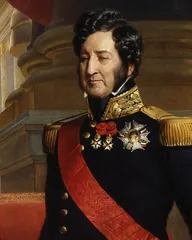
The collection records Louis-Philippe I’s birth in Paris in 1773. He was the son of Louis Philippe II, Duke of Orléans, and Louise Marie Adélaïde de Bourbon. Before his accession, he held the title Duke of Orléans. 1Birth · 6 Oct 1773, Paris · Probable2Parent · Louis Philippe II, Duke of Orléans · Confirmed3Parent · Louise Marie Adélaïde de Bourbon · Confirmed4Title · Duke of Orléans, 1793–1830 · Confirmed
In 1830, Louis-Philippe became King of the French, serving until 1848. He also held the office of French co-prince of Andorra. 5Title · King of the French, 1830–1848 · Confirmed6Title · head of government of France, 1830 · Confirmed7Title · French co-prince of Andorra, 1830–1848 · Confirmed8Title · Pair of France · Confirmed
Known as the Citizen King, Louis-Philippe I abdicated during the French Revolution of 1848, which led to the establishment of the French Second Republic. The collection records his death in Claremont in 1850. 9Known for · Louis Philippe I, nicknamed the Citizen King, was King of the French from 1830 to 1848, the penultimate monarch of France, the last French monarch to bear the title "King", and the only French monarch to descend from the Orléans branch of the Bourbon family. He abdicated from his throne during the French Revolution of 1848, which led to the foundation of the French Second Republic. · Probable10Death · 26 Aug 1850, Claremont · Probable
Drafted with AI and edited against the archive. Open a citation to see the record, its sources and how certain it is.
6 Oct 1773
Born in Paris
1793–1830
Duke of Orléans
1810–1824
10 children are born
1830
Head of government of France
1830–1848
French co-prince of Andorra
1830–1848
King of the French
26 Aug 1850
Dies in Claremont, aged 76
He lived through 9 decades. Pick one to hear and see what it was like around Paris.
General history, not a record about the family: each item says where it comes from.
In the news1775
The Flour War of 1775 involved widespread riots across northern France after grain trade deregulation caused bread prices to rise by over 50 percent.
What people wore
Common clothing colors
Common women’s clothing colors were mostly dark, with black, gray, and brown making up 45 percent of garments, while red accounted for 21 percent.
Getting around
Rapid descent by ramasse sled
When crossing the snowy Mount Cenis pass in the Alps, travelers could descend into Lanslebourg in just 15 minutes using a specialized sled called a ramasse.
 Around the world · 1769–1776
Watt’s steam engine. James Watt’s much more efficient steam engine, patented in 1769, powered the mills and mines of the Industrial Revolution.
In the news1772
Lord Mansfield ruled in 1772 that slavery was not supported by the common law of England, effectively outlawing it.
Music
Wind instruments dominated outdoor civic festivals
Wind instruments, especially the bassoon-serpent, were highly prized for outdoor festivities and civic celebrations because they were loud enough to be heard by large crowds. During the Revolution, the government promoted powerful patriotic hymns like La Marseillaise, often played by wind ensembles to help mobilize and unify citizens.
Daily life
Limited rural schooling
In many rural areas, primary education was inconsistently provided by the local priest or his vicar, focusing only on basic reading, writing, and catechism.