

%20{%20.f%20{%20fill:%20%23EE7466%20}%20.s%20{%20stroke:%20%23EE7466%20}%20}%3c/style%3e%3cdefs%3e%3cfilter%20id='ink-fav'%20x='-5%25'%20y='-5%25'%20width='110%25'%20height='110%25'%3e%3cfeTurbulence%20type='fractalNoise'%20baseFrequency='0.9'%20numOctaves='2'%20seed='7'%20result='n'/%3e%3cfeDisplacementMap%20in='SourceGraphic'%20in2='n'%20scale='2.2'%20result='d'/%3e%3cfeTurbulence%20type='fractalNoise'%20baseFrequency='0.05'%20numOctaves='3'%20seed='18'%20result='blot'/%3e%3cfeColorMatrix%20in='blot'%20type='matrix'%20values='0%200%200%200%200%200%200%200%200%200%200%200%200%200%200%200%200%200%20-1.5%201.62'%20result='m1'/%3e%3cfeTurbulence%20type='fractalNoise'%20baseFrequency='1.6'%20numOctaves='1'%20seed='12'%20result='grain'/%3e%3cfeColorMatrix%20in='grain'%20type='matrix'%20values='0%200%200%200%200%200%200%200%200%200%200%200%200%200%200%200%200%200%20-2.4%202.25'%20result='m2'/%3e%3cfeComposite%20in='m1'%20in2='m2'%20operator='arithmetic'%20k1='1'/%3e%3cfeComposite%20in='d'%20operator='in'/%3e%3c/filter%3e%3c/defs%3e%3cg%20filter='url(%23ink-fav)'%20transform='rotate(-6%2080%2080)'%3e%3ccircle%20class='s'%20cx='80'%20cy='80'%20r='69'%20fill='none'%20stroke-width='16'/%3e%3cpath%20class='f'%20d='M47.33%2044.42Q46.25%2041.94%2045.01%2040.64Q43.77%2039.35%2041.71%2038.75Q39.66%2038.16%2035.67%2037.84L35.67%2033.84L80.16%2033.84L80.16%2037.84Q74.11%2038.27%2071.85%2039.13Q69.58%2040%2069.58%2042.05Q69.58%2043.24%2070.23%2045.07L86.32%2089.57L86.97%2089.57L102.3%2049.61Q103.38%2046.8%20103.38%2044.75Q103.38%2041.83%20100.68%2040.27Q97.98%2038.7%2091.39%2037.84L91.39%2033.84L124.77%2033.84L124.77%2037.84Q119.69%2038.59%20117.15%2039.67Q114.61%2040.75%20113.05%2042.97Q111.48%2045.18%20109.65%2049.82L82.97%20118.08L77.79%20118.08L47.33%2044.42Z'/%3e%3c/g%3e%3c/svg%3e)
In the news1563
Statute of Artificers passed in 1563
The 1563 Statute of Artificers regulated wages and mandatory seven-year apprenticeships for laborers across the kingdom.
Edinburgh Castle, 29 Jun 1566 – Theobalds House, 6 Apr 1625
24 facts3 sources
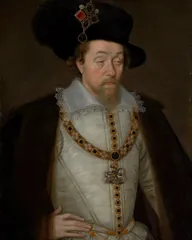
The collection records James’s birth in 1566 at Edinburgh Castle. His parents were Henry Stuart, Lord Darnley, and Mary, Queen of Scots. His early public life is associated with his baptism, his entry into Edinburgh, and his coronation as James VI of Scotland. 1Birth · 29 Jun 1566, Edinburgh Castle · Probable2Parent · Henry Stuart, Lord Darnley · Confirmed3Parent · Mary, Queen of Scots · Confirmed4Event · Baptism of James VI · Confirmed5Event · Entry of James VI into Edinburgh · Confirmed6Event · coronation of James VI of Scotland · Confirmed
James ruled as monarch of Scotland and, from 1603, as monarch of England and King of Ireland. The evidence presents a chronological discrepancy: one title claim dates his Scottish tenure from 1587, while the summary dates his reign as James VI from 1567. The Union of the Crowns links his Scottish and English identities. 7Title · Monarch of Scotland, 1587–1625 · Confirmed8Title · Monarch of England, 1603–1625 · Confirmed9Title · King of Ireland, 1603–1625 · Confirmed10Known for · James VI and I was King of Scotland as James VI from 24 July 1567, and King of England and Ireland as James I from the union of the Scottish and English crowns on 24 March 1603, until his death in 1625. · Probable11Event · Union of the Crowns · Confirmed
His rule is associated with the Jacobean era, the succession to Elizabeth I of England, and the Gunpowder Plot. The collection records his death in 1625 at Theobalds House, although this date and place are marked as probable rather than fully confirmed. 12Event · Jacobean era · Confirmed13Event · succession to Elizabeth I of England · Confirmed14Event · Gunpowder Plot · Confirmed15Death · 6 Apr 1625, Theobalds House · Probable
Drafted with AI and edited against the archive. Open a citation to see the record, its sources and how certain it is.
1566–1587
Duke of Rothesay
29 Jun 1566
Born in Edinburgh Castle
1587–1625
Monarch of Scotland
1594–1606
9 children are born
1603–1625
King of Ireland
1603–1625
Monarch of England
6 Apr 1625
Dies in Theobalds House, aged 58
He lived through 7 decades. Pick one to hear and see what it was like around Edinburgh Castle.
General history, not a record about the family: each item says where it comes from.
In the news1563
The 1563 Statute of Artificers regulated wages and mandatory seven-year apprenticeships for laborers across the kingdom.
Getting around
Navigation via Itineraries and Group Travel
Travelers often used itineraries listing destination towns and distances, as maps were large, expensive, and not highly detailed. People frequently traveled together for guidance and safety on roads that were often unpaved and rutted.
In the news1569
England's first known lottery was drawn in 1569 outside St Paul's Cathedral, with tickets costing ten shillings and a top prize of £5,000.
Daily life
Dark and smoky living conditions
Homes for the poor were extremely dark, having only small holes in walls for windows, and were filled with thick smoke because hearths lacked chimneys. Lighting was a luxury, as candles were expensive for ordinary families.
What people wore
Durable Fabrics for Commoners
Commoners used durable fabrics like linen, hemp canvas, and lockram for daily tasks and sometimes replaced worn hems with more resilient material to extend the life of their clothes.
Music
Musicians and Lucky Charms at Weddings
Musicians were highly valued at village weddings, where a bride might tie a ribbon around a bagpiper's drone as a lucky charm to bring fortune to the marriage.
At the table
Daily Ale and Beer Consumption
Ordinary people drank about one gallon of ale or beer per person daily because it was safer than potentially contaminated water. This low-alcohol drink was consumed by everyone, including children, throughout the day.