

%20{%20.f%20{%20fill:%20%23EE7466%20}%20.s%20{%20stroke:%20%23EE7466%20}%20}%3c/style%3e%3cdefs%3e%3cfilter%20id='ink-fav'%20x='-5%25'%20y='-5%25'%20width='110%25'%20height='110%25'%3e%3cfeTurbulence%20type='fractalNoise'%20baseFrequency='0.9'%20numOctaves='2'%20seed='7'%20result='n'/%3e%3cfeDisplacementMap%20in='SourceGraphic'%20in2='n'%20scale='2.2'%20result='d'/%3e%3cfeTurbulence%20type='fractalNoise'%20baseFrequency='0.05'%20numOctaves='3'%20seed='18'%20result='blot'/%3e%3cfeColorMatrix%20in='blot'%20type='matrix'%20values='0%200%200%200%200%200%200%200%200%200%200%200%200%200%200%200%200%200%20-1.5%201.62'%20result='m1'/%3e%3cfeTurbulence%20type='fractalNoise'%20baseFrequency='1.6'%20numOctaves='1'%20seed='12'%20result='grain'/%3e%3cfeColorMatrix%20in='grain'%20type='matrix'%20values='0%200%200%200%200%200%200%200%200%200%200%200%200%200%200%200%200%200%20-2.4%202.25'%20result='m2'/%3e%3cfeComposite%20in='m1'%20in2='m2'%20operator='arithmetic'%20k1='1'/%3e%3cfeComposite%20in='d'%20operator='in'/%3e%3c/filter%3e%3c/defs%3e%3cg%20filter='url(%23ink-fav)'%20transform='rotate(-6%2080%2080)'%3e%3ccircle%20class='s'%20cx='80'%20cy='80'%20r='69'%20fill='none'%20stroke-width='16'/%3e%3cpath%20class='f'%20d='M47.33%2044.42Q46.25%2041.94%2045.01%2040.64Q43.77%2039.35%2041.71%2038.75Q39.66%2038.16%2035.67%2037.84L35.67%2033.84L80.16%2033.84L80.16%2037.84Q74.11%2038.27%2071.85%2039.13Q69.58%2040%2069.58%2042.05Q69.58%2043.24%2070.23%2045.07L86.32%2089.57L86.97%2089.57L102.3%2049.61Q103.38%2046.8%20103.38%2044.75Q103.38%2041.83%20100.68%2040.27Q97.98%2038.7%2091.39%2037.84L91.39%2033.84L124.77%2033.84L124.77%2037.84Q119.69%2038.59%20117.15%2039.67Q114.61%2040.75%20113.05%2042.97Q111.48%2045.18%20109.65%2049.82L82.97%20118.08L77.79%20118.08L47.33%2044.42Z'/%3e%3c/g%3e%3c/svg%3e)
In the news1848
Cholera and Crop Failures in 1848
In 1848, a major cholera epidemic, coupled with a bad harvest and dry weather that caused widespread town fires, severely disrupted the lives of the agrarian population.
Anichkov Palace, 10 Mar 1845 – Livadia Palace, 1 Nov 1894
16 facts3 sources
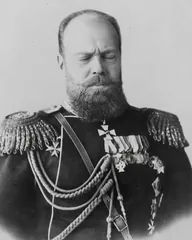
The collection records Alexander III’s probable birth in 1845 at Anichkov Palace and his probable death in 1894 at Livadia Palace. He was the son of Alexander II of Russia and Maria Alexandrovna, and his union was with Maria Feodorovna, also identified as Dagmar of Denmark. 1Birth · 10 Mar 1845, Anichkov Palace · Probable2Death · 1 Nov 1894, Livadia Palace · Probable3Parent · Alexander II of Russia · Confirmed4Parent · Maria Alexandrovna of Russia (Marie of Hesse) · Confirmed5Union · Maria Feodorovna (Dagmar of Denmark) · Confirmed
Alexander III held the title Emperor of all the Russias from 1881 to 1894. The collection also identifies him as King of Poland and Grand Duke of Finland, while his coronation took place in 1883. He was additionally recorded as head of the House of Romanov. 6Title · Emperor of all the Russias, 1881–1894 · Confirmed7Title · Grand Duke of Finland · Confirmed8Title · King of Poland · Confirmed9Event · coronation, 1883 · Confirmed10Title · Head of the House of Romanov · Confirmed
The collection characterizes Alexander III’s domestic government as strongly reactionary. It reports that he reversed some of the liberal reforms introduced by his father, Alexander II, describing this policy as a program of “counter-reforms.” 11Known for · Alexander III was Emperor of Russia, King of Poland and Grand Duke of Finland from 13 March 1881 until his death in 1894. He was highly reactionary in domestic affairs and reversed some of the liberal reforms of his father, Alexander II, a policy of "counter-reforms". · Probable
Drafted with AI and edited against the archive. Open a citation to see the record, its sources and how certain it is.
10 Mar 1845
Born in Anichkov Palace
1868–1882
6 children are born
1881–1894
Emperor of all the Russias
1883
Coronation
1 Nov 1894
Dies in Livadia Palace, aged 49
He lived through 6 decades. Pick one to hear and see what it was like around Anichkov Palace.
General history, not a record about the family: each item says where it comes from.
In the news1848
In 1848, a major cholera epidemic, coupled with a bad harvest and dry weather that caused widespread town fires, severely disrupted the lives of the agrarian population.
Getting around
Vast network of postal relay stations
The postal system maintained approximately 3,950 relay stations across the empire, utilizing over 50,000 horses to provide fresh teams for travelers and mail couriers.
In Europe1845–1852
Potato blight ruined harvests: a million Irish people died and a million more emigrated, many to America.
Daily life
Lighting and window materials in peasant homes
Peasant huts were typically illuminated by a torch inserted into the crack of the stove or by simple wicks dipped in oil. Glass was expensive and often replaced by bull bladders in peasant homes, while wealthier villagers began using mica.
What people wore
Peasant women's daily and festive attire
Peasant women wore a woolen skirt called a ponyova over a linen shirt, and they protected their hair with headdresses like the soroka, as showing hair was shameful for married women.
Music
Improvisational pliaska dances and percussion
Fast-paced pliaska dances were characterized by individual improvisations, sometimes accompanied by improvised percussion like wooden spoons or metal pots when standard instruments were unavailable.
At the table
Meal Customs in Peasant Households
Peasant families frequently ate from common dishes without individual cutlery, often eating in a set order led by the head of the household. Hygiene was minimal; dishes were typically rinsed in cold water after use rather than thoroughly washed.