

%20{%20.f%20{%20fill:%20%23EE7466%20}%20.s%20{%20stroke:%20%23EE7466%20}%20}%3c/style%3e%3cdefs%3e%3cfilter%20id='ink-fav'%20x='-5%25'%20y='-5%25'%20width='110%25'%20height='110%25'%3e%3cfeTurbulence%20type='fractalNoise'%20baseFrequency='0.9'%20numOctaves='2'%20seed='7'%20result='n'/%3e%3cfeDisplacementMap%20in='SourceGraphic'%20in2='n'%20scale='2.2'%20result='d'/%3e%3cfeTurbulence%20type='fractalNoise'%20baseFrequency='0.05'%20numOctaves='3'%20seed='18'%20result='blot'/%3e%3cfeColorMatrix%20in='blot'%20type='matrix'%20values='0%200%200%200%200%200%200%200%200%200%200%200%200%200%200%200%200%200%20-1.5%201.62'%20result='m1'/%3e%3cfeTurbulence%20type='fractalNoise'%20baseFrequency='1.6'%20numOctaves='1'%20seed='12'%20result='grain'/%3e%3cfeColorMatrix%20in='grain'%20type='matrix'%20values='0%200%200%200%200%200%200%200%200%200%200%200%200%200%200%200%200%200%20-2.4%202.25'%20result='m2'/%3e%3cfeComposite%20in='m1'%20in2='m2'%20operator='arithmetic'%20k1='1'/%3e%3cfeComposite%20in='d'%20operator='in'/%3e%3c/filter%3e%3c/defs%3e%3cg%20filter='url(%23ink-fav)'%20transform='rotate(-6%2080%2080)'%3e%3ccircle%20class='s'%20cx='80'%20cy='80'%20r='69'%20fill='none'%20stroke-width='16'/%3e%3cpath%20class='f'%20d='M47.33%2044.42Q46.25%2041.94%2045.01%2040.64Q43.77%2039.35%2041.71%2038.75Q39.66%2038.16%2035.67%2037.84L35.67%2033.84L80.16%2033.84L80.16%2037.84Q74.11%2038.27%2071.85%2039.13Q69.58%2040%2069.58%2042.05Q69.58%2043.24%2070.23%2045.07L86.32%2089.57L86.97%2089.57L102.3%2049.61Q103.38%2046.8%20103.38%2044.75Q103.38%2041.83%20100.68%2040.27Q97.98%2038.7%2091.39%2037.84L91.39%2033.84L124.77%2033.84L124.77%2037.84Q119.69%2038.59%20117.15%2039.67Q114.61%2040.75%20113.05%2042.97Q111.48%2045.18%20109.65%2049.82L82.97%20118.08L77.79%20118.08L47.33%2044.42Z'/%3e%3c/g%3e%3c/svg%3e)
In the news1810
Military Colonies Established in 1810
Military colonies were created in 1810, aiming to combine army life with agricultural labor, which essentially turned the peasants' daily existence into a structured, barracks-like routine.
Also known as Alexander the Liberator (epithet)
Small Nicholas Palace, 29 Apr 1818 – Winter Palace, 13 Mar 1881
16 facts3 sources
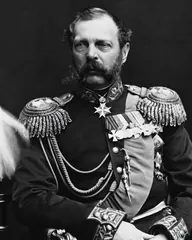
The collection records Alexander II’s probable birth in 1818 at the Small Nicholas Palace and his probable death in 1881 at the Winter Palace. He was the son of Nicholas I of Russia and Alexandra Feodorovna. He became Emperor of all the Russias and ruled from 1855 until 1881. 1Birth · 29 Apr 1818, Small Nicholas Palace · Probable2Death · 13 Mar 1881, Winter Palace · Probable3Parent · Nicholas I of Russia · Confirmed4Parent · Alexandra Feodorovna · Confirmed5Title · Emperor of all the Russias, 1855–1881 · Confirmed
Alexander II is remembered as “Alexander the Liberator” because his Edict of Emancipation officially abolished serfdom in Russia in 1861. He succeeded his father Nicholas I and held the office of member of the State Council of the Russian Empire. 6Known for · Alexander II was Emperor of Russia, King of Poland, and Grand Duke of Finland from 2 March 1855 until his assassination on 13 March 1881. He is also known as Alexander the Liberator because of his historic Edict of Emancipation, which officially abolished Russian serfdom in 1861. Crowned on 7 September 1856, he succeeded his father Nicholas I and was succeeded by his son Alexander III. · Probable3Parent · Nicholas I of Russia · Confirmed7Title · member of the State Council of the Russian Empire · Confirmed
An assassination attempt targeted Alexander II in 1867. The collection’s summary records his assassination in 1881 and his succession by his son Alexander III. 8Event · assassination attempt on Alexander II on May 25, 1867 · Confirmed9Event · assassination of Alexander II of Russia · Confirmed6Known for · Alexander II was Emperor of Russia, King of Poland, and Grand Duke of Finland from 2 March 1855 until his assassination on 13 March 1881. He is also known as Alexander the Liberator because of his historic Edict of Emancipation, which officially abolished Russian serfdom in 1861. Crowned on 7 September 1856, he succeeded his father Nicholas I and was succeeded by his son Alexander III. · Probable
Drafted with AI and edited against the archive. Open a citation to see the record, its sources and how certain it is.
29 Apr 1818
Born in Small Nicholas Palace
1842–1878
14 children are born
1855–1881
Emperor of all the Russias
13 Mar 1881
Dies in Winter Palace, aged 62
He lived through 8 decades. Pick one to hear and see what it was like around Small Nicholas Palace.
General history, not a record about the family: each item says where it comes from.
In the news1810
Military colonies were created in 1810, aiming to combine army life with agricultural labor, which essentially turned the peasants' daily existence into a structured, barracks-like routine.
Getting around
Essential road gear and carriages
Travelers commonly used specialized chests called pogrebetz, which featured internal partitions to hold essential items like tea-pots, glass carafes with rum, and milk jugs for long journeys. Many peasants used simple, horse-drawn carts known as telegi, which were frequently built without iron tires, making them highly susceptible to damage on rough roads.
At the table
Rye bread and cabbage soup staple
Ordinary families relied heavily on rye bread and shchi, a cabbage soup that was a dietary staple and was often made with sour, fermented grey cabbage.
 In Europe · 1803–1815
The Napoleonic Wars. Napoleon’s armies redrew the map of Europe from Spain to Moscow; his invasion of Portugal sent its court to Rio de Janeiro.
What people wore
Protective patches in peasant shirts
Peasant women stitched scarlet calico patches into the armpits of their linen shirts, serving as both decoration and an amulet to protect the body from unclean forces.
Music
Improvised percussion for fast folk dances
During fast-paced dances known as pliaska, performers often used improvised percussion instruments, including wooden spoons, metal pots, or even farm scythes to keep the rhythm.
Daily life
Children's home education
Many merchant and commoner children were educated at home by local sextons or clerks, with the Psalter and Book of Hours serving as their primary textbooks. Formal schooling remained rare for these groups, as even many noble children relied on varied levels of home instruction.