

%20{%20.f%20{%20fill:%20%23EE7466%20}%20.s%20{%20stroke:%20%23EE7466%20}%20}%3c/style%3e%3cdefs%3e%3cfilter%20id='ink-fav'%20x='-5%25'%20y='-5%25'%20width='110%25'%20height='110%25'%3e%3cfeTurbulence%20type='fractalNoise'%20baseFrequency='0.9'%20numOctaves='2'%20seed='7'%20result='n'/%3e%3cfeDisplacementMap%20in='SourceGraphic'%20in2='n'%20scale='2.2'%20result='d'/%3e%3cfeTurbulence%20type='fractalNoise'%20baseFrequency='0.05'%20numOctaves='3'%20seed='18'%20result='blot'/%3e%3cfeColorMatrix%20in='blot'%20type='matrix'%20values='0%200%200%200%200%200%200%200%200%200%200%200%200%200%200%200%200%200%20-1.5%201.62'%20result='m1'/%3e%3cfeTurbulence%20type='fractalNoise'%20baseFrequency='1.6'%20numOctaves='1'%20seed='12'%20result='grain'/%3e%3cfeColorMatrix%20in='grain'%20type='matrix'%20values='0%200%200%200%200%200%200%200%200%200%200%200%200%200%200%200%200%200%20-2.4%202.25'%20result='m2'/%3e%3cfeComposite%20in='m1'%20in2='m2'%20operator='arithmetic'%20k1='1'/%3e%3cfeComposite%20in='d'%20operator='in'/%3e%3c/filter%3e%3c/defs%3e%3cg%20filter='url(%23ink-fav)'%20transform='rotate(-6%2080%2080)'%3e%3ccircle%20class='s'%20cx='80'%20cy='80'%20r='69'%20fill='none'%20stroke-width='16'/%3e%3cpath%20class='f'%20d='M47.33%2044.42Q46.25%2041.94%2045.01%2040.64Q43.77%2039.35%2041.71%2038.75Q39.66%2038.16%2035.67%2037.84L35.67%2033.84L80.16%2033.84L80.16%2037.84Q74.11%2038.27%2071.85%2039.13Q69.58%2040%2069.58%2042.05Q69.58%2043.24%2070.23%2045.07L86.32%2089.57L86.97%2089.57L102.3%2049.61Q103.38%2046.8%20103.38%2044.75Q103.38%2041.83%20100.68%2040.27Q97.98%2038.7%2091.39%2037.84L91.39%2033.84L124.77%2033.84L124.77%2037.84Q119.69%2038.59%20117.15%2039.67Q114.61%2040.75%20113.05%2042.97Q111.48%2045.18%20109.65%2049.82L82.97%20118.08L77.79%20118.08L47.33%2044.42Z'/%3e%3c/g%3e%3c/svg%3e)
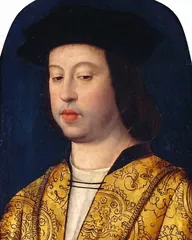
Ferdinand II of Aragon
Also known as Ferdinand the Catholic (epithet)
Palacio de los Sada, 19 Mar 1452 – Casa de Santa María, 2 Feb 1516
23 facts3 sources
Facts and their sources
- Born19 Mar 1452, Palacio de los SadaVerified · Vitrine1 source
- TitleDuke of Gandíaor Count of Ribagorza, 1458–1469 · Grand Master of the Order of Santiago, 1476–1477 · King of Castile and León (Iure uxoris), 1476–1504 · monarch of the Crown of Aragon, 1479–1516 · King of Sardinia, 1479–1516 · regent, 1504–1516Verified · Vitrine1 source
- TitleCount of Ribagorza, 1458–1469or Grand Master of the Order of Santiago, 1476–1477 · King of Castile and León (Iure uxoris), 1476–1504 · monarch of the Crown of Aragon, 1479–1516 · King of Sardinia, 1479–1516 · regent, 1504–1516 · Duke of GandíaVerified · Vitrine1 source
- TitleKing of Castile and León (Iure uxoris), 1476–1504or Count of Ribagorza, 1458–1469 · Grand Master of the Order of Santiago, 1476–1477 · monarch of the Crown of Aragon, 1479–1516 · King of Sardinia, 1479–1516 · regent, 1504–1516 · Duke of GandíaVerified · Vitrine1 source
- TitleGrand Master of the Order of Santiago, 1476–1477or Count of Ribagorza, 1458–1469 · King of Castile and León (Iure uxoris), 1476–1504 · monarch of the Crown of Aragon, 1479–1516 · King of Sardinia, 1479–1516 · regent, 1504–1516 · Duke of GandíaVerified · Vitrine1 source
- Titlemonarch of the Crown of Aragon, 1479–1516or Count of Ribagorza, 1458–1469 · Grand Master of the Order of Santiago, 1476–1477 · King of Castile and León (Iure uxoris), 1476–1504 · King of Sardinia, 1479–1516 · regent, 1504–1516 · Duke of GandíaVerified · Vitrine1 source
- TitleKing of Sardinia, 1479–1516or Count of Ribagorza, 1458–1469 · Grand Master of the Order of Santiago, 1476–1477 · King of Castile and León (Iure uxoris), 1476–1504 · monarch of the Crown of Aragon, 1479–1516 · regent, 1504–1516 · Duke of GandíaVerified · Vitrine1 source
- Titleregent, 1504–1516or Count of Ribagorza, 1458–1469 · Grand Master of the Order of Santiago, 1476–1477 · King of Castile and León (Iure uxoris), 1476–1504 · monarch of the Crown of Aragon, 1479–1516 · King of Sardinia, 1479–1516 · Duke of GandíaVerified · Vitrine1 source
- Event1492 assassination attempt of Ferdinand II of Aragonor Royal Wedding of Isabella of Castile and Ferdinand of Aragon, 1469 · dynastic union of Aragon and Castile, 1476 · coronation, 1506 · coronation of the Kings of AragonVerified · Vitrine1 source
- EventCoronation of the Kings of Aragonor Royal Wedding of Isabella of Castile and Ferdinand of Aragon, 1469 · dynastic union of Aragon and Castile, 1476 · coronation, 1506 · 1492 assassination attempt of Ferdinand II of AragonVerified · Vitrine1 source
- EventRoyal Wedding of Isabella of Castile and Ferdinand of Aragon, 1469or dynastic union of Aragon and Castile, 1476 · coronation, 1506 · 1492 assassination attempt of Ferdinand II of Aragon · coronation of the Kings of AragonVerified · Vitrine1 source
- EventDynastic union of Aragon and Castile, 1476or Royal Wedding of Isabella of Castile and Ferdinand of Aragon, 1469 · coronation, 1506 · 1492 assassination attempt of Ferdinand II of Aragon · coronation of the Kings of AragonVerified · Vitrine1 source
- EventCoronation, 1506or Royal Wedding of Isabella of Castile and Ferdinand of Aragon, 1469 · dynastic union of Aragon and Castile, 1476 · 1492 assassination attempt of Ferdinand II of Aragon · coronation of the Kings of AragonVerified · Vitrine1 source
- Died2 Feb 1516, Casa de Santa MaríaVerified · Vitrine1 source
A life in time
19 Mar 1452
Born in Palacio de los Sada
1458–1469
Count of Ribagorza
1469–1509
10 children are born
1469
Royal Wedding of Isabella of Castile and Ferdinand of Aragon
1476
Dynastic union of Aragon and Castile
1476–1504
King of Castile and León (Iure uxoris)
1476–1477
Grand Master of the Order of Santiago
1479–1516
Monarch of the Crown of Aragon
1479–1516
King of Sardinia
1504–1516
Regent
1506
Coronation
2 Feb 1516
Dies in Casa de Santa María, aged 63
Family
See the treeParents
Partners
Children · 10
During his lifetime
He lived through 7 decades. Pick one to hear and see what it was like around Palacio de los Sada.
General history, not a record about the family: each item says where it comes from.
The 1450s · Ferdinand II is born in Palacio de los Sada
What people wore
Around 1500–1524The Colorful Woolen Tunic Called Saya
Ordinary people wore a tunic called a saya, which was often made of wool and dyed in various colors like red, purple, ocher, blue, green, white, or black. It was typically worn by peasants and artisans, sometimes featuring an open neck known as an amigaut.
Daily life
Around 1500–1524Domestic heating and cleaning methods
Households used braziers to heat laundry and water for cleaning, as homes lacked modern amenities like running water.
Work
Around 1500–1524Seasonal and domestic labor rhythms
Daily life followed seasonal tasks like the pig slaughter in November, a scene frequently depicted in medieval carvings and paintings. Household chores often centered around the hearth, where servants and family members performed tasks like drying laundry.
Music
Around 1500–1524Social customs of the youth groups
Young men formed social groups called Los Mozos, where joining on the feast of Saint Agatha cost one real. Members shared communal items like guitars, wine skins, and playing cards for their social gatherings.
At the table
Around 1500–1524Wine as a daily essential drink
Wine was the essential daily drink, considered vital for health and often mixed with water because pure water was frequently unsafe to consume. It was consumed by all social classes, and many people carried their own measuring tools to ensure the wine was diluted correctly.
Getting around
Around 1500–1524Mules as primary transport animals
Travelers often used mules, which were the most valuable assistants for transport and could be used for riding or carrying cargo.
What it cost
Around 1500–1524Wheat and Bread as Basic Staples
Bread was the most appreciated food, with wheat being the basic crop; however, poor harvests frequently led to tragic famines.