

%20{%20.f%20{%20fill:%20%23EE7466%20}%20.s%20{%20stroke:%20%23EE7466%20}%20}%3c/style%3e%3cdefs%3e%3cfilter%20id='ink-fav'%20x='-5%25'%20y='-5%25'%20width='110%25'%20height='110%25'%3e%3cfeTurbulence%20type='fractalNoise'%20baseFrequency='0.9'%20numOctaves='2'%20seed='7'%20result='n'/%3e%3cfeDisplacementMap%20in='SourceGraphic'%20in2='n'%20scale='2.2'%20result='d'/%3e%3cfeTurbulence%20type='fractalNoise'%20baseFrequency='0.05'%20numOctaves='3'%20seed='18'%20result='blot'/%3e%3cfeColorMatrix%20in='blot'%20type='matrix'%20values='0%200%200%200%200%200%200%200%200%200%200%200%200%200%200%200%200%200%20-1.5%201.62'%20result='m1'/%3e%3cfeTurbulence%20type='fractalNoise'%20baseFrequency='1.6'%20numOctaves='1'%20seed='12'%20result='grain'/%3e%3cfeColorMatrix%20in='grain'%20type='matrix'%20values='0%200%200%200%200%200%200%200%200%200%200%200%200%200%200%200%200%200%20-2.4%202.25'%20result='m2'/%3e%3cfeComposite%20in='m1'%20in2='m2'%20operator='arithmetic'%20k1='1'/%3e%3cfeComposite%20in='d'%20operator='in'/%3e%3c/filter%3e%3c/defs%3e%3cg%20filter='url(%23ink-fav)'%20transform='rotate(-6%2080%2080)'%3e%3ccircle%20class='s'%20cx='80'%20cy='80'%20r='69'%20fill='none'%20stroke-width='16'/%3e%3cpath%20class='f'%20d='M47.33%2044.42Q46.25%2041.94%2045.01%2040.64Q43.77%2039.35%2041.71%2038.75Q39.66%2038.16%2035.67%2037.84L35.67%2033.84L80.16%2033.84L80.16%2037.84Q74.11%2038.27%2071.85%2039.13Q69.58%2040%2069.58%2042.05Q69.58%2043.24%2070.23%2045.07L86.32%2089.57L86.97%2089.57L102.3%2049.61Q103.38%2046.8%20103.38%2044.75Q103.38%2041.83%20100.68%2040.27Q97.98%2038.7%2091.39%2037.84L91.39%2033.84L124.77%2033.84L124.77%2037.84Q119.69%2038.59%20117.15%2039.67Q114.61%2040.75%20113.05%2042.97Q111.48%2045.18%20109.65%2049.82L82.97%20118.08L77.79%20118.08L47.33%2044.42Z'/%3e%3c/g%3e%3c/svg%3e)
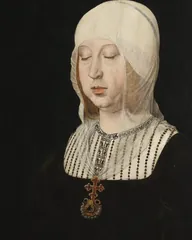
Isabella I of Castile
Also known as Isabella the Catholic (epithet)
Monasterio de Nuestra Señora de Gracia, 1 May 1451 – Palacio Testamentario, 6 Dec 1504
14 facts3 sources
Facts and their sources
- Born1 May 1451, Monasterio de Nuestra Señora de GraciaVerified · Vitrine1 source
- TitleMonarch of Castile and Leon, 1474–1504or royal Consort of Aragon, 1479–1504 · Lieutenant General of the States of the Crown of Aragon, 1488Verified · Vitrine1 source
- Titleroyal Consort of Aragon, 1479–1504or Monarch of Castile and Leon, 1474–1504 · Lieutenant General of the States of the Crown of Aragon, 1488Verified · Vitrine1 source
- TitleLieutenant General of the States of the Crown of Aragon, 1488or Monarch of Castile and Leon, 1474–1504 · royal Consort of Aragon, 1479–1504Verified · Vitrine1 source
- EventDynastic union of Aragon and CastileVerified · Vitrine1 source
- Died6 Dec 1504, Palacio TestamentarioVerified · Vitrine1 source
A life in time
1 May 1451
Born in Monasterio de Nuestra Señora de Gracia
1470–1485
5 children are born
1474–1504
Monarch of Castile and Leon
1479–1504
Royal Consort of Aragon
1488
Lieutenant General of the States of the Crown of Aragon
6 Dec 1504
Dies in Palacio Testamentario, aged 53
Family
See the treeParents
Partner
Children · 5
During her lifetime
She lived through 6 decades. Pick one to hear and see what it was like around Monasterio de Nuestra Señora de Gracia.
General history, not a record about the family: each item says where it comes from.
The 1450s · Isabella I is born in Monasterio de Nuestra Señora de Gracia
What people wore
Around 1500–1524The Colorful Woolen Tunic Called Saya
Ordinary people wore a tunic called a saya, which was often made of wool and dyed in various colors like red, purple, ocher, blue, green, white, or black. It was typically worn by peasants and artisans, sometimes featuring an open neck known as an amigaut.
Daily life
Around 1500–1524Domestic heating and cleaning methods
Households used braziers to heat laundry and water for cleaning, as homes lacked modern amenities like running water.
Work
Around 1500–1524Agricultural life and self-sufficiency
About 80 percent of Navarre's population relied on agriculture, with most households aiming for self-sufficiency. Two-thirds of farmers combined agricultural work with artisan activities.
Music
Around 1500–1524Cathedral music and instrument maintenance
In the Pamplona Cathedral during the early 16th century, musicians such as chirimia players were officially employed, and payments for instrument maintenance, like repairing a bajon, were recorded in ducats.
At the table
Around 1500–1524Wine as a daily essential drink
Wine was the essential daily drink, considered vital for health and often mixed with water because pure water was frequently unsafe to consume. It was consumed by all social classes, and many people carried their own measuring tools to ensure the wine was diluted correctly.
Getting around
Around 1500–1524Traveling primarily on foot
Ordinary people primarily traveled on foot, covering a maximum distance of 40 to 50 kilometers in a single day.
What it cost
Around 1500–1524Meat Consumption and Hunting Practices
Lamb was the most consumed meat, and hunting was crucial to supplement low calorie diets rather than just being a noble sport.