

%20{%20.f%20{%20fill:%20%23EE7466%20}%20.s%20{%20stroke:%20%23EE7466%20}%20}%3c/style%3e%3cdefs%3e%3cfilter%20id='ink-fav'%20x='-5%25'%20y='-5%25'%20width='110%25'%20height='110%25'%3e%3cfeTurbulence%20type='fractalNoise'%20baseFrequency='0.9'%20numOctaves='2'%20seed='7'%20result='n'/%3e%3cfeDisplacementMap%20in='SourceGraphic'%20in2='n'%20scale='2.2'%20result='d'/%3e%3cfeTurbulence%20type='fractalNoise'%20baseFrequency='0.05'%20numOctaves='3'%20seed='18'%20result='blot'/%3e%3cfeColorMatrix%20in='blot'%20type='matrix'%20values='0%200%200%200%200%200%200%200%200%200%200%200%200%200%200%200%200%200%20-1.5%201.62'%20result='m1'/%3e%3cfeTurbulence%20type='fractalNoise'%20baseFrequency='1.6'%20numOctaves='1'%20seed='12'%20result='grain'/%3e%3cfeColorMatrix%20in='grain'%20type='matrix'%20values='0%200%200%200%200%200%200%200%200%200%200%200%200%200%200%200%200%200%20-2.4%202.25'%20result='m2'/%3e%3cfeComposite%20in='m1'%20in2='m2'%20operator='arithmetic'%20k1='1'/%3e%3cfeComposite%20in='d'%20operator='in'/%3e%3c/filter%3e%3c/defs%3e%3cg%20filter='url(%23ink-fav)'%20transform='rotate(-6%2080%2080)'%3e%3ccircle%20class='s'%20cx='80'%20cy='80'%20r='69'%20fill='none'%20stroke-width='16'/%3e%3cpath%20class='f'%20d='M47.33%2044.42Q46.25%2041.94%2045.01%2040.64Q43.77%2039.35%2041.71%2038.75Q39.66%2038.16%2035.67%2037.84L35.67%2033.84L80.16%2033.84L80.16%2037.84Q74.11%2038.27%2071.85%2039.13Q69.58%2040%2069.58%2042.05Q69.58%2043.24%2070.23%2045.07L86.32%2089.57L86.97%2089.57L102.3%2049.61Q103.38%2046.8%20103.38%2044.75Q103.38%2041.83%20100.68%2040.27Q97.98%2038.7%2091.39%2037.84L91.39%2033.84L124.77%2033.84L124.77%2037.84Q119.69%2038.59%20117.15%2039.67Q114.61%2040.75%20113.05%2042.97Q111.48%2045.18%20109.65%2049.82L82.97%20118.08L77.79%20118.08L47.33%2044.42Z'/%3e%3c/g%3e%3c/svg%3e)
Nicholas I of Russia
Pushkin, 6 Jul 1796 – Saint Petersburg, 2 Mar 1855
14 facts1 source
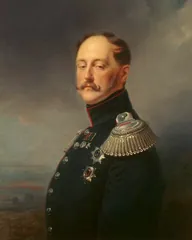
About Nicholas I
Nicholas I of Russia: Emperor and Grand Duke of Finland
AI-assisted · editedThe collection records Nicholas I’s birth in 1796 in Pushkin. He was the son of Paul I of Russia and Sophie Dorothee of Württemberg, and his union with Alexandra Feodorovna is also recorded. 1Birth · 6 Jul 1796, Pushkin · Probable2Parent · Paul I of Russia · Confirmed3Parent · Sophie Dorothee of Württemberg · Confirmed4Union · Alexandra Feodorovna · Confirmed
From 1825 to 1855, he held the titles Emperor of all the Russias and Grand Duke of Finland. The two offices connect his reign to territories with distinct titles within the same royal record. 5Title · Emperor of all the Russias, 1825–1855 · Confirmed6Title · Grand Duke of Finland, 1825–1855 · Confirmed7Description · The 11th Emperor of Russia, 1825–1855 (lived 1796-1855) · Probable
His reign is associated in the evidence with the Decembrist revolt, the Russo-Persian War of 1826–28, the Ninth Russo-Turkish War, and the Crimean War. The collection records his death in 1855 in Saint Petersburg, also with probable confidence. 8Event · Decembrist revolt · Confirmed9Event · Russo-Persian War of 1826–28 · Confirmed10Event · Ninth Russo-Turkish War · Confirmed11Event · Crimean War · Confirmed12Death · 2 Mar 1855, Saint Petersburg · Probable
Drafted with AI and edited against the archive. Open a citation to see the record, its sources and how certain it is.
Facts and their sources
- Born6 Jul 1796, PushkinVerified · Vitrine1 source
- TitleEmperor of all the Russias, 1825–1855or Grand Duke of Finland, 1825–1855Verified · Vitrine1 source
- TitleGrand Duke of Finland, 1825–1855or Emperor of all the Russias, 1825–1855Verified · Vitrine1 source
- EventCrimean Waror Ninth Russo-Turkish War · Decembrist revolt · Russo-Persian War of 1826–28Verified · Vitrine1 source
- EventNinth Russo-Turkish Waror Crimean War · Decembrist revolt · Russo-Persian War of 1826–28Verified · Vitrine1 source
- EventDecembrist revoltor Crimean War · Ninth Russo-Turkish War · Russo-Persian War of 1826–28Verified · Vitrine1 source
- EventRusso-Persian War of 1826–28or Crimean War · Ninth Russo-Turkish War · Decembrist revoltVerified · Vitrine1 source
- Died2 Mar 1855, Saint PetersburgVerified · Vitrine1 source
A life in time
6 Jul 1796
Born in Pushkin
1818–1832
13 children are born
1825–1855
Emperor of all the Russias
1825–1855
Grand Duke of Finland
2 Mar 1855
Dies in Saint Petersburg, aged 58
Family
See the treeParents
Partner
Children · 13
During his lifetime
He lived through 7 decades. Pick one to hear and see what it was like around Pushkin.
General history, not a record about the family: each item says where it comes from.
The 1790s · Nicholas I is born in Pushkin
What people wore
Russian court dress and military-style fashion
By the end of the 1770s, a distinct Russian court dress emerged for noblewomen, characterized by a short train and long hanging sleeves. Empress Catherine II sometimes wore a female version of a military regimental uniform, tailored in the style of an amazon riding habit and trimmed with gold lace.
Getting around
River crossings and ferry delays
Travel was often interrupted by river crossings, where passengers and carriages relied on slow ferries, leading to significant delays and occasional hazards like the loss of cargo or baggage.
At the table
Daily Rye Bread Staples
Rye bread was the essential staple, with adults consuming nearly two pounds daily, often stored as a sourdough starter for up to two weeks.
 In Europe · 1789–1799
The French Revolution. Parisians stormed the Bastille in 1789; the monarchy fell, the king was executed, and “liberty, equality, fraternity” spread across Europe.
Music
Popular instruments and music in society
In fashionable society, the harp and guitar became increasingly popular for accompanying sentimental songs and romances, while the polonaises of the Polish composer Kozlowski were played constantly in homes and at social gatherings.
Daily life
Wooden homes and new urban layouts
In the late 18th century, ordinary urban houses were built of wood, which created a constant risk of devastating fires across entire neighborhoods. New urban houses began to feature central corridors instead of the traditional layout where rooms were arranged directly around a central stove.
What it cost
Annual earnings of textile workers
In 1796, women working in textile production could earn 50 to 90 paper rubles per year.