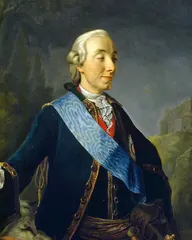
The collection records Peter III’s birth in Kiel in 1728, although the date is disputed. His parents were Charles Frederick, Duke of Schleswig-Holstein-Gottorp, and Anna Petrovna of Russia. 1Birth · 21 Feb 1728, Kiel · Probable2Birth · 1728 · Probable3Parent · Charles Frederick, Duke of Schleswig-Holstein-Gottorp · Confirmed4Parent · Anna Petrovna of Russia · Confirmed
The collection describes him as Russia’s seventh emperor, in 1762, and records his title as Emperor of all the Russias. Its historical summary places his brief reign in 1762, attributes notable reforms to him, and notes the criticism that his alliance with Prussia undid Russian gains in the Seven Years’ War. 5Description · The seventh Emperor of Russia, 1762 (lived 1728-1762) · Probable6Title · Emperor of all the Russias, 1762 · Confirmed7Known for · Peter III Fyodorovich was Emperor of Russia from 5 January 1762 until 9 July of the same year, when his wife, Catherine II, overthrew him in a palace coup d'état. He implemented many notable reforms during his reign, though he is criticised for undoing Russian gains in the Seven Years' War by forming an alliance with Prussia. · Probable
His wife was Catherine II, who, according to the summary, overthrew him in a palace coup d’état. The collection records his death in 1762 at Ropsha Palace and also identifies him as Head of the House of Romanov. 8Union · Catherine II of Russia · Confirmed7Known for · Peter III Fyodorovich was Emperor of Russia from 5 January 1762 until 9 July of the same year, when his wife, Catherine II, overthrew him in a palace coup d'état. He implemented many notable reforms during his reign, though he is criticised for undoing Russian gains in the Seven Years' War by forming an alliance with Prussia. · Probable9Death · 17 Jul 1762, Ropsha Palace · Probable10Title · Head of the House of Romanov · Confirmed


%20{%20.f%20{%20fill:%20%23EE7466%20}%20.s%20{%20stroke:%20%23EE7466%20}%20}%3c/style%3e%3cdefs%3e%3cfilter%20id='ink-fav'%20x='-5%25'%20y='-5%25'%20width='110%25'%20height='110%25'%3e%3cfeTurbulence%20type='fractalNoise'%20baseFrequency='0.9'%20numOctaves='2'%20seed='7'%20result='n'/%3e%3cfeDisplacementMap%20in='SourceGraphic'%20in2='n'%20scale='2.2'%20result='d'/%3e%3cfeTurbulence%20type='fractalNoise'%20baseFrequency='0.05'%20numOctaves='3'%20seed='18'%20result='blot'/%3e%3cfeColorMatrix%20in='blot'%20type='matrix'%20values='0%200%200%200%200%200%200%200%200%200%200%200%200%200%200%200%200%200%20-1.5%201.62'%20result='m1'/%3e%3cfeTurbulence%20type='fractalNoise'%20baseFrequency='1.6'%20numOctaves='1'%20seed='12'%20result='grain'/%3e%3cfeColorMatrix%20in='grain'%20type='matrix'%20values='0%200%200%200%200%200%200%200%200%200%200%200%200%200%200%200%200%200%20-2.4%202.25'%20result='m2'/%3e%3cfeComposite%20in='m1'%20in2='m2'%20operator='arithmetic'%20k1='1'/%3e%3cfeComposite%20in='d'%20operator='in'/%3e%3c/filter%3e%3c/defs%3e%3cg%20filter='url(%23ink-fav)'%20transform='rotate(-6%2080%2080)'%3e%3ccircle%20class='s'%20cx='80'%20cy='80'%20r='69'%20fill='none'%20stroke-width='16'/%3e%3cpath%20class='f'%20d='M47.33%2044.42Q46.25%2041.94%2045.01%2040.64Q43.77%2039.35%2041.71%2038.75Q39.66%2038.16%2035.67%2037.84L35.67%2033.84L80.16%2033.84L80.16%2037.84Q74.11%2038.27%2071.85%2039.13Q69.58%2040%2069.58%2042.05Q69.58%2043.24%2070.23%2045.07L86.32%2089.57L86.97%2089.57L102.3%2049.61Q103.38%2046.8%20103.38%2044.75Q103.38%2041.83%20100.68%2040.27Q97.98%2038.7%2091.39%2037.84L91.39%2033.84L124.77%2033.84L124.77%2037.84Q119.69%2038.59%20117.15%2039.67Q114.61%2040.75%20113.05%2042.97Q111.48%2045.18%20109.65%2049.82L82.97%20118.08L77.79%20118.08L47.33%2044.42Z'/%3e%3c/g%3e%3c/svg%3e)