

%20{%20.f%20{%20fill:%20%23EE7466%20}%20.s%20{%20stroke:%20%23EE7466%20}%20}%3c/style%3e%3cdefs%3e%3cfilter%20id='ink-fav'%20x='-5%25'%20y='-5%25'%20width='110%25'%20height='110%25'%3e%3cfeTurbulence%20type='fractalNoise'%20baseFrequency='0.9'%20numOctaves='2'%20seed='7'%20result='n'/%3e%3cfeDisplacementMap%20in='SourceGraphic'%20in2='n'%20scale='2.2'%20result='d'/%3e%3cfeTurbulence%20type='fractalNoise'%20baseFrequency='0.05'%20numOctaves='3'%20seed='18'%20result='blot'/%3e%3cfeColorMatrix%20in='blot'%20type='matrix'%20values='0%200%200%200%200%200%200%200%200%200%200%200%200%200%200%200%200%200%20-1.5%201.62'%20result='m1'/%3e%3cfeTurbulence%20type='fractalNoise'%20baseFrequency='1.6'%20numOctaves='1'%20seed='12'%20result='grain'/%3e%3cfeColorMatrix%20in='grain'%20type='matrix'%20values='0%200%200%200%200%200%200%200%200%200%200%200%200%200%200%200%200%200%20-2.4%202.25'%20result='m2'/%3e%3cfeComposite%20in='m1'%20in2='m2'%20operator='arithmetic'%20k1='1'/%3e%3cfeComposite%20in='d'%20operator='in'/%3e%3c/filter%3e%3c/defs%3e%3cg%20filter='url(%23ink-fav)'%20transform='rotate(-6%2080%2080)'%3e%3ccircle%20class='s'%20cx='80'%20cy='80'%20r='69'%20fill='none'%20stroke-width='16'/%3e%3cpath%20class='f'%20d='M47.33%2044.42Q46.25%2041.94%2045.01%2040.64Q43.77%2039.35%2041.71%2038.75Q39.66%2038.16%2035.67%2037.84L35.67%2033.84L80.16%2033.84L80.16%2037.84Q74.11%2038.27%2071.85%2039.13Q69.58%2040%2069.58%2042.05Q69.58%2043.24%2070.23%2045.07L86.32%2089.57L86.97%2089.57L102.3%2049.61Q103.38%2046.8%20103.38%2044.75Q103.38%2041.83%20100.68%2040.27Q97.98%2038.7%2091.39%2037.84L91.39%2033.84L124.77%2033.84L124.77%2037.84Q119.69%2038.59%20117.15%2039.67Q114.61%2040.75%20113.05%2042.97Q111.48%2045.18%20109.65%2049.82L82.97%20118.08L77.79%20118.08L47.33%2044.42Z'/%3e%3c/g%3e%3c/svg%3e)
In the news1723
New Warsaw trading house, 1723
A major trading house was established in Warsaw by French Huguenots in 1723, marking an early sign of economic recovery and industrial development.
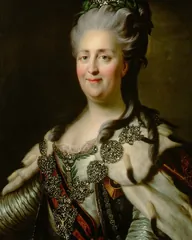
Also known as Catherine the Great (epithet)
Szczecin, 2 May 1729 – Saint Petersburg, 17 Nov 1796
13 facts3 sources
The collection records Catherine II’s birth in 1729 in Szczecin. She was the daughter of Christian August, Prince of Anhalt-Zerbst, and Joanna Elisabeth of Holstein-Gottorp. 1Birth · 2 May 1729, Szczecin · Probable2Parent · Christian August, Prince of Anhalt-Zerbst · Confirmed3Parent · Joanna Elisabeth of Holstein-Gottorp · Confirmed
Known as Catherine the Great, she held the imperial title from 1762 to 1796. Before her accession, she had been the consort of Emperor Peter III. The collection’s summary describes her rise to power after a coup that deposed him. 4Description · eighth Emperor of Russia, called the Great, r. 1762–1796 (lived 1729-1796) · Probable5Title · Emperor of all the Russias, 1762–1796 · Confirmed6Known for · Catherine II, known as Catherine the Great, was Empress of Russia from 9 July 1762 until her death in 1796. Before her accession, Catherine had been a royal consort as the wife of Emperor Peter III, whom she overthrew in a coup d'état. · Probable
The Sixth Russo-Turkish War is one confirmed event associated with her reign. The collection records her death in 1796, although the date is disputed; one of the competing records gives Saint Petersburg as the place of death. 7Event · Sixth Russo-Turkish War · Confirmed8Death · 17 Nov 1796, Saint Petersburg · Probable9Death · 16 Nov 1796 · Probable
Drafted with AI and edited against the archive. Open a citation to see the record, its sources and how certain it is.
2 May 1729
Born in Szczecin
1750–1775
5 children are born
1762–1796
Emperor of all the Russias
17 Nov 1796
Dies in Saint Petersburg, aged 67
She lived through 8 decades. Pick one to hear and see what it was like around Szczecin.
General history, not a record about the family: each item says where it comes from.
In the news1723
A major trading house was established in Warsaw by French Huguenots in 1723, marking an early sign of economic recovery and industrial development.
What people wore
Festive clothing regardless of heat
To manifest their status during feast days, peasants sometimes wore wadded caftans and fustian skirts even in the summer, regardless of the intense heat.
Getting around
Travel Methods for Different Social Classes
Ordinary people typically traveled by foot or in simple carts called kolasa, while the wealthy used horses, private carriages, or, by the late 18th century, stagecoaches on main routes.
 In Europe · 1700–1721
The Great Northern War. Russia, Denmark and Saxony fought Sweden for the Baltic; Peter the Great won and built St Petersburg on the conquered coast.
In the news1718–1722
The Russian state established police chief offices in 1718 in St. Petersburg and 1722 in Moscow, tasking them with regulating urban daily life, including sanitation, fire safety, and street behavior.
Music
Instruments in Inns and Churches
Bagpipes were popular instruments at village and city inns, and in Żywiec, court trumpeters played music from the church tower.
Daily life
Schooling for children
Formal schooling was rare for peasant children because they had to work on farms, though some attended schools in larger villages during winter. Elite boys could attend new institutions like the Collegium Nobilium, which taught natural sciences and Polish alongside Latin.