

%20{%20.f%20{%20fill:%20%23EE7466%20}%20.s%20{%20stroke:%20%23EE7466%20}%20}%3c/style%3e%3cdefs%3e%3cfilter%20id='ink-fav'%20x='-5%25'%20y='-5%25'%20width='110%25'%20height='110%25'%3e%3cfeTurbulence%20type='fractalNoise'%20baseFrequency='0.9'%20numOctaves='2'%20seed='7'%20result='n'/%3e%3cfeDisplacementMap%20in='SourceGraphic'%20in2='n'%20scale='2.2'%20result='d'/%3e%3cfeTurbulence%20type='fractalNoise'%20baseFrequency='0.05'%20numOctaves='3'%20seed='18'%20result='blot'/%3e%3cfeColorMatrix%20in='blot'%20type='matrix'%20values='0%200%200%200%200%200%200%200%200%200%200%200%200%200%200%200%200%200%20-1.5%201.62'%20result='m1'/%3e%3cfeTurbulence%20type='fractalNoise'%20baseFrequency='1.6'%20numOctaves='1'%20seed='12'%20result='grain'/%3e%3cfeColorMatrix%20in='grain'%20type='matrix'%20values='0%200%200%200%200%200%200%200%200%200%200%200%200%200%200%200%200%200%20-2.4%202.25'%20result='m2'/%3e%3cfeComposite%20in='m1'%20in2='m2'%20operator='arithmetic'%20k1='1'/%3e%3cfeComposite%20in='d'%20operator='in'/%3e%3c/filter%3e%3c/defs%3e%3cg%20filter='url(%23ink-fav)'%20transform='rotate(-6%2080%2080)'%3e%3ccircle%20class='s'%20cx='80'%20cy='80'%20r='69'%20fill='none'%20stroke-width='16'/%3e%3cpath%20class='f'%20d='M47.33%2044.42Q46.25%2041.94%2045.01%2040.64Q43.77%2039.35%2041.71%2038.75Q39.66%2038.16%2035.67%2037.84L35.67%2033.84L80.16%2033.84L80.16%2037.84Q74.11%2038.27%2071.85%2039.13Q69.58%2040%2069.58%2042.05Q69.58%2043.24%2070.23%2045.07L86.32%2089.57L86.97%2089.57L102.3%2049.61Q103.38%2046.8%20103.38%2044.75Q103.38%2041.83%20100.68%2040.27Q97.98%2038.7%2091.39%2037.84L91.39%2033.84L124.77%2033.84L124.77%2037.84Q119.69%2038.59%20117.15%2039.67Q114.61%2040.75%20113.05%2042.97Q111.48%2045.18%20109.65%2049.82L82.97%20118.08L77.79%20118.08L47.33%2044.42Z'/%3e%3c/g%3e%3c/svg%3e)
In the news1685
New postal service in Courland
Duke Frederick Casimir organized a separate, independent postal service through Courland in 1685, sparking fierce competition with the existing Swedish-run mail service.
Krustpils, 1684 – Saint Petersburg, 5 May 1727
15 facts3 sources
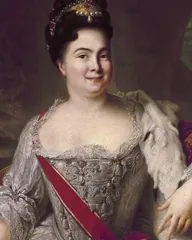
The collection records 1684 as Catherine I’s probable birth year in Krustpils, although the dating is disputed. It identifies Samuel Skowroński as her father and Dorothea Skowrońska as her mother. 1Birth · 1684, Krustpils · Probable2Parent · Samuel Skowroński · Confirmed3Parent · Dorothea Skowrońska · Confirmed
Catherine served as empress consort from 1721 to 1725. The collection’s summary describes her as Peter the Great’s second wife; a separate relationship record also links her to Johann Kruse. 4Description · The first Empress of Russia from 1725 to 1727 · Probable5Known for · Catherine I was Empress of Russia from 8 February 1725 until her death in 1727. She was previously empress consort of Russia from 1721 to 1725 as the second wife of Peter the Great, and tsaritsa consort from 1712 to 1721. · Probable6Title · empress consort · Confirmed7Union · Peter the Great · Confirmed8Union · Johann Kruse · Confirmed
Catherine ruled as Empress of Russia from 1725 until her death in 1727. The collection records her death in Saint Petersburg, while noting a dispute over the precise date. 5Known for · Catherine I was Empress of Russia from 8 February 1725 until her death in 1727. She was previously empress consort of Russia from 1721 to 1725 as the second wife of Peter the Great, and tsaritsa consort from 1712 to 1721. · Probable9Title · Emperor of all the Russias, 1725–1727 · Confirmed10Death · 5 May 1727, Saint Petersburg · Probable11Death · 1727 · Probable
Drafted with AI and edited against the archive. Open a citation to see the record, its sources and how certain it is.
1684
Born in Krustpils
1707–1718
8 children are born
1725–1727
Emperor of all the Russias
5 May 1727
Dies in Saint Petersburg
She lived through 5 decades. Pick one to hear and see what it was like around Krustpils.
General history, not a record about the family: each item says where it comes from.
In the news1685
Duke Frederick Casimir organized a separate, independent postal service through Courland in 1685, sparking fierce competition with the existing Swedish-run mail service.
Getting around
Cost of a winter transport vehicle
In 1586, a sledge was purchased at the Ramygala market for ten Lithuanian groši, illustrating the rural cost of winter transport equipment.
In the news1686–1690
The Church Law of 1686, extended to Livonia in 1690, mandated that parish priests monitor households to ensure they could read the Bible and participate in catechism.
Daily life
Schooling and Discipline for Children
Schooling for peasant children included reading, writing, and religion, often supervised by local pastors. In Liepāja, teachers were permitted to use a rod for discipline, though striking children with fists or sticks was prohibited by law.
What people wore
Traditional handmade accessories and footwear
Women covered their heads with linen scarves that were decorated with colorful threads and needle embroidery. People also skillfully made everyday shoes from linden or willow bark.
Music
Traditional musical instruments in villages
Traditional instruments during this era included bagpipes, which were widely known in villages, alongside shepherd instruments like whistles, horns, and trumpets.
At the table
Shared meals and personal wooden spoons
Ordinary families often ate from the same wooden bowl using their own personal wooden spoons, which were marked with notches or symbols to identify the owner.