

%20{%20.f%20{%20fill:%20%23EE7466%20}%20.s%20{%20stroke:%20%23EE7466%20}%20}%3c/style%3e%3cdefs%3e%3cfilter%20id='ink-fav'%20x='-5%25'%20y='-5%25'%20width='110%25'%20height='110%25'%3e%3cfeTurbulence%20type='fractalNoise'%20baseFrequency='0.9'%20numOctaves='2'%20seed='7'%20result='n'/%3e%3cfeDisplacementMap%20in='SourceGraphic'%20in2='n'%20scale='2.2'%20result='d'/%3e%3cfeTurbulence%20type='fractalNoise'%20baseFrequency='0.05'%20numOctaves='3'%20seed='18'%20result='blot'/%3e%3cfeColorMatrix%20in='blot'%20type='matrix'%20values='0%200%200%200%200%200%200%200%200%200%200%200%200%200%200%200%200%200%20-1.5%201.62'%20result='m1'/%3e%3cfeTurbulence%20type='fractalNoise'%20baseFrequency='1.6'%20numOctaves='1'%20seed='12'%20result='grain'/%3e%3cfeColorMatrix%20in='grain'%20type='matrix'%20values='0%200%200%200%200%200%200%200%200%200%200%200%200%200%200%200%200%200%20-2.4%202.25'%20result='m2'/%3e%3cfeComposite%20in='m1'%20in2='m2'%20operator='arithmetic'%20k1='1'/%3e%3cfeComposite%20in='d'%20operator='in'/%3e%3c/filter%3e%3c/defs%3e%3cg%20filter='url(%23ink-fav)'%20transform='rotate(-6%2080%2080)'%3e%3ccircle%20class='s'%20cx='80'%20cy='80'%20r='69'%20fill='none'%20stroke-width='16'/%3e%3cpath%20class='f'%20d='M47.33%2044.42Q46.25%2041.94%2045.01%2040.64Q43.77%2039.35%2041.71%2038.75Q39.66%2038.16%2035.67%2037.84L35.67%2033.84L80.16%2033.84L80.16%2037.84Q74.11%2038.27%2071.85%2039.13Q69.58%2040%2069.58%2042.05Q69.58%2043.24%2070.23%2045.07L86.32%2089.57L86.97%2089.57L102.3%2049.61Q103.38%2046.8%20103.38%2044.75Q103.38%2041.83%20100.68%2040.27Q97.98%2038.7%2091.39%2037.84L91.39%2033.84L124.77%2033.84L124.77%2037.84Q119.69%2038.59%20117.15%2039.67Q114.61%2040.75%20113.05%2042.97Q111.48%2045.18%20109.65%2049.82L82.97%20118.08L77.79%20118.08L47.33%2044.42Z'/%3e%3c/g%3e%3c/svg%3e)
In the news1670–1671
1670-1671 Stepan Razin's major uprising
The Cossack-led uprising of Stepan Razin, which challenged the state and landlords, peaked between 1670 and 1671 before the leader was captured and executed.
Moscow, 9 Jun 1672 – Saint Petersburg, 8 Feb 1725
15 facts3 sources
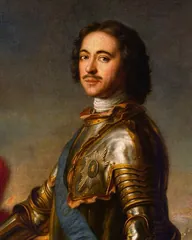
The collection records Peter the Great’s birth in Moscow in 1672. He was the son of Russia’s Tsar Alexei I and Natalya Naryshkina. 1Birth · 9 Jun 1672, Moscow · Probable2Parent · Alexei I of Russia · Confirmed3Parent · Natalya Naryshkina · Confirmed
Peter held the title Tsar of All Russia from 1682 to 1721, when he became Emperor of all the Russias. He ruled jointly with his brother Ivan V from 1682 until Ivan’s death in 1696, and remained emperor until his own death in Saint Petersburg in 1725. 4Title · Tsar of All Russia, 1682–1721 · Confirmed5Title · Emperor of all the Russias, 1721–1725 · Confirmed6Known for · Peter I, known by the epithet the Great, was the tsar of all Russia from 1682 to 1721, and the first emperor of Russia from 1721 until his death in 1725. He reigned jointly with his brother, Ivan V, from 1682 until Ivan's death in 1696. · Probable7Death · 8 Feb 1725, Saint Petersburg · Probable
The collection associates his reign with the Great Northern War, the Battle of Poltava, the Battle of Gangut, the Siege of Vyborg, and the Treaty of Nystad. These entries place his rule within the military and diplomatic history of the era. 8Event · Great Northern War · Confirmed9Event · Battle of Poltava · Confirmed10Event · Battle of Gangut · Confirmed11Event · Siege of Vyborg · Confirmed12Event · Treaty of Nystad · Confirmed
Drafted with AI and edited against the archive. Open a citation to see the record, its sources and how certain it is.
9 Jun 1672
Born in Moscow
1682–1721
Tsar of All Russia
1690–1718
11 children are born
1721–1725
Emperor of all the Russias
8 Feb 1725
Dies in Saint Petersburg, aged 52
He lived through 6 decades. Pick one to hear and see what it was like around Moscow.
General history, not a record about the family: each item says where it comes from.
In the news1670–1671
The Cossack-led uprising of Stepan Razin, which challenged the state and landlords, peaked between 1670 and 1671 before the leader was captured and executed.
At the table
Everyday kvass and hangover remedies
Kvass, a fermented beverage made from rye or barley, was a daily staple for people of all social classes. When feeling unwell, especially after drinking, Russians consumed a specific dish called pokhmelye, made from chopped cold mutton, pickles, spices, vinegar, and brine.
What people wore
Footwear and Winter Warmth
Peasant footwear was typically made from natural materials like tree bark or vine twigs, though some people used leather soles tied with belts. During winter, both men and women relied on sheepskin or hare fur coats to stay warm.
Getting around
Animal-drawn transport in 17th-century Russia
In the 17th century, there were no railways or steamships, so travelers relied on horses and animal-drawn transport such as carriages, carts, and sledges. During the winter, sledges were the preferred vehicle for travel, even for weddings or social visits.
What it cost
Food prices in mid-17th century Moscow
In Moscow during the mid-17th century, a chicken cost 3 kopecks, while a kilogram of bread, pork, oil, or sturgeon also cost approximately 1 kopeck and 3 kopecks, respectively.
Music
Church ban on musical instruments
The Russian Orthodox Church strictly forbade the use of musical instruments in churches, teaching that objects without souls could not praise God. Musical instruments were considered appropriate only for secular settings and private feasts, rather than religious worship.
Daily life
Home and monastery-based education
Children were typically educated at home, focusing on reading, writing, and counting, with some instruction provided by monasteries. Wealthier families also began to introduce foreign languages like Latin and Polish in the 17th century.