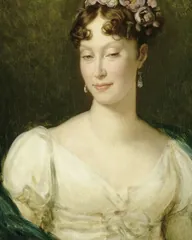
She lived through 6 decades. Pick one to hear and see what it was like around Vienna.
General history, not a record about the family: each item says where it comes from.
The 1790s · Marie is born in Vienna
In the news1799
Anti-Republican Risings (1799)
Popular anti-republican uprisings occurred throughout Italy during the summer and autumn of 1799, reflecting the intense instability following the French invasion and the collapse of the newly formed republican systems.
What people wore
Daily Versus Feast Day Clothing
For daily chores, workers wore simple garments like rough linen blouses, while on feast days they wore finer linen, often distinguished by the quality of the material.
Getting around
Danube boat travel time
The Danube was a vital transport route, where the weekly 'Ordinari' boat from Regensburg to Vienna took at least one week to complete the 450-kilometer journey.
In Europe · 1789–1799
The French Revolution. Parisians stormed the Bastille in 1789; the monarchy fell, the king was executed, and “liberty, equality, fraternity” spread across Europe.
Unidentified painter · public domain
In the news1796
French Invasion and Republics (1796)
French armies invaded Italy in 1796, initiating the era of the Italian Republics and ending the old order of the Settecento. This brought new political systems and constitutions that transformed the map of the peninsula.
Music
Church bells and daily rhythm
Religious music and church bells strictly structured daily life, with the ringing of bells signaling the start of the workday in the morning and its end with the evening Angelus. Religiously-themed customs, pilgrimages, and festivals remained central to the experiences of ordinary people throughout their lives.
Daily life
Lighting costs were a major household expense
Families relied on candles or oil lamps for light, with expensive beeswax candles providing a cleaner flame than cheaper, smoky tallow versions made from animal fat. Small lighting costs were so significant that they led to the common idiom that a task might not be worth the candle.


%20{%20.f%20{%20fill:%20%23EE7466%20}%20.s%20{%20stroke:%20%23EE7466%20}%20}%3c/style%3e%3cdefs%3e%3cfilter%20id='ink-fav'%20x='-5%25'%20y='-5%25'%20width='110%25'%20height='110%25'%3e%3cfeTurbulence%20type='fractalNoise'%20baseFrequency='0.9'%20numOctaves='2'%20seed='7'%20result='n'/%3e%3cfeDisplacementMap%20in='SourceGraphic'%20in2='n'%20scale='2.2'%20result='d'/%3e%3cfeTurbulence%20type='fractalNoise'%20baseFrequency='0.05'%20numOctaves='3'%20seed='18'%20result='blot'/%3e%3cfeColorMatrix%20in='blot'%20type='matrix'%20values='0%200%200%200%200%200%200%200%200%200%200%200%200%200%200%200%200%200%20-1.5%201.62'%20result='m1'/%3e%3cfeTurbulence%20type='fractalNoise'%20baseFrequency='1.6'%20numOctaves='1'%20seed='12'%20result='grain'/%3e%3cfeColorMatrix%20in='grain'%20type='matrix'%20values='0%200%200%200%200%200%200%200%200%200%200%200%200%200%200%200%200%200%20-2.4%202.25'%20result='m2'/%3e%3cfeComposite%20in='m1'%20in2='m2'%20operator='arithmetic'%20k1='1'/%3e%3cfeComposite%20in='d'%20operator='in'/%3e%3c/filter%3e%3c/defs%3e%3cg%20filter='url(%23ink-fav)'%20transform='rotate(-6%2080%2080)'%3e%3ccircle%20class='s'%20cx='80'%20cy='80'%20r='69'%20fill='none'%20stroke-width='16'/%3e%3cpath%20class='f'%20d='M47.33%2044.42Q46.25%2041.94%2045.01%2040.64Q43.77%2039.35%2041.71%2038.75Q39.66%2038.16%2035.67%2037.84L35.67%2033.84L80.16%2033.84L80.16%2037.84Q74.11%2038.27%2071.85%2039.13Q69.58%2040%2069.58%2042.05Q69.58%2043.24%2070.23%2045.07L86.32%2089.57L86.97%2089.57L102.3%2049.61Q103.38%2046.8%20103.38%2044.75Q103.38%2041.83%20100.68%2040.27Q97.98%2038.7%2091.39%2037.84L91.39%2033.84L124.77%2033.84L124.77%2037.84Q119.69%2038.59%20117.15%2039.67Q114.61%2040.75%20113.05%2042.97Q111.48%2045.18%20109.65%2049.82L82.97%20118.08L77.79%20118.08L47.33%2044.42Z'/%3e%3c/g%3e%3c/svg%3e)