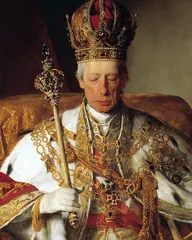
The collection records Francis II as born in Florence in 1768, although the precise birth date remains disputed. He was the son of Leopold II, Holy Roman Emperor, and Maria Luisa of Spain. The collection also records his death in Vienna in 1835. 1Birth · 12 Feb 1768, Florence · Probable2Birth · 14 Feb 1768 · Probable3Parent · Leopold II, Holy Roman Emperor · Confirmed4Parent · Maria Luisa of Spain · Confirmed5Death · 2 Mar 1835, Vienna · Probable
Francis held the title of Holy Roman Emperor from 1792 to 1806. He is remembered as the last Holy Roman Emperor, while also serving as Apostolic King of Hungary and King of Bohemia. From 1804 to 1835, he was Emperor of Austria, making him both the final emperor of the Holy Roman Empire and the first emperor of Austria. 6Title · Holy Roman Emperor, 1792–1806 · Confirmed7Title · Apostolic King of Hungary, 1792–1835 · Confirmed8Title · King of Bohemia, 1792–1835 · Confirmed9Title · Emperor of Austria, 1804–1835 · Confirmed10Known for · Francis II and I was the last Holy Roman Emperor from 1792 to 1806, and the first Emperor of Austria from 1804 to 1835. He was also King of Germany, Hungary, Croatia and Bohemia, and served as the first president of the German Confederation following its establishment in 1815. · Probable11Description · also known as Francis I, Emperor of Austria (1768-1835) · Probable
His family ties included unions with Maria Theresa of Naples and Sicily and Caroline Augusta of Bavaria. The evidence also identifies him as the first president of the German Confederation following its establishment in 1815. These offices and relationships frame the transition from imperial rule over the Holy Roman Empire to a new Austrian imperial identity. 12Union · Maria Theresa of Naples and Sicily · Confirmed13Union · Caroline Augusta of Bavaria · Confirmed10Known for · Francis II and I was the last Holy Roman Emperor from 1792 to 1806, and the first Emperor of Austria from 1804 to 1835. He was also King of Germany, Hungary, Croatia and Bohemia, and served as the first president of the German Confederation following its establishment in 1815. · Probable


%20{%20.f%20{%20fill:%20%23EE7466%20}%20.s%20{%20stroke:%20%23EE7466%20}%20}%3c/style%3e%3cdefs%3e%3cfilter%20id='ink-fav'%20x='-5%25'%20y='-5%25'%20width='110%25'%20height='110%25'%3e%3cfeTurbulence%20type='fractalNoise'%20baseFrequency='0.9'%20numOctaves='2'%20seed='7'%20result='n'/%3e%3cfeDisplacementMap%20in='SourceGraphic'%20in2='n'%20scale='2.2'%20result='d'/%3e%3cfeTurbulence%20type='fractalNoise'%20baseFrequency='0.05'%20numOctaves='3'%20seed='18'%20result='blot'/%3e%3cfeColorMatrix%20in='blot'%20type='matrix'%20values='0%200%200%200%200%200%200%200%200%200%200%200%200%200%200%200%200%200%20-1.5%201.62'%20result='m1'/%3e%3cfeTurbulence%20type='fractalNoise'%20baseFrequency='1.6'%20numOctaves='1'%20seed='12'%20result='grain'/%3e%3cfeColorMatrix%20in='grain'%20type='matrix'%20values='0%200%200%200%200%200%200%200%200%200%200%200%200%200%200%200%200%200%20-2.4%202.25'%20result='m2'/%3e%3cfeComposite%20in='m1'%20in2='m2'%20operator='arithmetic'%20k1='1'/%3e%3cfeComposite%20in='d'%20operator='in'/%3e%3c/filter%3e%3c/defs%3e%3cg%20filter='url(%23ink-fav)'%20transform='rotate(-6%2080%2080)'%3e%3ccircle%20class='s'%20cx='80'%20cy='80'%20r='69'%20fill='none'%20stroke-width='16'/%3e%3cpath%20class='f'%20d='M47.33%2044.42Q46.25%2041.94%2045.01%2040.64Q43.77%2039.35%2041.71%2038.75Q39.66%2038.16%2035.67%2037.84L35.67%2033.84L80.16%2033.84L80.16%2037.84Q74.11%2038.27%2071.85%2039.13Q69.58%2040%2069.58%2042.05Q69.58%2043.24%2070.23%2045.07L86.32%2089.57L86.97%2089.57L102.3%2049.61Q103.38%2046.8%20103.38%2044.75Q103.38%2041.83%20100.68%2040.27Q97.98%2038.7%2091.39%2037.84L91.39%2033.84L124.77%2033.84L124.77%2037.84Q119.69%2038.59%20117.15%2039.67Q114.61%2040.75%20113.05%2042.97Q111.48%2045.18%20109.65%2049.82L82.97%20118.08L77.79%20118.08L47.33%2044.42Z'/%3e%3c/g%3e%3c/svg%3e)