

%20{%20.f%20{%20fill:%20%23EE7466%20}%20.s%20{%20stroke:%20%23EE7466%20}%20}%3c/style%3e%3cdefs%3e%3cfilter%20id='ink-fav'%20x='-5%25'%20y='-5%25'%20width='110%25'%20height='110%25'%3e%3cfeTurbulence%20type='fractalNoise'%20baseFrequency='0.9'%20numOctaves='2'%20seed='7'%20result='n'/%3e%3cfeDisplacementMap%20in='SourceGraphic'%20in2='n'%20scale='2.2'%20result='d'/%3e%3cfeTurbulence%20type='fractalNoise'%20baseFrequency='0.05'%20numOctaves='3'%20seed='18'%20result='blot'/%3e%3cfeColorMatrix%20in='blot'%20type='matrix'%20values='0%200%200%200%200%200%200%200%200%200%200%200%200%200%200%200%200%200%20-1.5%201.62'%20result='m1'/%3e%3cfeTurbulence%20type='fractalNoise'%20baseFrequency='1.6'%20numOctaves='1'%20seed='12'%20result='grain'/%3e%3cfeColorMatrix%20in='grain'%20type='matrix'%20values='0%200%200%200%200%200%200%200%200%200%200%200%200%200%200%200%200%200%20-2.4%202.25'%20result='m2'/%3e%3cfeComposite%20in='m1'%20in2='m2'%20operator='arithmetic'%20k1='1'/%3e%3cfeComposite%20in='d'%20operator='in'/%3e%3c/filter%3e%3c/defs%3e%3cg%20filter='url(%23ink-fav)'%20transform='rotate(-6%2080%2080)'%3e%3ccircle%20class='s'%20cx='80'%20cy='80'%20r='69'%20fill='none'%20stroke-width='16'/%3e%3cpath%20class='f'%20d='M47.33%2044.42Q46.25%2041.94%2045.01%2040.64Q43.77%2039.35%2041.71%2038.75Q39.66%2038.16%2035.67%2037.84L35.67%2033.84L80.16%2033.84L80.16%2037.84Q74.11%2038.27%2071.85%2039.13Q69.58%2040%2069.58%2042.05Q69.58%2043.24%2070.23%2045.07L86.32%2089.57L86.97%2089.57L102.3%2049.61Q103.38%2046.8%20103.38%2044.75Q103.38%2041.83%20100.68%2040.27Q97.98%2038.7%2091.39%2037.84L91.39%2033.84L124.77%2033.84L124.77%2037.84Q119.69%2038.59%20117.15%2039.67Q114.61%2040.75%20113.05%2042.97Q111.48%2045.18%20109.65%2049.82L82.97%20118.08L77.79%20118.08L47.33%2044.42Z'/%3e%3c/g%3e%3c/svg%3e)
In the news1570–1599
Deadly epidemic after 1569
A severe epidemic struck several Prussian cities, with mortality so high in Toruń that corpses were moved by the dozen in carts.
Moscow, 22 Jul 1596 – Moscow, 23 Jul 1645
10 facts3 sources
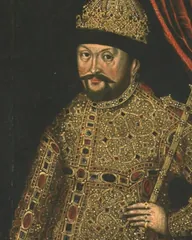
The collection records Michael I as born in Moscow in 1596 and as having died in Moscow in 1645. These dates are listed as probable rather than definitively verified. 1Birth · 22 Jul 1596, Moscow · Probable2Death · 23 Jul 1645, Moscow · Probable
After his election by the Zemsky Sobor in 1613, Michael I held the title Tsar of All Russia until 1645. He also headed the House of Romanov and was its first tsar. The Romanovs succeeded the House of Rurik following the Time of Troubles. 3Title · Tsar of All Russia, 1613–1645 · Confirmed4Title · Head of the House of Romanov · Confirmed5Known for · Michael I was Tsar of all Russia from 1613 after being elected by the Zemsky Sobor of 1613 until his death in 1645. He was the first tsar of the House of Romanov, which succeeded the House of Rurik following the Time of Troubles. · Probable
Michael I’s recorded family connections include unions with Eudoxia Streshneva and Maria Dolgorukova, identifying both women as part of his dynastic relationships. 6Union · Eudoxia Streshneva · Confirmed7Union · Maria Dolgorukova · Confirmed
Drafted with AI and edited against the archive. Open a citation to see the record, its sources and how certain it is.
22 Jul 1596
Born in Moscow
1613–1645
Tsar of All Russia
1627–1639
10 children are born
23 Jul 1645
Dies in Moscow, aged 49
He lived through 6 decades. Pick one to hear and see what it was like around Moscow.
General history, not a record about the family: each item says where it comes from.
In the news1570–1599
A severe epidemic struck several Prussian cities, with mortality so high in Toruń that corpses were moved by the dozen in carts.
Getting around
Challenging roads and poor lodging conditions
Deep, sandy, or muddy roads often forced travelers to stop frequently, and horses could become exhausted by heat and insects, necessitating breaks until temperatures dropped. Some travelers carried their own beds to ensure comfort when staying in poor-quality wayside inns.
In the news1598
In 1598, the Prussian estates adopted a new legal code, the Correction of Prussian Law, which standardized private and procedural law across the region.
Daily life
Simple wooden schoolhouses
School buildings were typically wooden and often consisted of only one room, which served as both the classroom and the teacher's living quarters. Many of these structures were poorly constructed and lacked chimneys.
What people wore
Carrying Cash in Needle Cases
Peasant men and women working in the fields often carried small amounts of cash in purses attached to their belts, specifically in needle cases, possibly for safety. In one 1540 incident, ten men and ten women working in a meadow were robbed of items including ten belts with needle cases that contained a total of 1.5 kopa grossi.
Music
Elite music societies in Prussian towns
Elite music societies called collegia musica were established in towns like Kwidzyn to provide polyphonic music for church services and education.
At the table
Meager diet of the rural peasantry
Ordinary peasants often relied on a meager diet consisting of black bread and porridge, frequently eaten without any added fat, while drinking plain water.