

%20{%20.f%20{%20fill:%20%23EE7466%20}%20.s%20{%20stroke:%20%23EE7466%20}%20}%3c/style%3e%3cdefs%3e%3cfilter%20id='ink-fav'%20x='-5%25'%20y='-5%25'%20width='110%25'%20height='110%25'%3e%3cfeTurbulence%20type='fractalNoise'%20baseFrequency='0.9'%20numOctaves='2'%20seed='7'%20result='n'/%3e%3cfeDisplacementMap%20in='SourceGraphic'%20in2='n'%20scale='2.2'%20result='d'/%3e%3cfeTurbulence%20type='fractalNoise'%20baseFrequency='0.05'%20numOctaves='3'%20seed='18'%20result='blot'/%3e%3cfeColorMatrix%20in='blot'%20type='matrix'%20values='0%200%200%200%200%200%200%200%200%200%200%200%200%200%200%200%200%200%20-1.5%201.62'%20result='m1'/%3e%3cfeTurbulence%20type='fractalNoise'%20baseFrequency='1.6'%20numOctaves='1'%20seed='12'%20result='grain'/%3e%3cfeColorMatrix%20in='grain'%20type='matrix'%20values='0%200%200%200%200%200%200%200%200%200%200%200%200%200%200%200%200%200%20-2.4%202.25'%20result='m2'/%3e%3cfeComposite%20in='m1'%20in2='m2'%20operator='arithmetic'%20k1='1'/%3e%3cfeComposite%20in='d'%20operator='in'/%3e%3c/filter%3e%3c/defs%3e%3cg%20filter='url(%23ink-fav)'%20transform='rotate(-6%2080%2080)'%3e%3ccircle%20class='s'%20cx='80'%20cy='80'%20r='69'%20fill='none'%20stroke-width='16'/%3e%3cpath%20class='f'%20d='M47.33%2044.42Q46.25%2041.94%2045.01%2040.64Q43.77%2039.35%2041.71%2038.75Q39.66%2038.16%2035.67%2037.84L35.67%2033.84L80.16%2033.84L80.16%2037.84Q74.11%2038.27%2071.85%2039.13Q69.58%2040%2069.58%2042.05Q69.58%2043.24%2070.23%2045.07L86.32%2089.57L86.97%2089.57L102.3%2049.61Q103.38%2046.8%20103.38%2044.75Q103.38%2041.83%20100.68%2040.27Q97.98%2038.7%2091.39%2037.84L91.39%2033.84L124.77%2033.84L124.77%2037.84Q119.69%2038.59%20117.15%2039.67Q114.61%2040.75%20113.05%2042.97Q111.48%2045.18%20109.65%2049.82L82.97%20118.08L77.79%20118.08L47.33%2044.42Z'/%3e%3c/g%3e%3c/svg%3e)
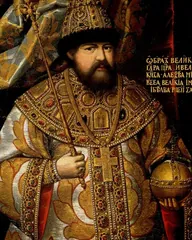
Alexei I of Russia
Moscow, 20 Mar 1629 – Moscow, 8 Feb 1676
12 facts3 sources
About Alexei I
Alexei I of Russia: Tsar of a Troubled Reign
AI-assisted · editedThe collection records Alexei Mikhailovich, also known as Alexis, as born in Moscow in 1629, although the precise date is disputed. His parents were Michael I of Russia and Eudoxia Streshneva. 1Birth · 20 Mar 1629, Moscow · Probable2Birth · 27 Mar 1629 · Probable3Birth · 29 Mar 1629 · Probable4Known for · Alexei Mikhailovich, also known as Alexis, was Tsar of all Russia from 1645 until his death in 1676. He was the second Russian tsar from the House of Romanov. · Probable5Parent · Michael I of Russia · Confirmed6Parent · Eudoxia Streshneva · Confirmed
Alexei was Tsar of Russia from 1645 to 1676 and held the title Prince of Moscow. His reign was marked by wars with Poland and Sweden, an internal schism in the Russian Orthodox Church, and the Cossack revolt of Stenka Razin. 7Description · Tsar of Russia (1645–1676) · Probable8Title · Prince of Moscow, 1645–1676 · Confirmed4Known for · Alexei Mikhailovich, also known as Alexis, was Tsar of all Russia from 1645 until his death in 1676. He was the second Russian tsar from the House of Romanov. · Probable
The collection records his death in Moscow in 1676, with the precise date disputed between 8 and 9 February. These uncertain dates, together with the conflicting birth dates, identify areas where further archival verification is needed. 9Death · 8 Feb 1676, Moscow · Probable10Death · 9 Feb 1676 · Probable1Birth · 20 Mar 1629, Moscow · Probable2Birth · 27 Mar 1629 · Probable3Birth · 29 Mar 1629 · Probable
Drafted with AI and edited against the archive. Open a citation to see the record, its sources and how certain it is.
Facts and their sources
- Born20 Mar 1629, Moscowor 29 Mar 1629 · 27 Mar 1629Records disagree1 source
- TitlePrince of Moscow, 1645–1676Verified · Vitrine1 source
- Died8 Feb 1676, Moscowor 9 Feb 1676Records disagree1 source
A life in time
20 Mar 1629
Born in Moscow
1645–1676
Prince of Moscow
1648–1674
15 children are born
8 Feb 1676
Dies in Moscow, aged 46
Family
See the treeParents
Partners
Children · 15
- Tsarevich Dmitry Alexeyevich of RussiaSon · 1648–1649
- Tsarevna Yevdokia Alekseyevna of RussiaDaughter · 1650–1712
- Marfa Alekseyevna of RussiaDaughter · 1652–1707
- Tsarevich Alexei Alexeyevich of RussiaSon · 1654–1670
- Anna Alexeevna RomanovaDaughter · 1655–1659
- Sophia Alekseyevna of RussiaDaughter · 1657–1704
- 9 more in the tree
During his lifetime
He lived through 6 decades. Pick one to hear and see what it was like around Moscow.
General history, not a record about the family: each item says where it comes from.
The 1620s · Alexei I is born in Moscow
What people wore
Footwear and practical peasant attire
Ordinary people commonly wore bast shoes woven from tree bark or vine twigs, though some used leather soles tied with belts. Zepya, or pockets, were sewn into peasant trousers, which were typically made of canvas or coarse wool.
Daily life
The multipurpose masonry stove
The massive masonry stove, occupying nearly a quarter of the home, was used for heating, cooking, and as a primary sleeping area. It was so efficient that it could keep food hot from the morning until lunch.
Work
Non-stop Harvest Labor
During the intense harvest season in late summer, work continued seven days a week, often lasting from dawn until dusk and sometimes continuing by moonlight or torchlight to ensure the crop was saved. This period of extreme physical exertion was a constant struggle for survival for the serf families.
Music
Destruction of Forbidden Musical Instruments
In 1636 and 1648, authorities confiscated and publicly burned carts filled with folk instruments like domras, bagpipes, and flutes to suppress performances. Owners found with these forbidden instruments faced severe punishment, including flogging and exile.
At the table
Kvass was the most common daily drink
Common folk drank kvass, a fermented beverage made from rye or barley malt, daily. Alcohol such as beer and honey-based drinks were also consumed, though rural residents often produced these at home, while urban tavern customers spent an average of about 3 rubles and 66 kopecks annually on drinks.
Getting around
Carrying Supplies for Long Journeys
Because inns were rare, travelers were advised to carry essential supplies including an axe, fire-starting equipment, a cooking pot, and food for the entire duration of the journey. In the 16th and 17th centuries, many travelers were forced to camp under the open sky along riverbanks.
What it cost
Monthly earnings for skilled workers
In the mid-17th century, a stonemason or carpenter in Moscow typically earned between 20 and 40 kopecks per month for a 12-hour workday.