

%20{%20.f%20{%20fill:%20%23EE7466%20}%20.s%20{%20stroke:%20%23EE7466%20}%20}%3c/style%3e%3cdefs%3e%3cfilter%20id='ink-fav'%20x='-5%25'%20y='-5%25'%20width='110%25'%20height='110%25'%3e%3cfeTurbulence%20type='fractalNoise'%20baseFrequency='0.9'%20numOctaves='2'%20seed='7'%20result='n'/%3e%3cfeDisplacementMap%20in='SourceGraphic'%20in2='n'%20scale='2.2'%20result='d'/%3e%3cfeTurbulence%20type='fractalNoise'%20baseFrequency='0.05'%20numOctaves='3'%20seed='18'%20result='blot'/%3e%3cfeColorMatrix%20in='blot'%20type='matrix'%20values='0%200%200%200%200%200%200%200%200%200%200%200%200%200%200%200%200%200%20-1.5%201.62'%20result='m1'/%3e%3cfeTurbulence%20type='fractalNoise'%20baseFrequency='1.6'%20numOctaves='1'%20seed='12'%20result='grain'/%3e%3cfeColorMatrix%20in='grain'%20type='matrix'%20values='0%200%200%200%200%200%200%200%200%200%200%200%200%200%200%200%200%200%20-2.4%202.25'%20result='m2'/%3e%3cfeComposite%20in='m1'%20in2='m2'%20operator='arithmetic'%20k1='1'/%3e%3cfeComposite%20in='d'%20operator='in'/%3e%3c/filter%3e%3c/defs%3e%3cg%20filter='url(%23ink-fav)'%20transform='rotate(-6%2080%2080)'%3e%3ccircle%20class='s'%20cx='80'%20cy='80'%20r='69'%20fill='none'%20stroke-width='16'/%3e%3cpath%20class='f'%20d='M47.33%2044.42Q46.25%2041.94%2045.01%2040.64Q43.77%2039.35%2041.71%2038.75Q39.66%2038.16%2035.67%2037.84L35.67%2033.84L80.16%2033.84L80.16%2037.84Q74.11%2038.27%2071.85%2039.13Q69.58%2040%2069.58%2042.05Q69.58%2043.24%2070.23%2045.07L86.32%2089.57L86.97%2089.57L102.3%2049.61Q103.38%2046.8%20103.38%2044.75Q103.38%2041.83%20100.68%2040.27Q97.98%2038.7%2091.39%2037.84L91.39%2033.84L124.77%2033.84L124.77%2037.84Q119.69%2038.59%20117.15%2039.67Q114.61%2040.75%20113.05%2042.97Q111.48%2045.18%20109.65%2049.82L82.97%20118.08L77.79%20118.08L47.33%2044.42Z'/%3e%3c/g%3e%3c/svg%3e)
In the news1840
Introduction of the Penny Post
The Uniform Penny Post was introduced in 1840, making mail affordable and leading to a five-fold increase in sent letters.
Also known as Bertie (nickname)
Buckingham Palace, 9 Nov 1841 – Buckingham Palace, 6 May 1910
17 facts3 sources
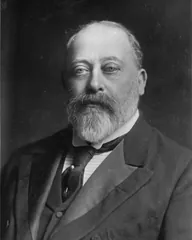
The collection records Edward VII’s birth in 1841 at Buckingham Palace. The family evidence identifies Queen Victoria as his mother and Prince Albert of Saxe-Coburg and Gotha as his father; the collection’s summary further describes him as Victoria’s eldest son. 1Birth · 9 Nov 1841, Buckingham Palace · Probable2Parent · Prince Albert of Saxe-Coburg and Gotha · Confirmed3Parent · Victoria · Confirmed4Known for · Edward VII was King of the United Kingdom and the British Dominions, and Emperor of India, from 22 January 1901 until his death in 1910. · Probable
Before his accession, Edward was Prince of Wales from 1841 to 1901. He then served as monarch of the United Kingdom of Great Britain and Ireland from 1901 to 1910. 5Title · Prince of Wales, 1841–1901 · Confirmed6Title · monarch of the United Kingdom of Great Britain and Ireland, 1901–1910 · Confirmed
The collection also records his death in 1910 at Buckingham Palace. The collection’s summary describes his more-than-nine-year reign as a period known as the Edwardian era. 7Death · 6 May 1910, Buckingham Palace · Probable4Known for · Edward VII was King of the United Kingdom and the British Dominions, and Emperor of India, from 22 January 1901 until his death in 1910. · Probable
Drafted with AI and edited against the archive. Open a citation to see the record, its sources and how certain it is.
1841–1901
Lord High Steward of Scotland
1841–1901
Prince of Wales
9 Nov 1841
Born in Buckingham Palace
1864–1871
6 children are born
1901–1910
Monarch of the United Kingdom of Great Britain and Ireland
1901–1910
Emperor of India
1901–1910
Monarch of Canada
6 May 1910
Dies in Buckingham Palace, aged 68
He lived through 8 decades. Pick one to hear and see what it was like around Buckingham Palace.
General history, not a record about the family: each item says where it comes from.
In the news1840
The Uniform Penny Post was introduced in 1840, making mail affordable and leading to a five-fold increase in sent letters.
Getting around
Steam ships slashed river travel times
Before steam packets, a boat trip from Gainsborough to Hull could take four to seven days; by 1833, a steam packet could travel the 104-mile return journey in a single day.
At the table
Widespread Adulteration of Basic Foods
Adulteration was widespread, with milk frequently mixed with chalk and water, and butter often colored with added copper.
 In Europe · 1848
The Revolutions of 1848. Uprisings spread from Paris to Vienna, Berlin and Milan; most were put down, but serfdom ended in Austria.
What people wore
The Monthly Laundry Operation
Laundry was so time-consuming that large households might only wash once a month, performing a massive operation lasting up to a week that disrupted the entire house.
Music
Diverse instruments in nineteenth-century dance bands
In the 1830s, dance bands often featured a diverse range of instruments including violins, cellos, double bass, harps, horns, clarinets, and flageolets. Innovations also included mechanical instruments like the flageolet piano, which could play dance music with the effect of multiple instruments.
Daily life
Candlelight and rushlights provided minimal illumination
Without electricity or gas, ordinary people relied on simple tallow candles or rushlights dipped in animal fat, which burned for only about one hour each.