

%20{%20.f%20{%20fill:%20%23EE7466%20}%20.s%20{%20stroke:%20%23EE7466%20}%20}%3c/style%3e%3cdefs%3e%3cfilter%20id='ink-fav'%20x='-5%25'%20y='-5%25'%20width='110%25'%20height='110%25'%3e%3cfeTurbulence%20type='fractalNoise'%20baseFrequency='0.9'%20numOctaves='2'%20seed='7'%20result='n'/%3e%3cfeDisplacementMap%20in='SourceGraphic'%20in2='n'%20scale='2.2'%20result='d'/%3e%3cfeTurbulence%20type='fractalNoise'%20baseFrequency='0.05'%20numOctaves='3'%20seed='18'%20result='blot'/%3e%3cfeColorMatrix%20in='blot'%20type='matrix'%20values='0%200%200%200%200%200%200%200%200%200%200%200%200%200%200%200%200%200%20-1.5%201.62'%20result='m1'/%3e%3cfeTurbulence%20type='fractalNoise'%20baseFrequency='1.6'%20numOctaves='1'%20seed='12'%20result='grain'/%3e%3cfeColorMatrix%20in='grain'%20type='matrix'%20values='0%200%200%200%200%200%200%200%200%200%200%200%200%200%200%200%200%200%20-2.4%202.25'%20result='m2'/%3e%3cfeComposite%20in='m1'%20in2='m2'%20operator='arithmetic'%20k1='1'/%3e%3cfeComposite%20in='d'%20operator='in'/%3e%3c/filter%3e%3c/defs%3e%3cg%20filter='url(%23ink-fav)'%20transform='rotate(-6%2080%2080)'%3e%3ccircle%20class='s'%20cx='80'%20cy='80'%20r='69'%20fill='none'%20stroke-width='16'/%3e%3cpath%20class='f'%20d='M47.33%2044.42Q46.25%2041.94%2045.01%2040.64Q43.77%2039.35%2041.71%2038.75Q39.66%2038.16%2035.67%2037.84L35.67%2033.84L80.16%2033.84L80.16%2037.84Q74.11%2038.27%2071.85%2039.13Q69.58%2040%2069.58%2042.05Q69.58%2043.24%2070.23%2045.07L86.32%2089.57L86.97%2089.57L102.3%2049.61Q103.38%2046.8%20103.38%2044.75Q103.38%2041.83%20100.68%2040.27Q97.98%2038.7%2091.39%2037.84L91.39%2033.84L124.77%2033.84L124.77%2037.84Q119.69%2038.59%20117.15%2039.67Q114.61%2040.75%20113.05%2042.97Q111.48%2045.18%20109.65%2049.82L82.97%20118.08L77.79%20118.08L47.33%2044.42Z'/%3e%3c/g%3e%3c/svg%3e)
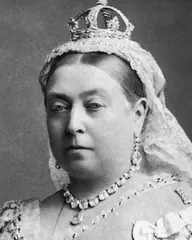
About Victoria
Queen Victoria: A Long Reign and Imperial Titles
AI-assisted · editedThe collection records Victoria’s birth in 1819 at Kensington Palace and her death in 1901 at Osborne House. Her parents were Princess Victoria of Saxe-Coburg-Saalfeld and Prince Edward, Duke of Kent and Strathearn. 1Birth · 24 May 1819, Kensington Palace · Probable2Death · 22 Jan 1901, Osborne House · Probable3Parent · Princess Victoria of Saxe-Coburg-Saalfeld · Confirmed4Parent · Prince Edward, Duke of Kent and Strathearn · Confirmed
Victoria reigned as monarch of the United Kingdom of Great Britain and Ireland from 1837 to 1901. She also held the title of Empress of India from 1876 to 1901. Her reign of 63 years and 216 days was longer than that of any of her predecessors. 5Title · monarch of the United Kingdom of Great Britain and Ireland, 1837–1901 · Confirmed6Title · Emperor of India, 1876–1901 · Confirmed7Known for · Victoria was Queen of the United Kingdom of Great Britain and Ireland from 20 June 1837 until her death in 1901. Her reign of 63 years and 216 days, which was longer than those of any of her predecessors, constituted the Victorian era, a period of industrial, political, scientific, and military change within the United Kingdom marked by a great expansion of the British Empire. · Probable
Her coronation took place in 1838. The era that bears her name is described as a period of industrial, political, scientific, and military change within the United Kingdom, marked by a great expansion of the British Empire. 8Event · coronation of Queen Victoria, 1838 · Confirmed7Known for · Victoria was Queen of the United Kingdom of Great Britain and Ireland from 20 June 1837 until her death in 1901. Her reign of 63 years and 216 days, which was longer than those of any of her predecessors, constituted the Victorian era, a period of industrial, political, scientific, and military change within the United Kingdom marked by a great expansion of the British Empire. · Probable6Title · Emperor of India, 1876–1901 · Confirmed
Drafted with AI and edited against the archive. Open a citation to see the record, its sources and how certain it is.
Facts and their sources
- Born24 May 1819, Kensington PalaceVerified · Vitrine1 source
- Titlemonarch of the United Kingdom of Great Britain and Ireland, 1837–1901or monarch of Canada, 1867–1901 · Emperor of India, 1876–1901Verified · Vitrine1 source
- Titlemonarch of Canada, 1867–1901or monarch of the United Kingdom of Great Britain and Ireland, 1837–1901 · Emperor of India, 1876–1901Verified · Vitrine1 source
- TitleEmperor of India, 1876–1901or monarch of the United Kingdom of Great Britain and Ireland, 1837–1901 · monarch of Canada, 1867–1901Verified · Vitrine1 source
- EventCoronation of Queen Victoria, 1838Verified · Vitrine1 source
- Died22 Jan 1901, Osborne HouseVerified · Vitrine1 source
A life in time
24 May 1819
Born in Kensington Palace
1837–1901
Monarch of the United Kingdom of Great Britain and Ireland
1838
Coronation of Queen Victoria
1840–1857
9 children are born
1867–1901
Monarch of Canada
1876–1901
Emperor of India
22 Jan 1901
Dies in Osborne House, aged 81
Family
See the treeParents
Partner
Children · 9
- Victoria, Princess RoyalDaughter · 1840–1901
- Edward VIISon · 1841–1910
- Princess Alice of the United KingdomDaughter · 1843–1878
- Alfred, Duke of Saxe-Coburg and GothaSon · 1844–1900
- Princess Helena of the United KingdomDaughter · 1846–1923
- Princess Louise, Duchess of ArgyllDaughter · 1848–1939
- 3 more in the tree
During her lifetime
She lived through 10 decades. Pick one to hear and see what it was like around Kensington Palace.
General history, not a record about the family: each item says where it comes from.
The 1810s · Victoria is born in Kensington Palace
What people wore
Everyday attire of working men
Working men typically wore a shirt, waistcoat, heavy wool coat, handkerchief, stockings, and a hat, with breeches being common until trousers gained popularity after 1800.
Getting around
Comparing stage-wagon and stagecoach speeds
Stage-wagons, which were the slow trucks of the era, charged about one penny per mile and could take nearly three days to cover 101 miles. In contrast, by 1800, a fast stagecoach could cover 168 miles in 32 hours.
At the table
Tea Becomes a Staple Drink
By the early 19th century, tea had moved down the social scale and became a staple drink, often served with bread, which was frequently the only meal for the poor.
 In Europe · 1803–1815
The Napoleonic Wars. Napoleon’s armies redrew the map of Europe from Spain to Moscow; his invasion of Portugal sent its court to Rio de Janeiro.
Music
Popular dance instrument
The tabor and pipe, featuring a small drum and a single-handed three-holed pipe, remained a popular and enduring instrument for dance bands well into the 1820s.
Daily life
Sunday School Rewards and Wages
Sunday school teachers were paid 1s. 6d. for the Sunday to teach children to read and spell. Attendance was often ensured by giving children sweets and gingerbread as rewards.
What it cost
Weekly earnings for workers
A skilled workman could earn up to two pounds per week, while farm labourers typically earned nine to twelve shillings.