

%20{%20.f%20{%20fill:%20%23EE7466%20}%20.s%20{%20stroke:%20%23EE7466%20}%20}%3c/style%3e%3cdefs%3e%3cfilter%20id='ink-fav'%20x='-5%25'%20y='-5%25'%20width='110%25'%20height='110%25'%3e%3cfeTurbulence%20type='fractalNoise'%20baseFrequency='0.9'%20numOctaves='2'%20seed='7'%20result='n'/%3e%3cfeDisplacementMap%20in='SourceGraphic'%20in2='n'%20scale='2.2'%20result='d'/%3e%3cfeTurbulence%20type='fractalNoise'%20baseFrequency='0.05'%20numOctaves='3'%20seed='18'%20result='blot'/%3e%3cfeColorMatrix%20in='blot'%20type='matrix'%20values='0%200%200%200%200%200%200%200%200%200%200%200%200%200%200%200%200%200%20-1.5%201.62'%20result='m1'/%3e%3cfeTurbulence%20type='fractalNoise'%20baseFrequency='1.6'%20numOctaves='1'%20seed='12'%20result='grain'/%3e%3cfeColorMatrix%20in='grain'%20type='matrix'%20values='0%200%200%200%200%200%200%200%200%200%200%200%200%200%200%200%200%200%20-2.4%202.25'%20result='m2'/%3e%3cfeComposite%20in='m1'%20in2='m2'%20operator='arithmetic'%20k1='1'/%3e%3cfeComposite%20in='d'%20operator='in'/%3e%3c/filter%3e%3c/defs%3e%3cg%20filter='url(%23ink-fav)'%20transform='rotate(-6%2080%2080)'%3e%3ccircle%20class='s'%20cx='80'%20cy='80'%20r='69'%20fill='none'%20stroke-width='16'/%3e%3cpath%20class='f'%20d='M47.33%2044.42Q46.25%2041.94%2045.01%2040.64Q43.77%2039.35%2041.71%2038.75Q39.66%2038.16%2035.67%2037.84L35.67%2033.84L80.16%2033.84L80.16%2037.84Q74.11%2038.27%2071.85%2039.13Q69.58%2040%2069.58%2042.05Q69.58%2043.24%2070.23%2045.07L86.32%2089.57L86.97%2089.57L102.3%2049.61Q103.38%2046.8%20103.38%2044.75Q103.38%2041.83%20100.68%2040.27Q97.98%2038.7%2091.39%2037.84L91.39%2033.84L124.77%2033.84L124.77%2037.84Q119.69%2038.59%20117.15%2039.67Q114.61%2040.75%20113.05%2042.97Q111.48%2045.18%20109.65%2049.82L82.97%20118.08L77.79%20118.08L47.33%2044.42Z'/%3e%3c/g%3e%3c/svg%3e)
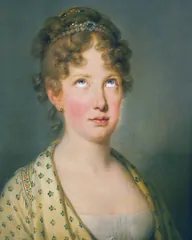
Maria Leopoldina of Austria
Vienna, 22 Jan 1797 – Rio de Janeiro, 11 Dec 1826
10 facts3 sources
About Maria
Leopoldina: family connections and royal offices
AI-assisted · editedThe collection records Maria Leopoldina’s birth in Vienna on 22 January 1797. Her parents were Francis II, Holy Roman Emperor, and Maria Theresa of Naples and Sicily. A recorded union with Pedro I connects that European family background to the Brazilian imperial family. 1Birth · 22 Jan 1797, Vienna · Probable2Parent · Francis II, Holy Roman Emperor · Confirmed3Parent · Maria Theresa of Naples and Sicily · Confirmed4Union · Pedro I of Brazil · Confirmed
The biographical summary identifies Leopoldina as the first Empress consort of Brazil, from 12 October 1822 until her death. It also records her as Queen consort of Portugal during Pedro’s brief Portuguese reign, from 10 March to 2 May 1826. These distinct titles connect her biography to both monarchies without implying that she travelled to every country named in a title. 5Known for · Dona Maria Leopoldina of Austria was the first Empress of Brazil as the wife of Emperor Dom Pedro I from 12 October 1822 until her death. She was also Queen of Portugal during her husband's brief reign as King Dom Pedro IV from 10 March to 2 May 1826. · Probable
A separate record identifies her as regent, though it supplies no dates for that office. Her death is recorded in Rio de Janeiro on 11 December 1826. Together, these entries preserve both family relationships and a public role that deserves further documentary investigation. 6Title · regent · Confirmed7Death · 11 Dec 1826, Rio de Janeiro · Probable
Drafted with AI and edited against the archive. Open a citation to see the record, its sources and how certain it is.
Facts and their sources
- Born22 Jan 1797, ViennaVerified · Vitrine1 source
- TitleregentVerified · Vitrine1 source
- Died11 Dec 1826, Rio de JaneiroVerified · Vitrine1 source
A life in time
22 Jan 1797
Born in Vienna
1819–1825
7 children are born
11 Dec 1826
Dies in Rio de Janeiro, aged 29
Family
See the treeParents
Partner
Children · 7
During her lifetime
She lived through 4 decades. Pick one to hear and see what it was like around Vienna.
General history, not a record about the family: each item says where it comes from.
The 1790s · Maria is born in Vienna
Who governed
- Maria I of Portugal(opens in a new tab)
Monarch of Portugal, 1777–1816 · Portuguese colony of Brazil
Music
A musician's typical annual work schedule
A local musician named Stelzl kept a ledger showing he was hired to play for dances an average of 14 times per year.
Daily life
Compulsory schooling for children began in 1774
In 1774, Empress Maria Theresa made elementary education compulsory for children aged six to twelve, though many still learned at home. Schools were required to be separate from the teacher's living quarters to prevent domestic disturbances.
What it cost
Regulated price of bread
Bread prices were regulated in Rio Grande, with a unit weighing 0.575 kilograms costing a constant 40 réis between 1792 and 1803.
 In Europe · 1789–1799
The French Revolution. Parisians stormed the Bastille in 1789; the monarchy fell, the king was executed, and “liberty, equality, fraternity” spread across Europe.
What people wore
Clothing as Annual Servant Wages
Servants often received clothes as part of their annual wages, but these garments were made of less durable fabrics and inferior thread, causing them to wear out quickly within a year.
Getting around
Travel on foot for ordinary people
Ordinary people typically traveled between towns on foot, covering about 20 to 35 kilometers per day, as they could not afford horses or coaches.
At the table
Potatoes become a staple food
During the second half of the eighteenth century, the potato became a vital staple food for lower social classes in the Habsburg monarchy because it was cheap, easy to grow, and yielded more than cereals.