

%20{%20.f%20{%20fill:%20%23EE7466%20}%20.s%20{%20stroke:%20%23EE7466%20}%20}%3c/style%3e%3cdefs%3e%3cfilter%20id='ink-fav'%20x='-5%25'%20y='-5%25'%20width='110%25'%20height='110%25'%3e%3cfeTurbulence%20type='fractalNoise'%20baseFrequency='0.9'%20numOctaves='2'%20seed='7'%20result='n'/%3e%3cfeDisplacementMap%20in='SourceGraphic'%20in2='n'%20scale='2.2'%20result='d'/%3e%3cfeTurbulence%20type='fractalNoise'%20baseFrequency='0.05'%20numOctaves='3'%20seed='18'%20result='blot'/%3e%3cfeColorMatrix%20in='blot'%20type='matrix'%20values='0%200%200%200%200%200%200%200%200%200%200%200%200%200%200%200%200%200%20-1.5%201.62'%20result='m1'/%3e%3cfeTurbulence%20type='fractalNoise'%20baseFrequency='1.6'%20numOctaves='1'%20seed='12'%20result='grain'/%3e%3cfeColorMatrix%20in='grain'%20type='matrix'%20values='0%200%200%200%200%200%200%200%200%200%200%200%200%200%200%200%200%200%20-2.4%202.25'%20result='m2'/%3e%3cfeComposite%20in='m1'%20in2='m2'%20operator='arithmetic'%20k1='1'/%3e%3cfeComposite%20in='d'%20operator='in'/%3e%3c/filter%3e%3c/defs%3e%3cg%20filter='url(%23ink-fav)'%20transform='rotate(-6%2080%2080)'%3e%3ccircle%20class='s'%20cx='80'%20cy='80'%20r='69'%20fill='none'%20stroke-width='16'/%3e%3cpath%20class='f'%20d='M47.33%2044.42Q46.25%2041.94%2045.01%2040.64Q43.77%2039.35%2041.71%2038.75Q39.66%2038.16%2035.67%2037.84L35.67%2033.84L80.16%2033.84L80.16%2037.84Q74.11%2038.27%2071.85%2039.13Q69.58%2040%2069.58%2042.05Q69.58%2043.24%2070.23%2045.07L86.32%2089.57L86.97%2089.57L102.3%2049.61Q103.38%2046.8%20103.38%2044.75Q103.38%2041.83%20100.68%2040.27Q97.98%2038.7%2091.39%2037.84L91.39%2033.84L124.77%2033.84L124.77%2037.84Q119.69%2038.59%20117.15%2039.67Q114.61%2040.75%20113.05%2042.97Q111.48%2045.18%20109.65%2049.82L82.97%20118.08L77.79%20118.08L47.33%2044.42Z'/%3e%3c/g%3e%3c/svg%3e)
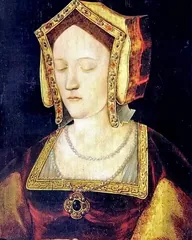
Catherine of Aragon
Alcalá de Henares, 16 Dec 1485 – Kimbolton Castle, 17 Jan 1536
11 facts3 sources
About Catherine
Catherine of Aragon: Dynasty, Diplomacy, and Marriage
AI-assisted · editedThe collection records Catherine of Aragon’s birth in 1485 at Alcalá de Henares. She was the daughter of Isabella I of Castile and Ferdinand II of Aragon. Between 1507 and 1509, she also served as ambassador of the Kingdom of Spain to the Kingdom of England, a notable diplomatic office in her early life. 1Birth · 16 Dec 1485, Alcalá de Henares · Probable2Parent · Isabella I of Castile · Confirmed3Parent · Ferdinand II of Aragon · Confirmed4Title · Ambassador of the Kingdom of Spain to the Kingdom of England, 1507–1509 · Confirmed
Catherine first married Arthur, Prince of Wales, and was briefly Princess of Wales before his death. She later married Henry VIII of England and became his first wife. According to the summary, she was Queen of England from their marriage in 1509 until its annulment in 1533. 5Union · Arthur, Prince of Wales · Confirmed6Known for · Catherine of Aragon was Queen of England as the first wife of Henry VIII from their marriage on 11 June 1509 until its annulment on 23 May 1533. She had previously been Princess of Wales as the wife of Henry's elder brother Arthur, Prince of Wales for a short time before his death. · Probable7Union · Henry VIII of England · Confirmed8Description · first wife of Henry VIII of England (1485–1536) · Probable
The collection records her death in 1536 at Kimbolton Castle. 9Death · 17 Jan 1536, Kimbolton Castle · Probable2Parent · Isabella I of Castile · Confirmed3Parent · Ferdinand II of Aragon · Confirmed4Title · Ambassador of the Kingdom of Spain to the Kingdom of England, 1507–1509 · Confirmed6Known for · Catherine of Aragon was Queen of England as the first wife of Henry VIII from their marriage on 11 June 1509 until its annulment on 23 May 1533. She had previously been Princess of Wales as the wife of Henry's elder brother Arthur, Prince of Wales for a short time before his death. · Probable7Union · Henry VIII of England · Confirmed5Union · Arthur, Prince of Wales · Confirmed
Drafted with AI and edited against the archive. Open a citation to see the record, its sources and how certain it is.
Facts and their sources
- Born16 Dec 1485, Alcalá de HenaresVerified · Vitrine1 source
- TitleAmbassador of the Kingdom of Spain to the Kingdom of England, 1507–1509Verified · Vitrine1 source
- Died17 Jan 1536, Kimbolton CastleVerified · Vitrine1 source
A life in time
16 Dec 1485
Born in Alcalá de Henares
1507–1509
Ambassador of the Kingdom of Spain to the Kingdom of England
1511–1516
4 children are born
17 Jan 1536
Dies in Kimbolton Castle, aged 50
Family
See the treeParents
Partners
Children · 4
During her lifetime
She lived through 6 decades. Pick one to hear and see what it was like around Alcalá de Henares.
General history, not a record about the family: each item says where it comes from.
The 1480s · Catherine is born in Alcalá de Henares
What people wore
Around 1500–1524The Colorful Woolen Tunic Called Saya
Ordinary people wore a tunic called a saya, which was often made of wool and dyed in various colors like red, purple, ocher, blue, green, white, or black. It was typically worn by peasants and artisans, sometimes featuring an open neck known as an amigaut.
Daily life
Around 1500–1524Domestic heating and cleaning methods
Households used braziers to heat laundry and water for cleaning, as homes lacked modern amenities like running water.
Work
Around 1500–1524Seasonal and domestic labor rhythms
Daily life followed seasonal tasks like the pig slaughter in November, a scene frequently depicted in medieval carvings and paintings. Household chores often centered around the hearth, where servants and family members performed tasks like drying laundry.
Music
Around 1500–1524Cathedral music and instrument maintenance
In the Pamplona Cathedral during the early 16th century, musicians such as chirimia players were officially employed, and payments for instrument maintenance, like repairing a bajon, were recorded in ducats.
At the table
Around 1500–1524Large feasts and local wine consumption
Ordinary people often held large feasts after mass, consuming lamb, veal, and wine from local towns like Artajona and Olite. These communal meals were so common that they were eventually restricted by law in 1757 to prevent excessive spending and disorder.
Getting around
Around 1500–1524Limited river navigation
Rivers in the region were generally not navigable, except for the Ebro, where small boats transported goods like grain, wine, and iron.
What it cost
Around 1500–1524Wheat and Bread as Basic Staples
Bread was the most appreciated food, with wheat being the basic crop; however, poor harvests frequently led to tragic famines.