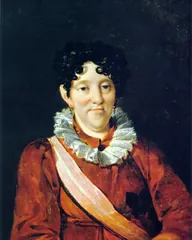
Monarch of Portugal, 1777–1816 · Kingdom of Portugal
What people wore
The universal male cloak
Regardless of wealth, men almost universally wore a cloak as an essential outer layer, even over French-style clothing, and it was often used for multiple purposes including as a mattress or blanket.
Daily life
Kitchen life and cooking customs
Cooking was done in fireplaces using basic equipment like iron pots, pans, and grills, and families often gathered in the kitchen because it was the only room in the house kept warm. Chocolate was a prized, calorie-rich item used to show social status, often consumed as a drink by those who could afford it.
In the news1771
New Mail Coach Service Established in 1771
In 1771, a mail coach service was established between Madrid, Barcelona, and Cádiz, charging four to five reales per league and promising travel in twenty-one days. This was considered a remarkable speed and comfort for passengers at the time.
Music
Popular instruments and castanets
The guitar was the most popular domestic instrument, often used to accompany dances like the seguidilla and tirana. Dancers frequently played simple castanets, which were held in the palm by a bead tied to their fingers.
At the table
Diet of the Laboring Poor
Poor laborers often ate soup with oil or cornmeal porridge in the morning and legumes or salted sardines at midday. Wine was considered expensive, so these families typically drank it only on feast days, sometimes to excess.
In Europe1772–1795
Poland is partitioned
Russia, Prussia and Austria divided Poland among themselves in three steps until, in 1795, it vanished from the map for 123 years.
Getting around
Carriages and mule travel options
A traveler seeking economy might hire a light carriage called a volante, paying about six to nine livres per day for the machine and a mule to travel eight to ten leagues daily. Alternatively, those crossing bandit-prone areas could ride on a mule with common carriers, occupying the space otherwise used for a bale of goods.


%20{%20.f%20{%20fill:%20%23EE7466%20}%20.s%20{%20stroke:%20%23EE7466%20}%20}%3c/style%3e%3cdefs%3e%3cfilter%20id='ink-fav'%20x='-5%25'%20y='-5%25'%20width='110%25'%20height='110%25'%3e%3cfeTurbulence%20type='fractalNoise'%20baseFrequency='0.9'%20numOctaves='2'%20seed='7'%20result='n'/%3e%3cfeDisplacementMap%20in='SourceGraphic'%20in2='n'%20scale='2.2'%20result='d'/%3e%3cfeTurbulence%20type='fractalNoise'%20baseFrequency='0.05'%20numOctaves='3'%20seed='18'%20result='blot'/%3e%3cfeColorMatrix%20in='blot'%20type='matrix'%20values='0%200%200%200%200%200%200%200%200%200%200%200%200%200%200%200%200%200%20-1.5%201.62'%20result='m1'/%3e%3cfeTurbulence%20type='fractalNoise'%20baseFrequency='1.6'%20numOctaves='1'%20seed='12'%20result='grain'/%3e%3cfeColorMatrix%20in='grain'%20type='matrix'%20values='0%200%200%200%200%200%200%200%200%200%200%200%200%200%200%200%200%200%20-2.4%202.25'%20result='m2'/%3e%3cfeComposite%20in='m1'%20in2='m2'%20operator='arithmetic'%20k1='1'/%3e%3cfeComposite%20in='d'%20operator='in'/%3e%3c/filter%3e%3c/defs%3e%3cg%20filter='url(%23ink-fav)'%20transform='rotate(-6%2080%2080)'%3e%3ccircle%20class='s'%20cx='80'%20cy='80'%20r='69'%20fill='none'%20stroke-width='16'/%3e%3cpath%20class='f'%20d='M47.33%2044.42Q46.25%2041.94%2045.01%2040.64Q43.77%2039.35%2041.71%2038.75Q39.66%2038.16%2035.67%2037.84L35.67%2033.84L80.16%2033.84L80.16%2037.84Q74.11%2038.27%2071.85%2039.13Q69.58%2040%2069.58%2042.05Q69.58%2043.24%2070.23%2045.07L86.32%2089.57L86.97%2089.57L102.3%2049.61Q103.38%2046.8%20103.38%2044.75Q103.38%2041.83%20100.68%2040.27Q97.98%2038.7%2091.39%2037.84L91.39%2033.84L124.77%2033.84L124.77%2037.84Q119.69%2038.59%20117.15%2039.67Q114.61%2040.75%20113.05%2042.97Q111.48%2045.18%20109.65%2049.82L82.97%20118.08L77.79%20118.08L47.33%2044.42Z'/%3e%3c/g%3e%3c/svg%3e)