

%20{%20.f%20{%20fill:%20%23EE7466%20}%20.s%20{%20stroke:%20%23EE7466%20}%20}%3c/style%3e%3cdefs%3e%3cfilter%20id='ink-fav'%20x='-5%25'%20y='-5%25'%20width='110%25'%20height='110%25'%3e%3cfeTurbulence%20type='fractalNoise'%20baseFrequency='0.9'%20numOctaves='2'%20seed='7'%20result='n'/%3e%3cfeDisplacementMap%20in='SourceGraphic'%20in2='n'%20scale='2.2'%20result='d'/%3e%3cfeTurbulence%20type='fractalNoise'%20baseFrequency='0.05'%20numOctaves='3'%20seed='18'%20result='blot'/%3e%3cfeColorMatrix%20in='blot'%20type='matrix'%20values='0%200%200%200%200%200%200%200%200%200%200%200%200%200%200%200%200%200%20-1.5%201.62'%20result='m1'/%3e%3cfeTurbulence%20type='fractalNoise'%20baseFrequency='1.6'%20numOctaves='1'%20seed='12'%20result='grain'/%3e%3cfeColorMatrix%20in='grain'%20type='matrix'%20values='0%200%200%200%200%200%200%200%200%200%200%200%200%200%200%200%200%200%20-2.4%202.25'%20result='m2'/%3e%3cfeComposite%20in='m1'%20in2='m2'%20operator='arithmetic'%20k1='1'/%3e%3cfeComposite%20in='d'%20operator='in'/%3e%3c/filter%3e%3c/defs%3e%3cg%20filter='url(%23ink-fav)'%20transform='rotate(-6%2080%2080)'%3e%3ccircle%20class='s'%20cx='80'%20cy='80'%20r='69'%20fill='none'%20stroke-width='16'/%3e%3cpath%20class='f'%20d='M47.33%2044.42Q46.25%2041.94%2045.01%2040.64Q43.77%2039.35%2041.71%2038.75Q39.66%2038.16%2035.67%2037.84L35.67%2033.84L80.16%2033.84L80.16%2037.84Q74.11%2038.27%2071.85%2039.13Q69.58%2040%2069.58%2042.05Q69.58%2043.24%2070.23%2045.07L86.32%2089.57L86.97%2089.57L102.3%2049.61Q103.38%2046.8%20103.38%2044.75Q103.38%2041.83%20100.68%2040.27Q97.98%2038.7%2091.39%2037.84L91.39%2033.84L124.77%2033.84L124.77%2037.84Q119.69%2038.59%20117.15%2039.67Q114.61%2040.75%20113.05%2042.97Q111.48%2045.18%20109.65%2049.82L82.97%20118.08L77.79%20118.08L47.33%2044.42Z'/%3e%3c/g%3e%3c/svg%3e)
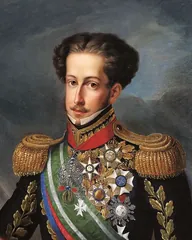
About Pedro I
Pedro I: titles on both sides of the Atlantic
AI-assisted · editedPedro I was the son of João VI of Portugal and Carlota Joaquina of Spain. The collection records his birth in Queluz, Portugal, on 12 October 1798, placing his origins within the Portuguese royal family before his later Brazilian imperial title. 1Parent · John VI of Portugal · Confirmed2Parent · Carlota Joaquina of Spain · Confirmed3Birth · 12 Oct 1798, Queluz · Probable
His title as Emperor of Brazil is dated 1822–1831; a Portuguese royal title is recorded for 1826. The biographical summary identifies him as the founder and first ruler of the Empire of Brazil and records the names “the Liberator” and “the Soldier King”. The title dates show why both countries appear in an account of his public life. 4Title · Emperor of Brazil, 1822–1831 · Confirmed5Title · Monarch of Portugal, 1826 · Confirmed6Known for · Dom Pedro I, known in Brazil and in Portugal as "the Liberator" or "the Soldier King" in Portugal, was the founder and first ruler of the Empire of Brazil from 1822 to 1831 and King of Portugal in 1826. · Probable
The records also name Pedro as grand master of the Order of the Immaculate Conception of Vila Viçosa and the Order of the Tower and Sword. His death is recorded in Queluz on 24 September 1834. Alongside the two crowns, these offices form part of the ceremonial titles preserved in the collection. 7Title · Grand Master of the Order of the Immaculate Conception of Vila Viçosa · Confirmed8Title · Grand Master of the Order of the Tower and Sword · Confirmed9Death · 24 Sep 1834, Queluz · Probable
Drafted with AI and edited against the archive. Open a citation to see the record, its sources and how certain it is.
Facts and their sources
- Born12 Oct 1798, QueluzVerified · Vitrine1 source
- TitleGrand Master of the Order of the Immaculate Conception of Vila Viçosaor Emperor of Brazil, 1822–1831 · Monarch of Portugal, 1826 · Grand Master of the Order of the Tower and SwordVerified · Vitrine1 source
- TitleGrand Master of the Order of the Tower and Swordor Emperor of Brazil, 1822–1831 · Monarch of Portugal, 1826 · Grand Master of the Order of the Immaculate Conception of Vila ViçosaVerified · Vitrine1 source
- TitleEmperor of Brazil, 1822–1831or Monarch of Portugal, 1826 · Grand Master of the Order of the Immaculate Conception of Vila Viçosa · Grand Master of the Order of the Tower and SwordVerified · Vitrine1 source
- TitleMonarch of Portugal, 1826or Emperor of Brazil, 1822–1831 · Grand Master of the Order of the Immaculate Conception of Vila Viçosa · Grand Master of the Order of the Tower and SwordVerified · Vitrine1 source
- Died24 Sep 1834, QueluzVerified · Vitrine1 source
A life in time
12 Oct 1798
Born in Queluz
1819–1831
15 children are born
1822–1831
Emperor of Brazil
1826
Monarch of Portugal
24 Sep 1834
Dies in Queluz, aged 35
Family
See the treeParents
Partners
Children · 15
During his lifetime
He lived through 5 decades. Pick one to hear and see what it was like around Queluz.
General history, not a record about the family: each item says where it comes from.
The 1790s · Pedro I is born in Queluz
Who governed
- Maria I of Portugal(opens in a new tab)
Monarch of Portugal, 1777–1816 · Kingdom of Portugal
Music
Fandango as a popular tavern dance
The fandango was a popular dance of courtship and seduction, often performed in taverns by ordinary people to the sound of the viola. Dancers marked the beat with their feet and castanets, or by snapping their fingers if castanets were unavailable.
Daily life
Rural living and animal cohabitation
In rural homes, families sometimes lived in a single room where they slept and ate alongside their domestic animals.
What it cost
Ox meat prices in Porto
In Porto, the price of ox meat rose from 36 réis per arrátel in 1780 to 47 réis by 1783, eventually reaching 63 réis by 1798.
 In Europe · 1789–1799
The French Revolution. Parisians stormed the Bastille in 1789; the monarchy fell, the king was executed, and “liberty, equality, fraternity” spread across Europe.
What people wore
Linen for life and coarse work clothes
In Lousada, families stored fine linen for a lifetime to create feast-day clothing and religious vestments, while coarse tow fabric was used for everyday and work clothes.
Getting around
Introduction of the Mala-posta Stagecoach
In 1798, a new public stagecoach service known as the mala-posta was established between Lisbon and Coimbra to improve travel for people and mail.
At the table
Shared meals from clay plates
Ordinary families ate together from a single large red clay plate, which usually held potatoes, vegetables, bacon, and sometimes salt-cured sardine or cod.