

%20{%20.f%20{%20fill:%20%23EE7466%20}%20.s%20{%20stroke:%20%23EE7466%20}%20}%3c/style%3e%3cdefs%3e%3cfilter%20id='ink-fav'%20x='-5%25'%20y='-5%25'%20width='110%25'%20height='110%25'%3e%3cfeTurbulence%20type='fractalNoise'%20baseFrequency='0.9'%20numOctaves='2'%20seed='7'%20result='n'/%3e%3cfeDisplacementMap%20in='SourceGraphic'%20in2='n'%20scale='2.2'%20result='d'/%3e%3cfeTurbulence%20type='fractalNoise'%20baseFrequency='0.05'%20numOctaves='3'%20seed='18'%20result='blot'/%3e%3cfeColorMatrix%20in='blot'%20type='matrix'%20values='0%200%200%200%200%200%200%200%200%200%200%200%200%200%200%200%200%200%20-1.5%201.62'%20result='m1'/%3e%3cfeTurbulence%20type='fractalNoise'%20baseFrequency='1.6'%20numOctaves='1'%20seed='12'%20result='grain'/%3e%3cfeColorMatrix%20in='grain'%20type='matrix'%20values='0%200%200%200%200%200%200%200%200%200%200%200%200%200%200%200%200%200%20-2.4%202.25'%20result='m2'/%3e%3cfeComposite%20in='m1'%20in2='m2'%20operator='arithmetic'%20k1='1'/%3e%3cfeComposite%20in='d'%20operator='in'/%3e%3c/filter%3e%3c/defs%3e%3cg%20filter='url(%23ink-fav)'%20transform='rotate(-6%2080%2080)'%3e%3ccircle%20class='s'%20cx='80'%20cy='80'%20r='69'%20fill='none'%20stroke-width='16'/%3e%3cpath%20class='f'%20d='M47.33%2044.42Q46.25%2041.94%2045.01%2040.64Q43.77%2039.35%2041.71%2038.75Q39.66%2038.16%2035.67%2037.84L35.67%2033.84L80.16%2033.84L80.16%2037.84Q74.11%2038.27%2071.85%2039.13Q69.58%2040%2069.58%2042.05Q69.58%2043.24%2070.23%2045.07L86.32%2089.57L86.97%2089.57L102.3%2049.61Q103.38%2046.8%20103.38%2044.75Q103.38%2041.83%20100.68%2040.27Q97.98%2038.7%2091.39%2037.84L91.39%2033.84L124.77%2033.84L124.77%2037.84Q119.69%2038.59%20117.15%2039.67Q114.61%2040.75%20113.05%2042.97Q111.48%2045.18%20109.65%2049.82L82.97%20118.08L77.79%20118.08L47.33%2044.42Z'/%3e%3c/g%3e%3c/svg%3e)
In the news1769
Abolition of slavery in continental Portugal
In 1769, the Marquis of Pombal abolished slavery in continental Portugal and Portuguese India, significantly changing the legal status of enslaved people.
Also known as John the Clement (epithet)
Lisbon, 13 May 1767 – Lisbon, 10 Mar 1826
13 facts3 sources
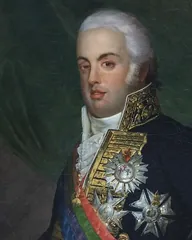
The collection records João VI’s birth in Lisbon on 13 May 1767. He was the son of Pedro III and Maria I of Portugal. His recorded offices begin with the regency of Portugal, from 1799 to 1816, followed by the Portuguese monarchy from 1816 to 1826. 1Birth · 13 May 1767, Lisbon · Probable2Parent · Pedro III of Portugal · Confirmed3Parent · Maria I of Portugal · Confirmed4Title · Regent of Portugal, 1799–1816 · Confirmed5Title · Monarch of Portugal, 1816–1826 · Confirmed
Another title names him as King of the United Kingdom of Portugal, Brazil and the Algarves, beginning in 1816. His biographical summary later describes him as King of Portugal and titular Emperor of Brazil. A separate title record dates the Brazilian imperial title to 1825–1826. These were different titles, rather than evidence of a single unchanging office. 6Title · King of the United Kingdom of Portugal, Brazil and the Algarve, 1816–1822 · Confirmed7Known for · Dom John VI, known as "the Clement", was King of the United Kingdom of Portugal, Brazil and the Algarves from 1816 to 1825, and after the recognition of Brazil's independence, titular Emperor of Brazil and King of Portugal until his death in 1826. · Probable8Title · Emperor of Brazil, 1825–1826 · Confirmed
The same summary records the epithet “the Clement”. The collection gives Lisbon as the place of his death on 10 March 1826. His life can therefore be explored through the relationships and changing forms of authority recorded beside his portrait. 7Known for · Dom John VI, known as "the Clement", was King of the United Kingdom of Portugal, Brazil and the Algarves from 1816 to 1825, and after the recognition of Brazil's independence, titular Emperor of Brazil and King of Portugal until his death in 1826. · Probable9Death · 10 Mar 1826, Lisbon · Probable
Drafted with AI and edited against the archive. Open a citation to see the record, its sources and how certain it is.
13 May 1767
Born in Lisbon
1793–1806
9 children are born
1799–1816
Regent of Portugal
1816–1826
Monarch of Portugal
1816–1822
King of the United Kingdom of Portugal, Brazil and the Algarve
1825–1826
Emperor of Brazil
10 Mar 1826
Dies in Lisbon, aged 58
He lived through 7 decades. Pick one to hear and see what it was like around Lisbon.
General history, not a record about the family: each item says where it comes from.
Who governed
Monarch of Portugal, 1750–1777 · Kingdom of Portugal
What people wore
Linen saved for lifetime festive wear
Villagers painstakingly washed and bleached fine linen to store in wooden trunks, saving these materials to be hand-sewn into special feast-day clothing that would last a lifetime. In contrast, coarser tow-cloth was used for everyday work clothes, which were constantly patched by local seamstresses to maintain them.
Getting around
Travel in luxury via mule-drawn litters
Wealthy individuals traveled between cities in litters, which were carriage-like boxes pulled by mules, at a cost of 80,000 to 90,000 réis for a journey between Lisbon and Porto.
At the table
Regulated bread weight during scarcity
Bread prices were regulated, and during times of scarcity, a loaf known as pão de vintém would be sold with a reduced weight of approximately 0.3 kg.
 Around the world · 1756–1763
The Seven Years’ War. Fought in Europe, the Americas, Africa and India, often called the first world war: Britain took Canada and India from France.
In the news1769
In 1769, the Marquis of Pombal abolished slavery in continental Portugal and Portuguese India, significantly changing the legal status of enslaved people.
Music
Social Gatherings and Entertainment
Private social gatherings often featured music, dancing, and card games, with attendees enjoying tea, chocolate, and sweets. Orchestras or individual musicians were hired, and guests sometimes participated alongside professionals; dancing was so central that admission to events with balls could cost twice as much as those without.
Daily life
Rural living and animal cohabitation
In rural homes, families sometimes lived in a single room where they slept and ate alongside their domestic animals.